
Portage immigration lead speaks at national conference
Advertisement
Read this article for free:
or
Already have an account? Log in here »
We need your support!
Local journalism needs your support!
As we navigate through unprecedented times, our journalists are working harder than ever to bring you the latest local updates to keep you safe and informed.
Now, more than ever, we need your support.
Starting at $15.99 plus taxes every four weeks you can access your Brandon Sun online and full access to all content as it appears on our website.
Subscribe Nowor call circulation directly at (204) 727-0527.
Your pledge helps to ensure we provide the news that matters most to your community!
To continue reading, please subscribe:
Add Brandon Sun access to your Free Press subscription for only an additional
$1 for the first 4 weeks*
*Your next subscription payment will increase by $1.00 and you will be charged $20.00 plus GST for four weeks. After four weeks, your payment will increase to $24.00 plus GST every four weeks.
Read unlimited articles for free today:
or
Already have an account? Log in here »
PORTAGE LA PRAIRIE — A local immigration official says the key to keeping newcomers in rural Manitoba lies in small, personal gestures and a deeper understanding of Canada’s history.
Mitch Tilk, the Local Immigration Partnership (LIP) program co-ordinator for the Portage Community Revitalization Corporation (PCRC), recently returned from Halifax after presenting at the Pathways to Prosperity national immigration conference. Speaking to colleagues from across the country, Tilk addressed the complex intersection of settlement services and reconciliation.
“I like to do things a little backwards sometimes,” Tilk said of his presentation, which used the history of colonization to provide a roadmap for the future of immigration programs.
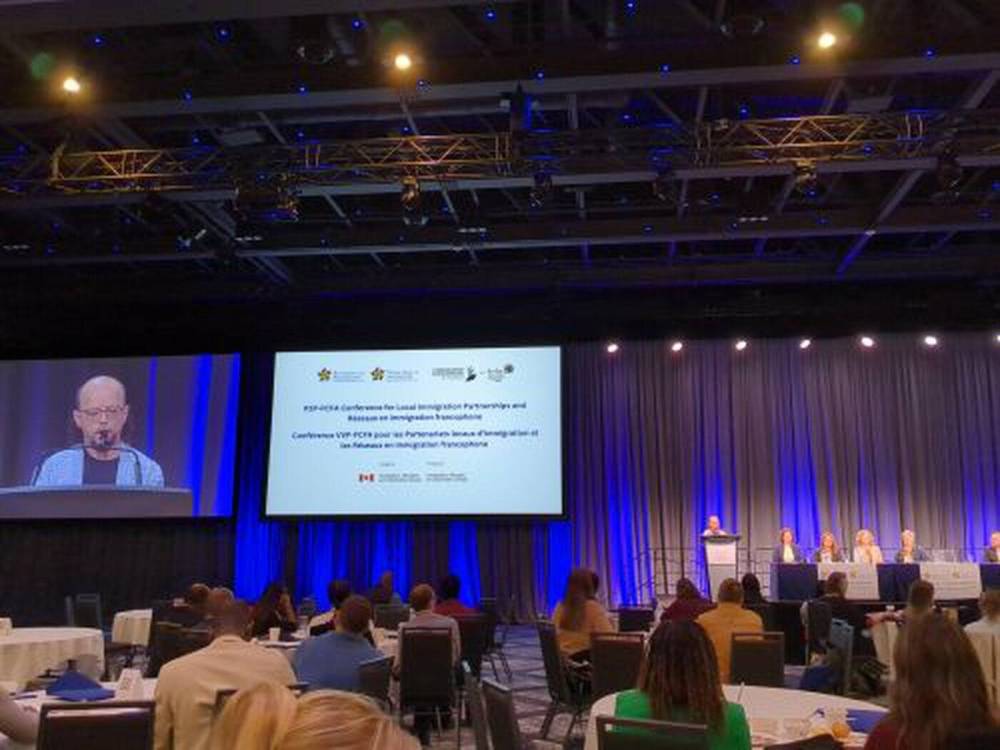
Mitch Tilk makes a presentation at the Pathways to Prosperity national immigration conference in Halifax. (Submitted)
He noted that for those working in the settlement sector, balancing the work of decolonization with the act of settling new people on the land can be a challenge.
“Decolonization and reconciliation is something that we’ve all been called to do, but it can be a bit of an authority issue in the settlement sector because you’re actively working on settling new people into the land here,” Tilk said. “I tried to help people figure out how they can orient their mind around that.”
Closer to home, Tilk recently addressed the local Rotary Club to discuss how community organizations can help remove barriers for those moving to the area. He emphasized that while significant effort goes into initial settlement, the real challenge is retention.
If newcomers have poor experiences at work or in the community, Tilk said, they are unlikely to feel a sense of belonging and may eventually leave.
“A large focus on what we’re trying to do is about retention,” he said. “We hate to see people leave our community.”
Tilk is encouraging Portage residents to consider how their existing boards, volunteer groups and social circles can be more inclusive. He suggested that simple acts of inclusion can “break the ice” for someone navigating a new culture.
“Anything that people can do to help bridge some gaps for people, like inviting people out to networking opportunities or fall suppers,” Tilk suggested. “These are all things that we all get invitations to, but could be a scary thing to approach on your own as a new person.”
Tilk has served as the LIP co-ordinator at the PCRC since the summer of 2019. He says his goal remains focused on making the community more aware of the “little things” that help integrated people stay in the region long-term.
» Portage Graphic Leader