
‘Naughty list’: Alberta government looks to protect bridges from big trucks
Advertisement
Read this article for free:
or
Already have an account? Log in here »
We need your support!
Local journalism needs your support!
As we navigate through unprecedented times, our journalists are working harder than ever to bring you the latest local updates to keep you safe and informed.
Now, more than ever, we need your support.
Starting at $15.99 plus taxes every four weeks you can access your Brandon Sun online and full access to all content as it appears on our website.
Subscribe Nowor call circulation directly at (204) 727-0527.
Your pledge helps to ensure we provide the news that matters most to your community!
To continue reading, please subscribe:
Add Brandon Sun access to your Free Press subscription for only an additional
$1 for the first 4 weeks*
*Your next subscription payment will increase by $1.00 and you will be charged $20.00 plus GST for four weeks. After four weeks, your payment will increase to $24.00 plus GST every four weeks.
Read unlimited articles for free today:
or
Already have an account? Log in here »
EDMONTON – Alberta’s transportation minister could hear the horns blaring from inside his office.
It wasn’t from a rally or protest on the Edmonton legislature grounds but, as Devin Dreeshen went outside to discover, the sound of confused and angry drivers.
“It was a truck that had hit (the bridge) and was stopped and backing up traffic all the way up 109 Street,” he recalled of the summer gridlock.
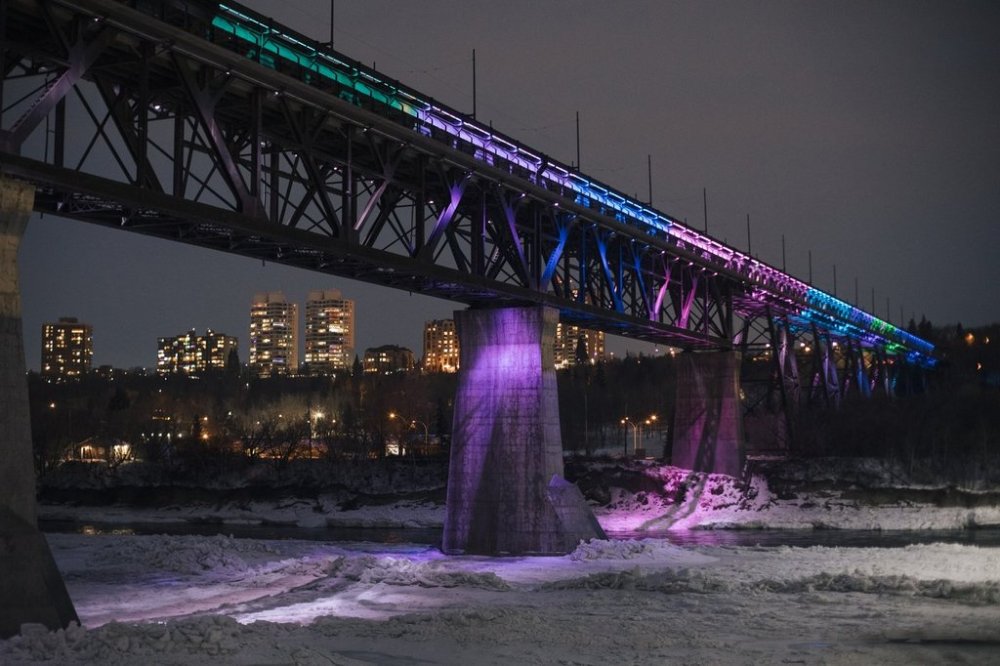
Five times this year, large trucks heading onto the double-decker High Level Bridge, a stone’s throw west of the legislature, have hit the structure. Ten other times, trucks stopped before it was too late.
Dreeshen is hoping the government can fix the problem right outside its door, with new policies — and potential fine increases for truckers.
The 112-year-old steel truss bridge is a striking feature in the core of Alberta’s capital. It reaches high above the North Saskatchewan River and stretches more than 750 metres across.
It originally supported horses and buggies, trains, early automobiles and streetcars. The Canadian Pacific Railway, which built the bridge, stopped running freight on the upper deck in 1989.
The lower level has a clearance of 3.2 metres, or 10.6 feet, meaning a bus fits with just centimetres to spare. Most semis and other big rigs are a no-go.
Bright yellow signs along the preceding median warn trucks to turn off before it’s too late, but many try to squeeze on anyway.
Police say the bridge has been hit 21 times in the past six years, with 63 close calls of trucks stopping in time but creating traffic jams by having to back out.
It’s not a new phenomenon. Photos of trucks mangled by the bridge, dating back at least 50 years, can be found in the city’s archives.
Construction of the bridge was considered a key reason why the cities of Edmonton, on the north side of the river, and Strathcona, on the south, amalgamated in 1912.
That achievement was partly why the bridge was designated a local historic resource in 1995, which commits Edmonton to maintain it but not make drastic alterations.
However, some changes have been made.
In 2005, the city turned off the taps of a man-made waterfall that, for 25 years, poured thousands of litres of chlorinated tap water off the bridge on summer holiday weekends. Nearly a decade after the waterfall ran dry, programmable lights were installed on the bridge to recognize events and pay tributes.
In 2016, emergency phones and higher barriers were installed in an effort to curb suicide attempts, a longtime issue on the bridge.
City spokesperson Nicole Boychuk said in an email the High Level is due for maintenance and crews are planning out what all needs to be done.
She didn’t say if increasing the clearance for trucks is a possibility. “The city is examining options to ensure the most appropriate investment is made in the High Level Bridge.”
Dreeshen, Alberta’s transportation minister since 2022, said a “naughty list” for truckers might help.
The new provincial policy being phased in will require truckers to produce a driver’s abstract when they try to switch jobs, Dreeshen said.
“If you get laid off by the company that you’re working for because you hit a bridge, when you go work for a different company or a different company’s looking to hire you, they can see that you’ve been on the naughty list and that you’ve hit a bridge in the past,” he said in a recent interview.
“You won’t be able to hide as much as was done in the past.”
The province can currently lay fines of $10,000 for bridge collisions, Dreeshen said. As part of a widespread review of relevant legislation slated for next year, he added, it’s possible that figure could become steeper.
The review could also grant the provincial motor vehicle registrar new powers to suspend or confiscate driver’s licences.
“Whether it’s education to trucking companies (or) increasing the fines as deterrents, we want to make sure that we can keep our roads safe,” Dreeshen said.
Jurgen Henn isn’t sure more serious penalties will prevent such accidents.
For more than a decade, Henn has been filming a bridge outside his North Carolina office window that has become well-known for getting hit by trucks. His YouTube channel features nearly 200 crash videos, garnering nearly 100 million views.
The bridge in Durham is known as “The Can Opener” for its ability to rip the tops off semi-trailers.
“Drivers have pretty good motivation not to hit the bridge,” said Henn, a technology professional.
“Most of them are devastated on a sort of professional level and on a personal level. It’s just super embarrassing.”
In 2021, crews raised Durham’s bridge, creating about 20 centimetres, about the length of an average banana, of additional clearance. It reduced the frequency and destructiveness of collisions, Henn said, but it didn’t solve the issue.
But he believes the real reason trucks are hitting it less lately is because a new highway opened nearby, reducing the need for trucks to use the bridge.
Henn has sold scraps of metal left behind from trucks as “crash art.” He also makes and sells bridge T-shirts, which he says are worn proudly around the city.
His advice for Edmonton and Alberta is to eliminate the need for trucks to be in the area. But he admitted that’s likely not feasible.
“There’s no way to completely foolproof that situation,” Henn said.
“It’s a worldwide phenomenon. Wherever there are trucks and low bridges, they will collide.”
This report by The Canadian Press was first published Dec. 24, 2025.
Note to readers:This is a corrected story. An earlier version incorrectly said the bridge had a clearance of 10.6 metres. Its clearance is actually 3.2 metres, or 10.6 feet.