
The value of giving back
Gord and Diane Peters talk about philanthropy, volunteering and the next generation
Advertisement
Read this article for free:
or
Already have an account? Log in here »
We need your support!
Local journalism needs your support!
As we navigate through unprecedented times, our journalists are working harder than ever to bring you the latest local updates to keep you safe and informed.
Now, more than ever, we need your support.
Starting at $15.99 plus taxes every four weeks you can access your Brandon Sun online and full access to all content as it appears on our website.
Subscribe Nowor call circulation directly at (204) 727-0527.
Your pledge helps to ensure we provide the news that matters most to your community!
To continue reading, please subscribe:
Add Brandon Sun access to your Free Press subscription for only an additional
$1 for the first 4 weeks*
- Enjoy unlimited reading on brandonsun.com
- Read the Brandon Sun E-Edition, our digital replica newspaper
*Your next Free Press subscription payment will increase by $1.00 and you will be charged $20.95 plus GST for four weeks. After four weeks, your payment will increase to $24.95 plus GST every four weeks.
Read unlimited articles for free today:
or
Already have an account? Log in here »
For longtime residents of Brandon and western Manitoba, the names Gord and Diane Peters need little introduction. Gord, co-founder of Cando Contracting (now Cando Rail & Terminals), and his wife, Diane, are prominent Brandon philanthropists and community champions who have been widely recognized for their substantial financial donations and volunteer efforts.
The pair served as fundraising co-chairs for the Provincial Exhibition of Manitoba’s “Restoring the Glory” campaign that focused on saving and rejuvenating the city’s historic Dome Building, originally built for the 1913 Dominion Exhibition.
They have also made several donations to Assiniboine College, and to numerous initiatives through the Brandon Area Community Foundation. Most recently, the Peters donated $1 million to the Brandon Regional Health Centre Foundation to support the construction of the facility’s new critical care centre.
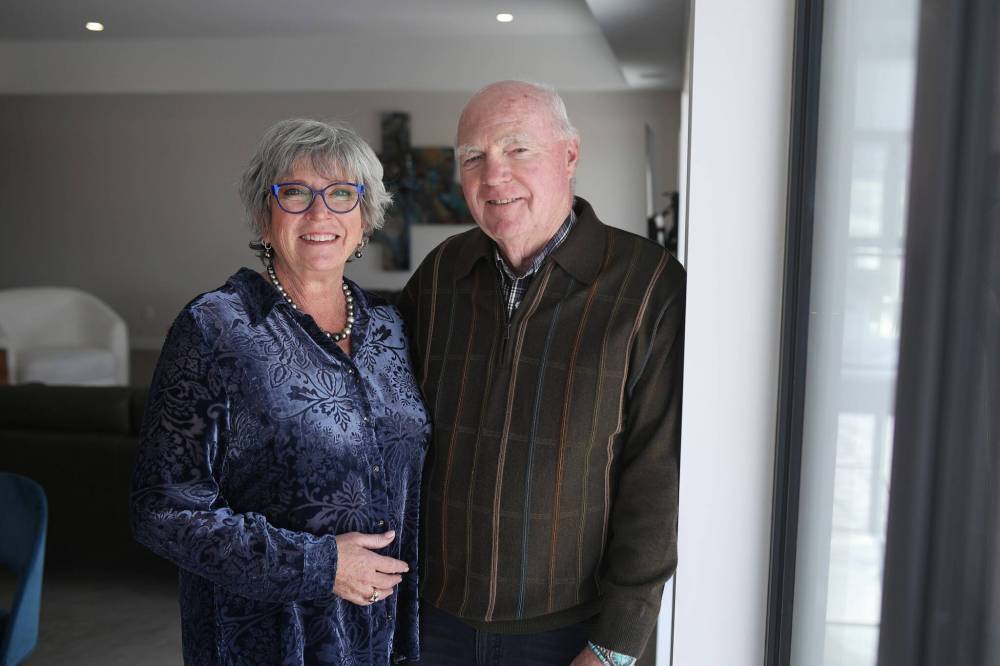
Diane and Gord Peters in their condo at Riverside Lifestyle Estates in Brandon. (Tim Smith/The Brandon Sun)
Shortly before Christmas, Brandon Sun editor Matt Goerzen sat down with the couple in their condo at the Riverside Lifestyle Estates to ask them about their approach to community stewardship and what they hope the next generation of philanthropists can learn from their experiences.
This conversation has been edited for clarity and length.
Matt Goerzen — I’m only a 20-year resident of Brandon, so my first real understanding of Gord and Diane Peters, and what you both had done, was through my work as the Sun’s agriculture reporter, where I got to know more about Cando and a little bit about the Dome Building restoration project. That was where I really first heard your names, back in 2011, I think. Out of curiosity, what made you want to volunteer your time to (restore) that building?
Gord Peters — We’re both from small communities. I’m from Rapid City originally, and Diane is from Cardiff. We get instilled in us pretty early that you’ve got to learn to give back to the community. So when we got into Brandon here, things are busy. We did a lot of travelling, but Cando did well, and we thought it was time to start stepping up. Because of our agricultural backgrounds, the dome building, to me, is a fantastic building, a historical building — to see it go would have been a shame. So I always had a soft spot for the Provincial Exhibition and then I used to show cattle when I was younger and stuff like that. So that’s what led to that particular project on the end of the day.
Diane Peters — We were always sort of sponsors of the (Royal Manitoba Winter Fair). And we had been on other projects, smaller. We had been fundraising with the Assiniboine (College) and with the YMCA. We were sort of there. I don’t know who approached us, and we just sort of said, “Sure, we’ll take it on.”
MG — What did you see as the special part of that project?
GP — For me, it was the history of agriculture in southwestern Manitoba, and that Dome Building was with the World Fair. It had a close connection. It’s a beautiful building. It, and the one in Ottawa, are the only two left in Canada.
DP — And there’s always been like, “Oh, it could have would have should have been the Prince Eddy.” There were so many things in the past that we should have saved. And then when the door closes, the door closes. And this door was still open.
MG — Are you happy with the way the results of the way the dome came out?
GP — I think so. I think the story is still to be told how the Provincial Ex has a lot of work to do. I think they’re in the midst of trying to define themselves, and what they’re going to do and what they’re going to offer the community. But I think having a home out of it … I talked with somebody last night who had their Christmas party there, and that was absolutely great.
MG — Part of why I wanted to talk with both of you concerns the next generation of people, like yourselves, who have made Brandon home, or grew up in the region and decided to build a business or volunteer their time. I read recently in a 2025 report that the number of dollars given by donors and philanthropists has gone up, but the number of people giving has gone down. In fact, it’s at a 20-year low. Have you noticed something similar here in Brandon?
DP — You know what? Maybe the number of people giving has gone down in the dollar column, but maybe the number of people who are using their hands and helping has gone up. I don’t want everybody to think that to support, to give, is a dollar sign that’s attached to it. And it shouldn’t be. I think sometimes people get confused that, well, I don’t have any money, (so) I can’t help. I want people to realize that everybody has their part to play. And if everybody plays their part, a lot gets done. All the money in the world won’t get the project done, if there’s nobody there to do the project.
GP — I think there’s a couple points. One is, I think everybody looks to either local government, the city or the province or the feds, that they want them to do a lot for their life kind of idea. We have to take control and we have to do our own stuff, too, at the end of the day. Another good example of that nowadays they have in the Brandon Area Community Foundation. (Their) sponsorship to the high schools of a philanthropy program. The philanthropy club at the school gets a pool of money, and they have to make a case of what they’re going to hand it out to. So how many people that touches — 10 kids every year in each high school? That’s a good sign that down the road, they probably won’t forget (what) they started. They joined that club for a reason. They didn’t have to join it, but they understand what philanthropy is all about. It’s a good starting point.
DP — Sometimes people feel as if they’re always handing money out, but if they actually kept track of how much it was, it’s not as much as you really think it is. I think people need to, if they’re in a position to give money out, they need to, sort of, they say, ‘OK, I’m going to give this much money away.’ And pick an amount. And then after that year, you’ll realize, “Oh well, that was sort of easy. And then the next, let’s re-budget, and maybe I can give a bit more.”
MG — When you two were starting out together, I mean, you must have had some help in terms of people offering their time, offering their expertise. Did you ever have any mentors? I understand you do mentorship as well. So I’m kind of wondering if you had mentors.
GP — Well, Ron Helwer and Bob Mazer, Don Penny. Don Penny and Bob Mazer and myself went through the (Brandon Chamber of Commerce) together. So we had lots of people and friends, business people. Personally for me, I’m just a Grade 12 graduate on the end of the day. But who I learned off … the Chamber of Commerce taught me a lot at the end of the day. So there were a lot of mentors, and at a bigger level, once I got on the chamber board, the Canadian board. There was 15 people on the Canadian board, we dealt with half them. So it was quite an experience for four or five years. And guys talk in those companies, CEOs of the railroad companies and things like that. It really helped out. So no, we’ve had lots of help. There’s no doubt about it. But we also keep a close eye on our community, southwestern Manitoba and different projects.
MG — I think it was in 2018 you talked about, I think both of you at some point have talked about community stewardship. What does that mean to you?
DP — When we started our relationship with the Brandon Area Community Foundation, we gave them a block of money with the fact that we wanted it. We didn’t want it in perpetuity. We didn’t want to give this money and then say, OK, it has to sit there for however many decades. We wanted money spent. We wanted it — in 20 years time, we wanted that money gone.
GP — That’s unusual for a lot of foundations. They’re great at collecting money and not handing it out.
DP — The foundations sort of want the money, because that’s their whole concept of being in existence, is having a pool of money, and if you give it away, their concern is, well, we won’t have any money left to be a foundation, right? But our belief is that if … some of these organizations aren’t looked after, they’re not around to be looked after down the way. So the stewardship is, we’re here now. We’re all here today, and it’s our responsibility…
GP — To try to make Brandon, or the whole community a better …
DP — To make life good for all. And then if you can instil the belief of helping to the 40-year-olds, the 30-year-olds, the 20-year-olds, the 10-year-olds, those 10-year-olds will be the 30-year-olds. Those 10-year-olds will be the 50-year-olds who will take over my responsibility, my job. But it’s just not my job. So to say, “I don’t have to do anything because grandpa’s gonna do it.” No, stewardship is taught to teen to teen, to adult to adult to senior. So it’s not a singular thing for one generation to look after. There’s no point in me doing it, if the 20-year-olds aren’t going to do it, and aren’t going to continue it. There’s no point. I might as well close up shop now.
GP — I’m confident the next generations will. You know, that’s why, not, in perpetuity — spend the money now for the next 20 years, kind of idea. You can really have a lot bigger effect now. You can hand out three, four times as much money as putting something in perpetuity.
DP — And then, because you see something being done, then that person says, “Oh, maybe I will help.” But if things just keep on getting run down and not looked after and not maintained and not prosperous, then people kind of go, “Why would I even bother to help with that?” Something like stewardship … the question is, what do we see that as? And stewardship is not just one group. It’s all of us that need to be conscious of …
GP — Well, the old saying … you can’t take it with you. You should build a plan out what you can give away.
MG — What is the most important lesson about giving back that you would hope new young leaders would learn?
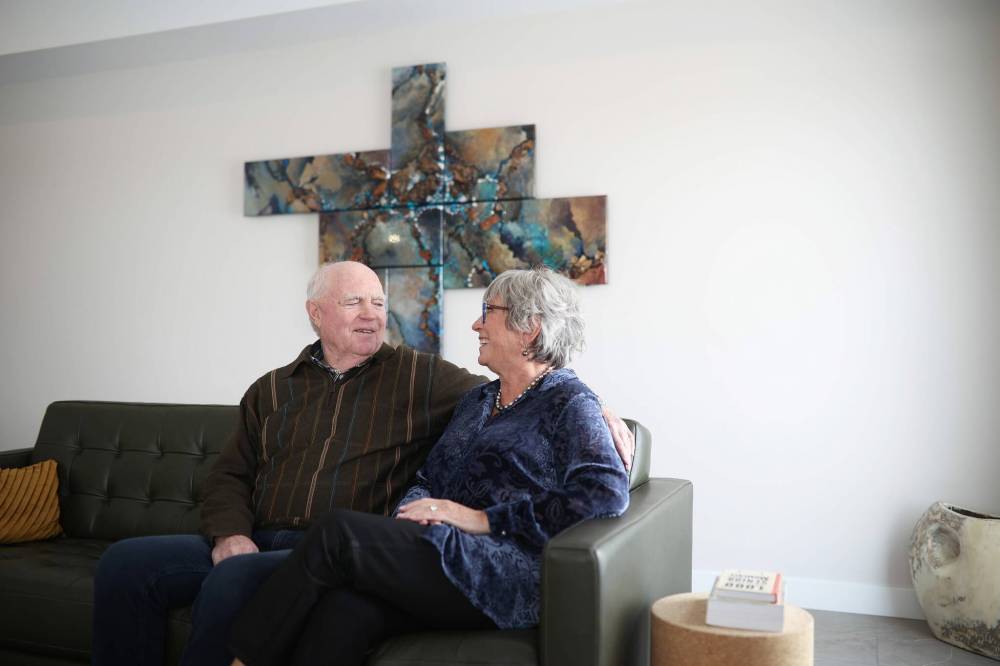
Gord and Diane Peters in their condo at Riverside Lifestyle Estates in Brandon. (Tim Smith/The Brandon Sun)
GP — I think, people, you know, the young people today, that I think they see the hardship in the world. They see it in the ground floor. And so if they can do something to improve that, it doesn’t matter whether it’s Salvation Army, they put $20 in the thing, I think it’s a starting point. Our goal is to keep talking, keep talking, and try to convince people. There’s a lot of capacity to give more money in Brandon, you know, and we set our goals fairly high. You know, we should be aggressive. But, you know, it’s amazing what Assiniboine College has done with the school of business, but also other funds that people have come and put money in, millions of dollars. So they’ve done a good job. But people see the value of AC and say, “If we can have that in our community teaching a couple thousand kids a year, that’s got to be worthwhile. We’ve got to look after it.”
DP — Since the Brandon Area Community Foundation, since we’ve started with that, that’s really helped, because they filter. Everybody will ask for donation through their process. And so we’re not getting phone calls, and so it’s going through that, so that helps big time. The foundation has been really, really instrumental in bringing projects that wouldn’t even come to our door. And we’re able to help with a lot of different projects through the foundation. And the foundation has just been — I think it’s a gem for Brandon, for lots of organizations, a lot of communities.
MG — I’m going to go back for a moment to something you had said about helping in the community, and community involvement. How can a growing city like Brandon preserve a volunteer spirit?
DP — It’s a tough one, as communities get bigger. You talk to kids or family, young families now, and they’ve got five-year-olds, away all weekend playing six games of hockey. So people, right or wrong, people just get busy. So volunteering, it sort of, I think, gets put to the back burner because they get busy. But if everybody would just, sort of, if everybody would pick one thing, you’d be covered (for) one or two things that they support, but sometimes what happens is that it’s the same group doing it over and over again, and they get burnt out.
MG — In terms of just volunteering, right? They go hand in hand, do they not — philanthropy and the idea of volunteering your time?
GP — It’s like running a good company in that you’ve got to lead. Somebody in the community has got to lead and to get it started and get everybody on board. It takes a lot of drivers.
DP — The next, the youngest generation, is not going to learn unless we show, unless we’re doing it. So if it’s gotten less, it’s because kids haven’t seen their parents volunteer. And when I say kids — 20-year-olds didn’t see their parents volunteer. So it’s foreign to them, right? … I think for volunteering, if everybody could try and do one thing a week, and it doesn’t have to be a big thing, it would be as much as a small project. And it goes back to, “Oh, I thought I gave a lot of money away, and I really didn’t, I think I’m busy.” But if it’s consciously planned in, it just becomes, “Oh, I got to go do that.” No different than you get up and brush your teeth.
MG — When you’re looking at projects to support, how do you choose them?
GP — The first question I ask is, “What are you putting in?” That solves a lot of problems, because if they say “nothing,” I say, “Well, if you’re not putting in, I’m not putting in. I’ll put $20,000 if you put $20,000 in,” because most of these guys, they start projects, you know, they’ve got the money to do it if they want. But they want somebody else to put the money in. And so you got to separate that right off the bat.
DP — We’re diversified. It could be the arts, it could be health, it could be sports. It could be …
GP — Daycares … But I think that’s where the Brandon Area Community Foundation comes in. They front the whole thing. They do a great job of separating and they track the project.
DP — Not only that, there’s an application and it’s got to be filled out so that they know it’s viable.
GP — Their business is handing money out, and tracking the projects to make sure they’re done right. A lot of people will have questions about them sometimes, about how much paperwork to go through. But you’ve got to do it right, or you’re wasting your money.
MG — So what’s next? Is there a next?
DP — Oh, there’s always a next.
GP — We’ve got a pretty aggressive program for the next five to 10 years, as far as looking for projects and stuff like that. There’s some things in town here that are going to need some help. There’s no doubt, I think, the Keystone is one of them. There’s the Keystone, the (Western Manitoba Centennial Auditorium).
DP — The YMCA. There’s always something.
MG — From people who are actively participating in building up organizations and projects, what do you think Brandon needs right now? If you had a project that you thought this city needs, what would it be?
GP — I don’t know. We’re a nice-sized city, at the end of the day. We’ve travelled a lot of big centres and stuff like that. I think (we should) look after some of the stuff we’ve got. You know, cities or whatever, will often build something but can’t look after it. They don’t have enough operating money. I think that’s a major problem. You can look at the Sportsplex and stuff like that, all the problems we’ve had there. They built it, but they can’t look after it. So, you know a good example is the (Wheat City Golf Course) right here. The city tried for years to run it. Now they’ve got a private sector running it, and I think it’s a lot better. So I think the city’s got to recognize the problems.
MG — Is there anything else you’d like to add that I have not asked you?
GP — I’m hoping our openness to some of this philanthropy, I hope it spurs other people to take a hard look at their own individual circumstances, and help out where they can. That’s our wish, I think, on the end of why we’re maybe having this interview, and why we’re going down this road, because I believe there’s a lot more capacity here than we’ve seen yet in our community. So if I had one wish, and I’d like to see a bunch of people step forward and, you know, and help out more at the end of the day.
DP — And don’t miss out on the feeling of giving. You don’t need to anguish over it. You’ll get as much back as you give. Just don’t, don’t miss out on it.
» mgoerzen@brandonsun.com