
No good reason for sobering centre delay
Advertisement
Read this article for free:
or
Already have an account? Log in here »
We need your support!
Local journalism needs your support!
As we navigate through unprecedented times, our journalists are working harder than ever to bring you the latest local updates to keep you safe and informed.
Now, more than ever, we need your support.
Starting at $15.99 plus taxes every four weeks you can access your Brandon Sun online and full access to all content as it appears on our website.
Subscribe Nowor call circulation directly at (204) 727-0527.
Your pledge helps to ensure we provide the news that matters most to your community!
To continue reading, please subscribe:
Add Brandon Sun access to your Free Press subscription for only an additional
$1 for the first 4 weeks*
*Your next subscription payment will increase by $1.00 and you will be charged $20.00 plus GST for four weeks. After four weeks, your payment will increase to $24.00 plus GST every four weeks.
Read unlimited articles for free today:
or
Already have an account? Log in here »
It has been more than four years since the Manitoba government pledged $2 million to create a new 24-hour, seven-day-a-week facility that would hold non-violent, intoxicated people while sobering from the effects of drugs or alcohol. It subsequently promised an annual budget $1.5-million budget to operate that facility.
It’s time those promises were kept.
After the commitment for a sobering centre was made — and perhaps because that promise had been made — an agreement for “direct lockup” with the Brandon Correctional Centre was not renewed. As a result, it became the responsibility of the Brandon Police Service to hold intoxicated persons who police fear may be a danger to themselves or others.
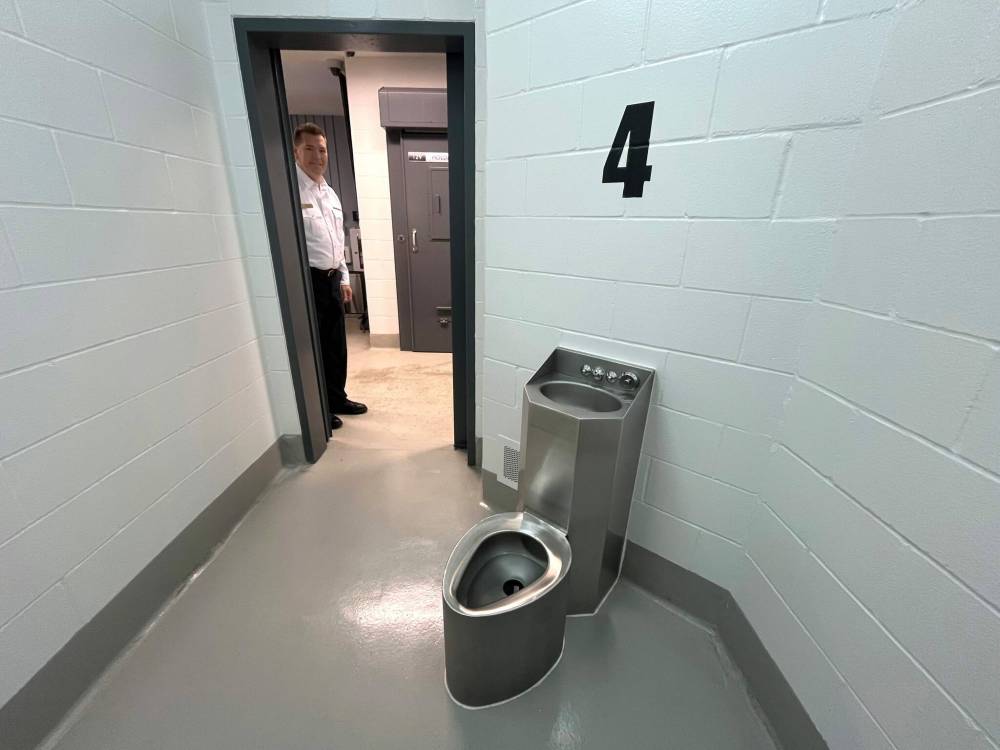
Brandon police Chief Tyler Bates looks in the door of a holding cell at the new police detention facility at BPS headquarters on Victoria Avenue and 10th Street. Cells are small, holding a urinal and wash basin, as well as a mattress. The number of intoxicated persons being held in the detention cells until sober has skyrocketed. (Matt Goerzen/The Brandon Sun files)
At that time, then-police chief Wayne Balcaen (who now serves as the MLA for Brandon West) told the CBC that “There’s other social programs within the community, but when it comes to non-compliance and people that need to be detained until sober, the police service is the only option right now … We did not have the facilities for that.”
Since then, the number of intoxicated persons being held in the new BPS detention cells until sober has skyrocketed. In 2023, a total of 372 intoxicated persons were detained during the period of July 3 to Sept. 15, 2023. For the same time frame this year, however, the number of detainees increased to a staggering 663 persons.
In past years, each of those detainees would have to be taken the Brandon Regional Health Centre emergency department to be assessed, taking BPS officers off the street for long periods of time. With paramedics now on duty at the BPS detention centre, however, those assessments can be done on-site.
That new approach frees up staff at the BRHC and allows for our police officers to return to their duties far faster, but it leads to other questions: Are jail cells the optimal, most appropriate place to hold intoxicated people who have committed no crime? Aren’t there better ways to address what is really a health issue?
In 2021, the consensus in Brandon appeared to be that a sobering centre was the better, less-costly way to address the issue. A custom-designed space was to be located on McGregor Avenue and 16th Street North, on the same site as the John Howard Society of Brandon transitional housing program.
In July of last year, the City of Brandon issued a request for expressions of interest, seeking potential operators of the facility, with the full-staffed facility expected to open by this past summer. That hasn’t happened, however, despite the BPS detention numbers showing a clear and growing need for such a facility.
The passage of the Protective Detention and Care of Intoxicated Persons Act by the Legislative Assembly last month allows for impaired persons to now be held for up to 72 hours — reflecting the reality that it can often take a longer period of time to sober up from some drugs — and yet the prospect of a much-needed sobering centre operating here in Brandon appears no closer than it was four years ago.
With a new 20-room sobering facility opening in Winnipeg, it’s fair to ask why Brandon still does not have a similar facility. The problems we are encountering with intoxicated persons in this city are just as serious, yet we continue to be denied an important, more compassionate, manner of addressing the problem.
An explanation is required from the Kinew government. Or, better yet, it’s time for the government to stop dragging its feet and finally take the necessary steps to ensure that Brandon has the sobering centre it was promised four years ago.