
Natasha Mumba’s ‘Copperbelt’ likened to ‘African “Succession”‘ as play spotlights Zambia’s elite
Advertisement
Read this article for free:
or
Already have an account? Log in here »
We need your support!
Local journalism needs your support!
As we navigate through unprecedented times, our journalists are working harder than ever to bring you the latest local updates to keep you safe and informed.
Now, more than ever, we need your support.
Starting at $15.99 plus taxes every four weeks you can access your Brandon Sun online and full access to all content as it appears on our website.
Subscribe Nowor call circulation directly at (204) 727-0527.
Your pledge helps to ensure we provide the news that matters most to your community!
To continue reading, please subscribe:
Add Brandon Sun access to your Free Press subscription for only an additional
$1 for the first 4 weeks*
*Your next subscription payment will increase by $1.00 and you will be charged $20.00 plus GST for four weeks. After four weeks, your payment will increase to $24.00 plus GST every four weeks.
Read unlimited articles for free today:
or
Already have an account? Log in here »
OTTAWA – When someone sarcastically mentions “The Lion King” in a rehearsal for the National Arts Centre’s new play “Copperbelt,” actor-and-playwright Natasha Mumba scoffs.
Her director and co-stars like to needle her about the Disney production as a sort of shorthand for a story that treats the African continent as a monolith, lacking all possible specificity.
“What do people think about when they think about Africa?” Mumba posited in a recent interview ahead of a rehearsal for her play, in which she stars.
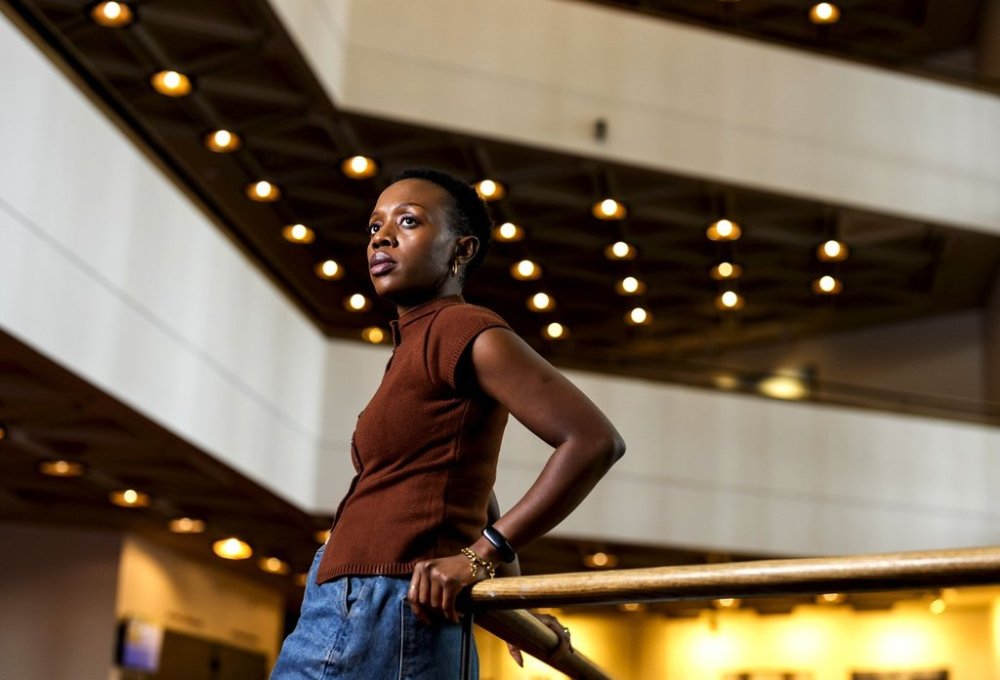
“You think about animals, you think about suffering, you think about ‘The Lion King.'”
In essence, it’s the opposite of what the Zambian-Canadian theatre multihyphenate is trying to do with her play, which opens at the NAC in Ottawa on Tuesday before heading to Toronto’s Soulpepper Theatre on Feb. 7.
“For me, being so specific about a country, and then being so specific about the class of a family, and being so specific about their position in this larger story, that’s what I’m excited for audiences to experience.”
Mumba playfully refers to “Copperbelt” as “African ‘Succession.'” It tells the story of Eden Chileshe (Mumba), the semi-estranged daughter of an ultra-wealthy Zambian mining CEO who built his business from nothing.
Eden’s father, Chimfwembe Kasuba, has suffered a heart attack and is looking to solidify his legacy — a legacy of reclaiming the Zambian people’s power by seizing control of their country’s resources from foreign players — by bringing his three children back into the family business they left behind.
The play gets its name from the region where it’s set, a copper-rich stretch of land that straddles the border between northern Zambia and the southern Democratic Republic of Congo.
Who controls the resources within that land and who benefits from their extraction are central to the story Mumba is telling.
“There is, I think, a nuance in that conversation about how people who have been disenfranchised for a while, how do they build something substantial for their families, for the generations?” she said.
And importantly, she added, who gets to make those choices?
“We’re dealing with the one per cent of the wealthy elites on the continent who are a big part of what shifts the policy in our nations,” Mumba said. “It’s important to me to put (the elites) up to task as well in the global conversation, especially about extraction.”
Mumba brought her perspective as a Zambian-Canadian to the play, but she also wanted to make sure the story held up in Zambia itself.
The daughter of a diplomat, Mumba was born in Zambia, grew up in the Copperbelt and moved around internationally as a teen, before finishing high school in Ottawa and attending the National Theatre School of Canada in Montreal.
She and director Nina Lee Aquino connected with Chiluba Nsofu, who served as the cultural consultant on the play and translated portions of it into Bemba, one of Zambia’s official languages.
Mumba and Aquino also travelled to Zambia in January 2025 and held a weeklong workshop with local artists there to ensure the script resonated with them.
CAST CONNECTIONS
For Kapembwa Wanjelani, who participated in that workshop and now stars as the Kasuba family patriarch, it did.
Growing up in Zambia, he remembered, he would learn European proverbs and folklore in school because the curriculum was set by the British.
“And then there was a moment of realizing like, don’t we have folklore of our own? Don’t we have proverbs of our own?”
When he listened, he heard his parents and grandparents tell those stories and share that folklore, but they weren’t codified in the same way as European stories.
“Copperbelt,” he said, is a Zambian story that is being brought to the West and shared in Canadian cultural institutions.
“What joy it is to share these stories with everyone,” he said.
Warona Setshwaelo said she’s particularly satisfied that the play will reach African Canadians who don’t have the opportunity to go back to the continent.
The Botswana-born, Montreal-based actor plays Harriett Kasuba, Chimfwembe’s wife and chair of the board.
These days, she said, it’s common to see nuanced stories about Africa on the continent itself, but it’s much less common in North America.
“If it were up to the media here, it’s like Africa is a tiny village full of wild animals,” Setshwaelo said. “And so to tell this very human story, that’s really close to my heart. I grew up very similarly to this family.”
The role also marks a first for her career. Despite working as an actor for nearly 30 years, she’s never before played a character from southern Africa.
Setshwaelo is used to taking leaps in her acting — “leaps of culture, leaps of language. Different things like that. So to be able to play a character where you don’t have to leap at all, I think a lot of people take it for granted,” she said.
Even in this case, there’s a small leap. Setshwaelo is from Botswana, south of Zambia.
“It’s very, very different,” she said. “The language is very different. But it’s way closer to me than most of the stuff I end up playing here. Just to be able to do a very basic actor thing, playing a character close to who you are or close to what you know. It’s kind of sad and kind of awesome all at once.”
DIRECTOR’S TAKE
Aquino, director of “Copperbelt” and artistic director of the NAC English Theatre, said she sees it as her job to bring these sorts of personal, specific stories to the Canadian stage.
As she led a rehearsal last week, she sought to give each actor room to dial in on their performance in a pivotal scene in which Chimfwembe’s past misdeeds are revealed.
She split the scene into three concurrent ones, focusing on a couple actors at a time, asking the others to deliver their lines more quietly as if the volume had been turned down on their parts.
It allowed them to make sure each interaction works while maintaining the chaos of the scene: Would one character want to verify the news about her father on a cellphone before demanding answers, or would she simply turn to her husband for confirmation? How would Chimfwembe’s only son feel to see his domineering father brought down a peg?
Aquino’s relationship with Mumba goes back more than a decade. She taught the playwright at the National Theatre School, and they’ve worked together periodically ever since.
Mumba tapped Aquino for advice early in the writing process — about five years ago — and Aquino said she immediately knew she wanted to be involved.
She joined the NAC as artistic director of English theatre several years ago and championed “Copperbelt.”
“If this was going to be on our national stage then I had the power to not only lift the words off the page, I was excited at the idea of starting a cultural exchange of sorts — a national conversation with this piece,” she said.
“I felt that if there was a company that could do this, that could really help Natasha dream big, then it was going to be the National Arts Centre. I took full advantage of that.”
This report by The Canadian Press was first published Jan. 12, 2026.