
Premier highlights continuing challenges for exports
Advertisement
Read this article for free:
or
Already have an account? Log in here »
We need your support!
Local journalism needs your support!
As we navigate through unprecedented times, our journalists are working harder than ever to bring you the latest local updates to keep you safe and informed.
Now, more than ever, we need your support.
Starting at $15.99 plus taxes every four weeks you can access your Brandon Sun online and full access to all content as it appears on our website.
Subscribe Nowor call circulation directly at (204) 727-0527.
Your pledge helps to ensure we provide the news that matters most to your community!
To continue reading, please subscribe:
Add Brandon Sun access to your Free Press subscription for only an additional
$1 for the first 4 weeks*
- Enjoy unlimited reading on brandonsun.com
- Read the Brandon Sun E-Edition, our digital replica newspaper
*Your next Free Press subscription payment will increase by $1.00 and you will be charged $20.95 plus GST for four weeks. After four weeks, your payment will increase to $24.95 plus GST every four weeks.
Read unlimited articles for free today:
or
Already have an account? Log in here »
Hey there, time traveller!
This article was published 20/01/2026 (275 days ago), so information in it may no longer be current.
The recent reductions in canola tariffs have provided some relief for Manitoba farmers, but unresolved pork tariffs and broader trade uncertainty continue to weigh on the agriculture sector, Premier Wab Kinew said.
Kinew spoke with the Sun at the Brandon Community Sportsplex on Tuesday, the same day Manitoba Ag Days officially opened at the Keystone Centre.
“We still have to see more progress on the pork tariffs,” Kinew said. “Getting everything back to normal in terms of being able to export to the world’s second-largest economy would be great. If you’re in the ag industry, you certainly want to see some more happen.”
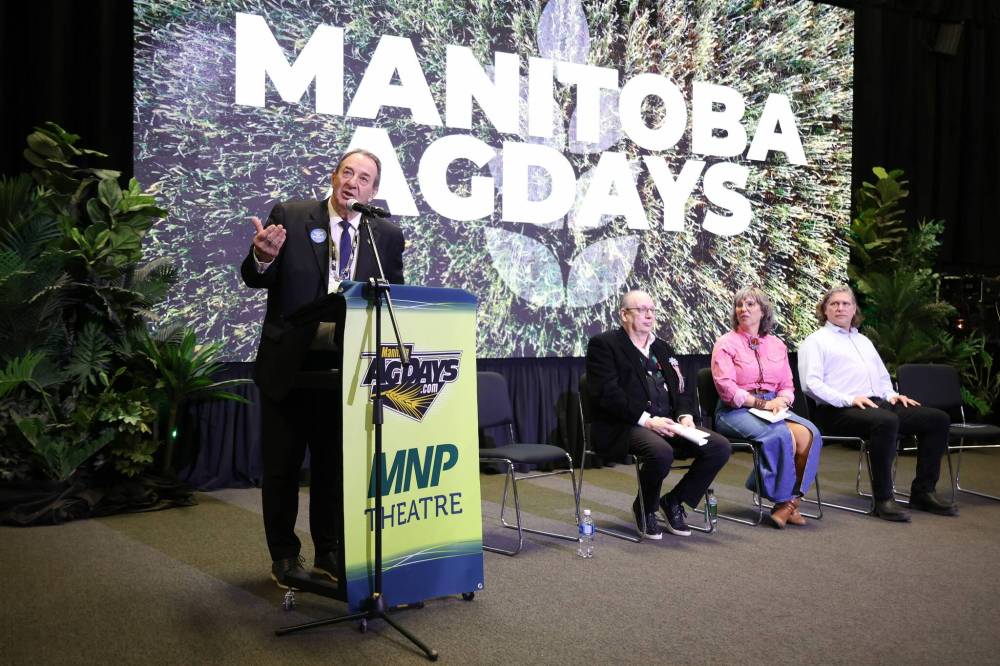
Manitoba Agriculture Minister Ron Kostyshyn speaks during the dignitaries' address in the MNP theatre at Manitoba Ag Days 2026 at the Keystone Centre on Tuesday. (Tim Smith/The Brandon Sun)
Kinew said there is a need to balance trade relations with China and the United States carefully. Manitoba and other western provinces will continue working with the federal government ahead of a March 1 deadline when some of the Chinese tariff reductions are set to take effect, he said.
The premier also emphasized the strategic importance of the Port of Churchill, describing it as a key opportunity to strengthen Manitoba’s economy, expand export routes and reinforce Canada’s northern sovereignty.
“Investing in Churchill makes sense for Manitoba and for Canada,” Kinew said, adding the port provides the country’s only rail access to a deep-water Arctic port and offers faster routes to Europe and parts of Asia than other Canadian ports.
Kinew’s comments framed the opening day of Manitoba Ag Days, where provincial, federal, Métis and municipal leaders addressed producers, exhibitors and industry stakeholders during the show’s dignitaries’ program.
Manitoba Agriculture Minister Ron Kostyshyn, who delivered the provincial address, welcomed attendees to the 49th edition of Manitoba Ag Days and reflected on the event’s role as a gathering point for producers and agribusinesses across the province.
Kostyshyn said the ag sector contributes about eight per cent of Manitoba’s gross domestic product, and praised the rapid pace of innovation transforming farming, from drone technology to artificial intelligence.
Kostyshyn also announced details of Manitoba’s 2026 Ag Insurance Program, including updated insured crop values. More than 90 per cent of Manitoba’s crop acres are enrolled in AgriInsurance, he said, outlining the growing importance of risk management amid climate variability and tightening margins.
Program enhancements include a new forage insurance incentive pilot offering a 15 per cent premium discount for eligible perennial forage crops, expanded coverage for meadow fescue and an expanded Wildlife Damage Compensation Program for the 2026 crop year.
Federal Indigenous Services Minister Ginette Lavack, speaking on behalf of Agriculture and Agri-Food Minister Heath MacDonald, delivered the federal address.
Lavack congratulated Manitoba Ag Days organizers on nearly five decades of growth and hailed the event as Canada’s largest indoor farm show.
She highlighted federal efforts to expand market access, cut red tape and invest in innovation, pointing to recent trade discussions with China as a positive step for producers.
Manitoba Métis Federation Agriculture Minister David Beaudin spoke about the historic and ongoing role of agriculture in sustaining Red River Métis communities, outlining initiatives focused on climate adaptation, food security and youth engagement across the Métis homeland.
Brandon Mayor Jeff Fawcett closed the dignitaries’ program by welcoming visitors to the city and emphasizing the economic and community impact of Manitoba Ag Days, noting the event fills hotels, restaurants and retail outlets during a traditionally slower season.
“Ag Days is more than a trade show,” Fawcett said. “It’s a community catalyst.”
» aodutola@brandonsun.com, with files from Alex Lambert
» X: @AbiolaOdutola