
Carney delivers a vision for the future
Advertisement
Read this article for free:
or
Already have an account? Log in here »
We need your support!
Local journalism needs your support!
As we navigate through unprecedented times, our journalists are working harder than ever to bring you the latest local updates to keep you safe and informed.
Now, more than ever, we need your support.
Starting at $15.99 plus taxes every four weeks you can access your Brandon Sun online and full access to all content as it appears on our website.
Subscribe Nowor call circulation directly at (204) 727-0527.
Your pledge helps to ensure we provide the news that matters most to your community!
To continue reading, please subscribe:
Add Brandon Sun access to your Free Press subscription for only an additional
$1 for the first 4 weeks*
- Enjoy unlimited reading on brandonsun.com
- Read the Brandon Sun E-Edition, our digital replica newspaper
*Your next Free Press subscription payment will increase by $1.00 and you will be charged $20.95 plus GST for four weeks. After four weeks, your payment will increase to $24.95 plus GST every four weeks.
Read unlimited articles for free today:
or
Already have an account? Log in here »
Hey there, time traveller!
This article was published 20/01/2026 (247 days ago), so information in it may no longer be current.
“We are in the midst of a rupture, not a transition. Over the past two decades, a series of crises in finance, health, energy and geopolitics have laid bare the risks of extreme global integration. But more recently, great powers have begun using economic integration as weapons, tariffs as leverage, financial infrastructure as coercion, supply chains as vulnerabilities to be exploited.”
— Prime Minister Mark Carney
With those bleak words, spoken yesterday at the World Economic Forum in Davos, Switzerland, Prime Minister Mark Carney delivered what some have described as a eulogy for the rules-based trade and economic system that has served the world well since the end of the Second World War.
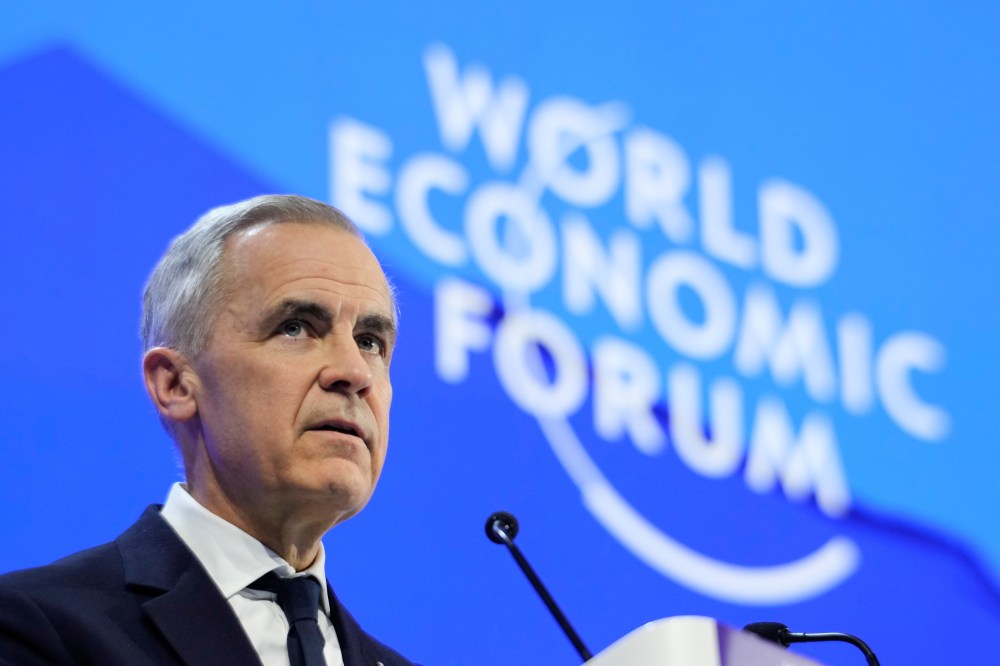
In what may be the most significant international speech delivered by a Canadian leader in more than a generation, Carney accurately described the immense economic, political and social challenges facing many nations across the globe. His words represented a troubling assessment of the perilous state of world trade, along with a viable vision for so-called “middle power” nations to withstand the growing crisis.
He told the audience of international leaders that the rules-based economic order no longer exists, and warned that middle powers, which includes Canada, “must act together because if we’re not at the table, we’re on the menu.”
Those are attention-getting words, but they are hardly a surprise to those who have followed Carney’s response to the abusive economic policies of the Trump administration since he became PM. Last March, he warned that the U.S. policies were aimed at subjugating Canada’s economy to the economic interests of the America and its government.
His actions since then have sought to arrive at an equitable, long-term trade agreement with the U.S., but have also been aimed at reducing our economic reliance on America by building new, reliable trade relationships with other nations.
On that front, there have been several successes, most notably the agreement reached with China last week, which will reduce tariffs on a range of Canadian products commodities, including canola. When discussing that agreement, Carney pointed to Canada’s efforts to build new “strategic partnerships” as part of a more diversified trade strategy. Those remarks were repeated last weekend in his remarks from Qatar, which is apparently weighing a range of large investments in Canada.
Carney’s remarks in Davos yesterday represent the most recent, and perhaps most vivid, instalment of a vision he has been communicating for months now. The difference is that he articulated that vision in the heart of Europe, where nations and citizens appear to only be awakening to the danger of the threats posed to them by the erratic and abusive policies of the Trump administration — threats and policies Canadians have been grappling with for a year now.
Viewed from that perspective, Carney’s speech should be regarded as a call to action aimed at European governments in particular. He is telling them to wake up and accept that the old economic order is gone forever.
He is warning them that “In a world of great power rivalry, the countries in between have a choice: compete with each other for favour, or combine to create a third path with impact.”
That third path would be a rules-based, multinational trade and economic alliance that draws its strength from its collective size and common principles. “This is the task of the middle powers,” he says. “The countries that have the most to lose from a world of fortresses and the most to gain from genuine co-operation.”
Carney received a standing ovation for his remarks, but the challenge for Canada and other middle-power nations is to quickly convert his words into reality: to build an economic coalition capable of acting as a viable and durable counterbalance to the economic power wielded by America and China.
It is a daunting mission, with its success depending on the willingness of those governments to compromise, to set aside their differences on a range of issues and to resist attempts by China and the U.S. to sow division and rivalry among them.
The challenge is significant, but Carney deserves immense credit for having the courage to accurately frame the economic crisis facing the world, and for crafting a credible, rules-based plan capable of guiding nations caught in the financial crossfire navigate toward a more stable, predictable and prosperous future.
At a time when the world appears increasingly in need of principled, skilled leadership, Carney and Canada have stepped forward to fill that void.