
Agriculture research cuts a disservice to producers
Advertisement
Read this article for free:
or
Already have an account? Log in here »
We need your support!
Local journalism needs your support!
As we navigate through unprecedented times, our journalists are working harder than ever to bring you the latest local updates to keep you safe and informed.
Now, more than ever, we need your support.
Starting at $15.99 plus taxes every four weeks you can access your Brandon Sun online and full access to all content as it appears on our website.
Subscribe Nowor call circulation directly at (204) 727-0527.
Your pledge helps to ensure we provide the news that matters most to your community!
To continue reading, please subscribe:
Add Brandon Sun access to your Free Press subscription for only an additional
$1 for the first 4 weeks*
*Your next subscription payment will increase by $1.00 and you will be charged $20.00 plus GST for four weeks. After four weeks, your payment will increase to $24.00 plus GST every four weeks.
Read unlimited articles for free today:
or
Already have an account? Log in here »
At a time when Canada needs more research and innovation to remain competitive in world markets, the last thing this country needs are the deep cuts to Agriculture and Agri-Food Canada facilities that were made public last week.
Thousands of federal employees across Canada have received workforce adjustment notices following the federal government’s comprehensive expenditure review, aimed at cutting program spending and administrative costs by about $60 billion over the next five years.
As part of these cuts, the federal government has confirmed that the AAFC workforce will be reduced by at least 665 positions, with notices having been sent out to 1,043 affected employees on Jan. 22.
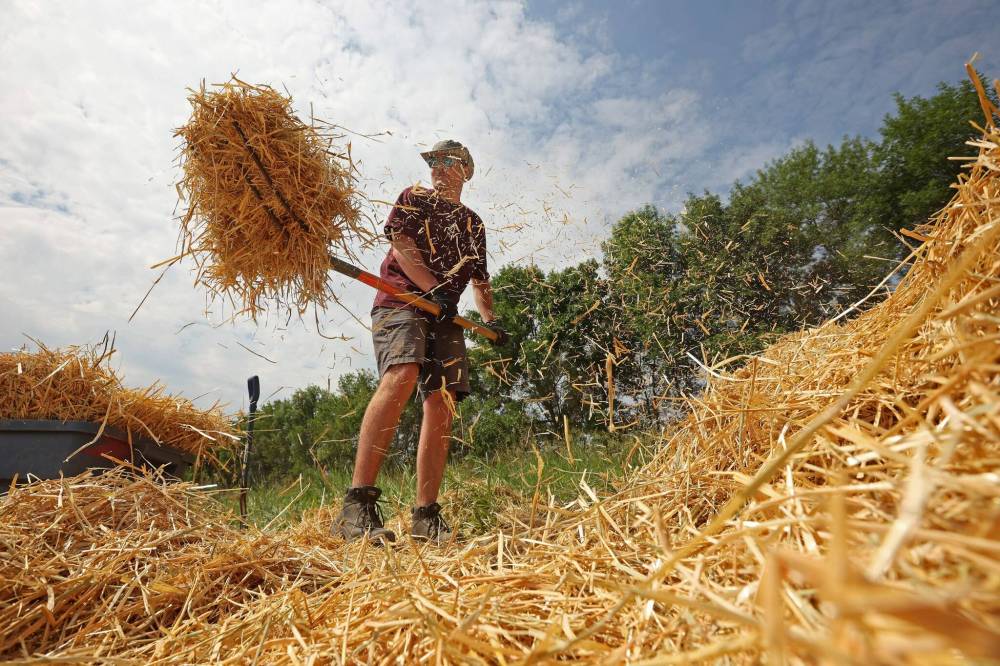
Summer student Rylen Brown pitchforks straw into plastic bins so the straw can be used to cover plots in the barley nursery at the Brandon Research and Development Centre. (Tim Smith/The Brandon Sun files)
This reduction includes the closure of three research and development centres — in Guelph, Ont., Quebec City and Lacombe, Alta. — along with four satellite research farms, including the office in Portage la Prairie, which is a satellite of the Brandon Research and Development Centre.
We learned over the weekend that the federal government’s plan — as part of its effort to reduce the size of the public service — will affect agriculture staff here at the Brandon facility as well, with possibly 10 positions out of 70 employees being reduced.
In a letter to AAFC staff, Deputy Agriculture Minister Lawrence Hanson said the coming layoffs are intended to help the federal department “ensure spending is sustainable and activities reflect the Department’s core mandate.”
Agricultural groups that have weighed in on the federal layoffs and closures say these cuts to the AAFC will have significant impacts on Canada’s agricultural research capacity, the country’s long-term industry innovation and the local communities where the facilities are situated.
“These cuts will sabotage important gains we’ve made in agricultural research and set research on Canadian food products back by decades,” Milton Dyck, national president of the Agriculture Union, said in a press release from the National Farmers Union on Monday. “We have been warning the federal government for months about cutting an already-decimated department. There is simply no more room to cut.”
In his comments to the Sun on Saturday, Dyck warned that the staffing reductions in Brandon will limit the scope of work carried out at the Brandon facility and reduce its overall impact on the community.
This is the latest in a series of closures and cuts to federal agriculture research over the last several years. The most significant hit to the Brandon research centre came in 2012, when the Harper government cut its beef research programs and reduced staff as part of broader, nationwide budget cuts to the federal agriculture department.
The Brandon Research and Development Centre was established in this city in 1886 by the Canadian government, one of the nation’s original five agricultural research facilities that was designed to develop crops and production methods that would be suitable for the Prairies. While local residents don’t always realize it, there are significant benefits to having the research facility in Brandon — not the least of which are the researchers and staff and their families who call the region home.
Agricultural research is vital to developing new and resilient varieties of wheat and barley in Western Canada, and these facilities also do extensive research in crop sustainability and agriculture’s environmental footprint.
While we are relieved that the damage to Brandon’s research facility did not include its closure, the continued ignorance of the federal government when it comes to investing in our country’s agricultural future is damaging more than just the industry. Brandon — nicknamed the “Wheat City” — is only as prosperous as the agricultural communities that surround it. Cuts to our facilities and institutions may help the federal government’s bottom line, but in the long run do a disservice to producers and their ability to find innovative solutions to help diversify markets and adjust to a changing climate.
While this is a federal facility — and therefore subject to the financial whims of the bean counters in Ottawa — there are some things the community can do to strengthen the research facility in Brandon. Strengthening relationships with Brandon’s own Assiniboine College facilities and Brandon University would be a good start. We could also include the University of Manitoba’s agriculture program as well.
But it would also behoove our politicians — Conservative MP Grant Jackson, Manitoba Premier Wab Kinew and Mayor Jeff Fawcett — to reach out to the federal agriculture minister and make a little noise on Brandon and Manitoba’s behalf.