
BU students gather for bannock cooked over fire
Advertisement
Read this article for free:
or
Already have an account? Log in here »
We need your support!
Local journalism needs your support!
As we navigate through unprecedented times, our journalists are working harder than ever to bring you the latest local updates to keep you safe and informed.
Now, more than ever, we need your support.
Starting at $15.99 plus taxes every four weeks you can access your Brandon Sun online and full access to all content as it appears on our website.
Subscribe Nowor call circulation directly at (204) 727-0527.
Your pledge helps to ensure we provide the news that matters most to your community!
To continue reading, please subscribe:
Add Brandon Sun access to your Free Press subscription for only an additional
$1 for the first 4 weeks*
*Your next subscription payment will increase by $1.00 and you will be charged $20.00 plus GST for four weeks. After four weeks, your payment will increase to $24.00 plus GST every four weeks.
Read unlimited articles for free today:
or
Already have an account? Log in here »
Smoke rose from a small fire in Brandon University’s Kavanagh Courtyard on Friday as students and passersby gathered for something warm and cultural.
About 50 people showed up around lunchtime to watch, wait for and eat bannock prepared over an open flame as part of a new Indigenous foodways of the Western Hemisphere course. Some stopped briefly to grab a piece and move on, while others lingered in the cold, chatting and waiting their turn.
The outdoor cooking session was a way to bring classroom discussions to life, Ian Puppe of BU’s Rural Development Department told the Sun in an interview.
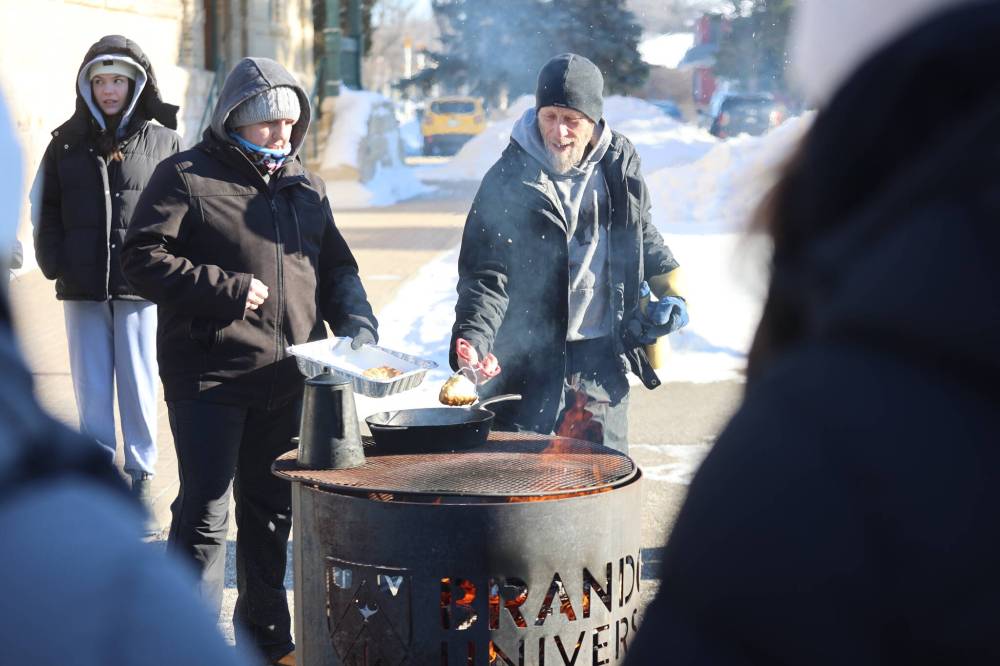
Brandon University’s Ian Puppe (right) and one of his students, Alyx Storm, fry bannock during the outdoor cooking session in the university’s Kavanagh Courtyard on Friday afternoon. (Abiola Odutola/The Brandon Sun)
“I’m teaching a course right now on Indigenous foodways of the Western Hemisphere, and we’ve been talking about a bunch of different kinds of food that people made and continue to make here in Canada and across Turtle Island,” he said. “Bannock, or fry bread as it’s sometimes called, is a really popular food in lots of communities.”
He said bannock is deceptively simple — typically made with flour, baking powder, water, salt and sometimes sugar, cinnamon or raisins — but carries deep cultural meaning.
“These are foods that people ate and continue to eat as soul food and heartwarming foods,” Puppe said. “They’re easy to whip up. Grandma will whip up a warm fry bread when you’re just hanging out in the afternoon, or you’ll have it for breakfast or after dinner.”
Bannock also opens the door to complex conversations about history and colonialism, and most of its ingredients are not indigenous to Turtle Island, said Puppe, an assistant professor.
“Wheat comes from Europe, and the olive oil we’re using today definitely comes from somewhere else,” he said. “Yet these recipes are mainly thought of as First Nations food. Most communities, including Haudenosaunee, Anishinaabe, Dakota, have their own version.”
Cooking over a fire, he said, allowed students to explore not just taste, but technique and knowledge passed down over generations.
“Sometimes things get burnt, sometimes things aren’t cooked as much as you’d hope,” he said. “Learning how skilled people had to be to make use of fire and much more direct ways of cooking is one of the things we’re looking at.”
The session sparked discussion among students about regional and family variations, from adding oil directly into the dough to cooking Bannock dry over the fire.
“It gave us a chance to talk about why we would do it differently and what the effects of cooking differently would be,” Puppe said. “So we’re doing everything from a little bit of Indigenous chemistry and cooking to a little bit of Indigenous philosophy and politics in the course.”
Puppe said he was surprised by the turnout, especially given the cold.
“We have 30 enrolled in the class, and I saw about 20 or 25 of them,” he said. “But more people from outside the class than inside the class turned out, and they snapped up the bannock. It got eaten pretty quickly.”
Any leftovers, he said, would be dropped off at the Indigenous Peoples’ Centre on campus.
Friday’s event marked several firsts for Puppe.
“This is the first time I’ve taught the course, and the first time I’ve had a campfire on campus,” he said.
Organizing it came with challenges. “It’s not something people are used to doing on campus, so there were a few hiccups.”
Still, he hopes it won’t be the last.
“Now that we’ve got it rolling, I think it would be easy to do it again,” Puppe said.
“I might make it a pretty common event.”
» aodutola@brandonsun.com
» X: @AbiolaOdutola