
More Canadian athletes powered by artificial intelligence at Winter Games
Advertisement
Read this article for free:
or
Already have an account? Log in here »
We need your support!
Local journalism needs your support!
As we navigate through unprecedented times, our journalists are working harder than ever to bring you the latest local updates to keep you safe and informed.
Now, more than ever, we need your support.
Starting at $15.99 plus taxes every four weeks you can access your Brandon Sun online and full access to all content as it appears on our website.
Subscribe Nowor call circulation directly at (204) 727-0527.
Your pledge helps to ensure we provide the news that matters most to your community!
To continue reading, please subscribe:
Add Brandon Sun access to your Free Press subscription for only an additional
$1 for the first 4 weeks*
*Your next subscription payment will increase by $1.00 and you will be charged $20.00 plus GST for four weeks. After four weeks, your payment will increase to $24.00 plus GST every four weeks.
Read unlimited articles for free today:
or
Already have an account? Log in here »
Just for fun, Xavier McKeever and his cross-country ski teammates once tasked ChatGPT to design a training plan for them.
“It was the craziest training plan we’ve ever seen,” said the 22-year-old from Canmore, Alta.
“It basically said you should do intensity every single day. You should do three hours of skiing and then an hour of intensity, and repeat that a few times — and then you should take a week off completely. We know you can’t do that.

“It was pretty funny to see and do, to see Chat GPT can’t write a training plan, and that we need our coaching to help us with that.”
While OpenAI’s chatbot didn’t nail a workout for the skiers, artificial intelligence has entered the lives of Canada’s athletes at the Winter Games in Milan-Cortina, Italy.
The Oxford Dictionary defines AI as “the capacity of computers or other machines to exhibit or simulate intelligent behaviour” and “software used to perform tasks or produce output previously thought to require human intelligence, esp. by using machine learning to extrapolate from large collections of data.”
“The word ‘artificial intelligence’ or ‘AI’ is so misunderstood,” said Andy Van Neutegem, vice-president of performance sciences, research and innovation at Own the Podium, Canada’s high-performance sport funding and advisory body.
“We tend to use the word ‘machine learning.'”
From Apple and Garmin watches and Oura rings that feed sleep and heart-rate data into smartphones to generate recovery scores, to inertial measurement units attached to athletes’ bodies for three-dimensional positioning analysis, the AI boom is inescapable.
A common theme among Canadian athletes is that AI is more of a tool for training than competition. They value instinct and lived experience just as much as, if not more than, data.
“In my sport that’s performance on demand, it’s important to have some data, but have a very good feel for the snow,” said freestyle skier and triple Olympic moguls medallist Mikael Kingsbury.
“In a sport where things change a lot because we’re outside, I don’t want numbers to be my indicator.”
When it comes to Olympic and Paralympic Games, sport science is the game within the Games as countries keep their technology secrets under wraps.
Van Neutegem won’t get into specifics on the Canadian team’s preparation for the Milan Cortina Games, but allows some sports to make heavy use of AI.
“You can talk about snowboarding, talk about freestyle,” he said.
“When it comes to AI, where we’re at right now globally in Olympic and Paralympic sport and pro sport is that we’re using AI to track biomechanical positioning of the body. It’s about body shapes. Are the body shapes optimal? AI does the work of a human eye. It’s a branch of AI that we call computer vision, and it really just mimics the capabilities of the human brain. The computer detects, does object recognition, and it starts understanding whether that’s optimal.”
Sliding sports used local positioning systems (LPS) and leveraged AI to determine the fastest line down a track, he added.
“You’re bringing an extraordinary amount of information into a computer, which is computating it and spitting out an interpretation of whether this is optimal or not optimal based upon data that’s been collected over a long period of time,” Van Neutegem explained.
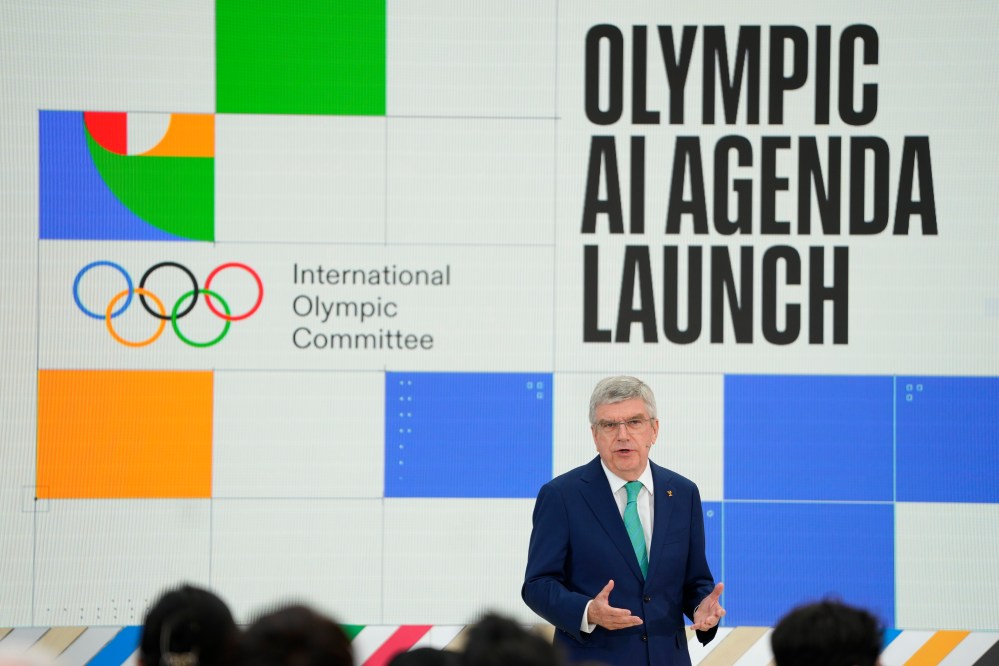
When the International Olympic Committee launched its AI Agenda almost two years ago, IOC president Thomas Bach said, “AI can revolutionize judging and refereeing.”
The International Gymnastics Federation implemented an AI judging platform at the Paris 2024 Summer Games to help human judges evaluate gymnasts’ moves.
Snowboard judging was a flashpoint in Beijing in 2022, when Canada’s slopestyle champion Max Parrot acknowledged he touched his knee instead of grabbing his board on one run — and the judges missed it.
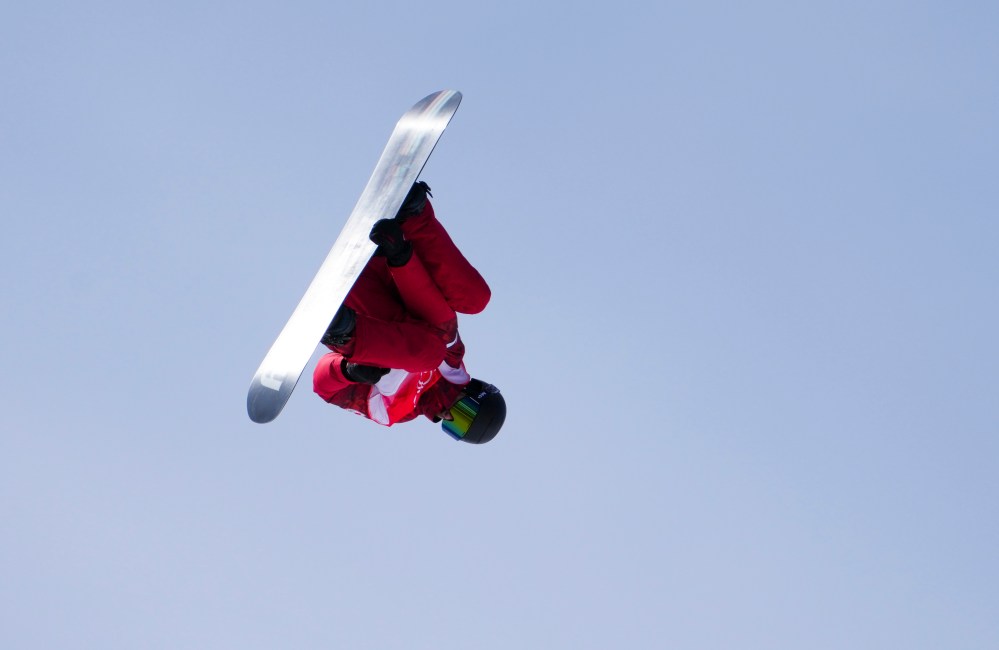
The X Games, ESPN’s action sports competition that helped popularize disciplines later added to the Olympics, has turned an AI judging platform into a business called “The Owl AI” since first testing it on men’s halfpipe snowboarders at the 2025 event in Aspen.
“They were using AI to see if it could call the tricks to make sure that that is what someone did,” recalled Canadian freestyle halfpipe skier Rachel Karker.
“I still think it’s really important to have a human set of eyes to watch because the issue with our sport is that everyone does their tricks slightly differently. It’s not like gymnastics or aerials, where they have a really strict way of how you do a trick.
“Everyone sort of spins on a different axis and sort of has a slightly different variation to it. It might struggle to pick up on nuances like that and maybe call it a bit different, but it’s starting to get introduced in competition. I’m torn on whether it’ll make it better or make it worse.”
This report by The Canadian Press was first published Feb. 13, 2026.