
Brandonites air pre-budget concerns
Advertisement
Read this article for free:
or
Already have an account? Log in here »
We need your support!
Local journalism needs your support!
As we navigate through unprecedented times, our journalists are working harder than ever to bring you the latest local updates to keep you safe and informed.
Now, more than ever, we need your support.
Starting at $15.99 plus taxes every four weeks you can access your Brandon Sun online and full access to all content as it appears on our website.
Subscribe Nowor call circulation directly at (204) 727-0527.
Your pledge helps to ensure we provide the news that matters most to your community!
To continue reading, please subscribe:
Add Brandon Sun access to your Free Press subscription for only an additional
$1 for the first 4 weeks*
*Your next subscription payment will increase by $1.00 and you will be charged $20.00 plus GST for four weeks. After four weeks, your payment will increase to $24.00 plus GST every four weeks.
Read unlimited articles for free today:
or
Already have an account? Log in here »
Climate change, health care and affordability were hot topics at the provincial government’s 2026 budget consultation in Brandon.
Finance Minister Adrien Sala opened the presentation at The Backyard on Aberdeen by acknowledging Manitobans’ priorities have been clear — fixing the health-care system, lowering the cost of living and making communities safer.
He went on to highlight announcements the NDP government has made, including the hiring of 3,500 net new health-care workers since October 2023.
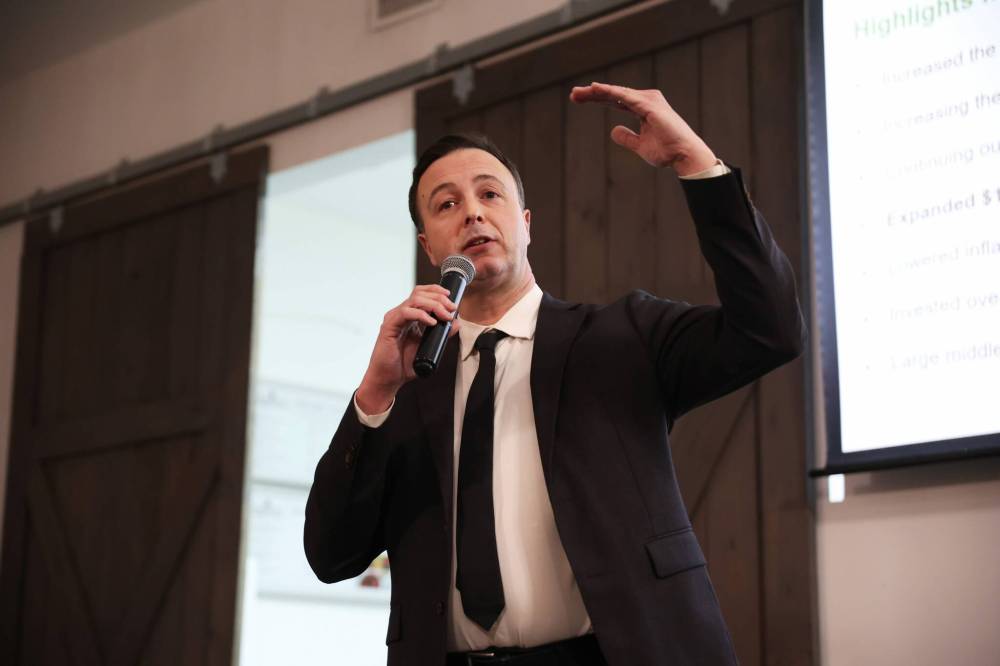
Manitoba Finance Minister Adrien Sala speaks during a pre-budget consultation at The Backyard on Aberdeen in Brandon in February. (Photos by Tim Smith/The Brandon Sun files)
Sala also highlighted announcements regarding protecting the environment, like the province installing 51 new electric vehicle charging stations and issuing more than 4,000 EV rebates.
Eleven registered speakers addressed Sala before the floor was opened to other residents.
Spruce Woods Housing Co-Operative manager Eva Cameron said when she sat down to write what she was going to say in her presentation, she had a déjà vu moment, as everything she said last year still stands.
Cameron said if the government truly wants to fix the health-care and justice systems, they need to address the root of the problem — making sure everyone has an affordable place to live.
Seniors are having to choose between buying food and medication, and when they choose food, they get sicker, she said.
“A lot of families are having to work multiple jobs just to pay rent and put food on the table, so what happens to the children? The parents don’t have enough time to spend with their children to guide them in the right direction.”
Cameron said if children grow up to find a job and find an affordable place to live, they may not have learned how to cook healthy meals, causing them to resort to junk food.
She said they may struggle with their mental health and resort to drugs and alcohol, and “all of the sudden our health-care system is overloaded, or, God forbid, they start committing crimes to get food or their next fix.”
She called for more non-market rental units geared to income.
Brandon resident Quentin Robinson said environmental issues are often framed in social terms and that many governments say, “We need to take care of the economic horse so that we can hold the environmental cart.”
“This is a huge mistake,” he said.
“Our environment is not part of the cart. Our environment is part of the horse. In fact, it’s the feet and legs of the horse on which everything stands.”
The provincial budget needs to reflect that environmental concerns are taken seriously, he said, adding that a great place to start is funding sustainable agriculture, as farmers need more technical support and financial resources to find low-emission ways to operate.
“As climate change damages increase, so will these costs, so it would seem to make a lot of sense to spend more on reducing agricultural emissions now, rather than paying for the ever-increasing damage that unchecked emissions will cause in the future.”
Brandon West Progressive Conservative MLA Wayne Balcaen said he is hearing the same three priorities that Sala highlighted from residents in Brandon and encouraged the government to continue investing in those areas.
But he also said more needs to be done to reduce the province’s debt.
The province’s deficit forecast for the 2025-26 fiscal year, Sala confirmed at the meeting, is $1.661 billion.
“We’re paying more per year for debt servicing than we are for many of the other portfolios that we have,” Balcaen said. “So, I would encourage this government to put funds into debt reduction to make sure that our grandchildren, my grandchildren and great grandchildren, aren’t paying off our services of today.”
He pointed out the gas tax holiday from last year, which he said cost hundreds of millions of dollars for people to save a few dollars here and there, including people passing through from other provinces.
“These really aren’t savings that are going to impact us.”
Super Thrifty president and CEO Jennifer Ludwig said there are roughly 1,700 pharmacists scattered throughout the province and they are trained not only to be experts in medication, but also in assessing patients for certain medical conditions and prescribing the right medications to them.
The province allows pharmacists to assess patients for “just 14 conditions,” she said.
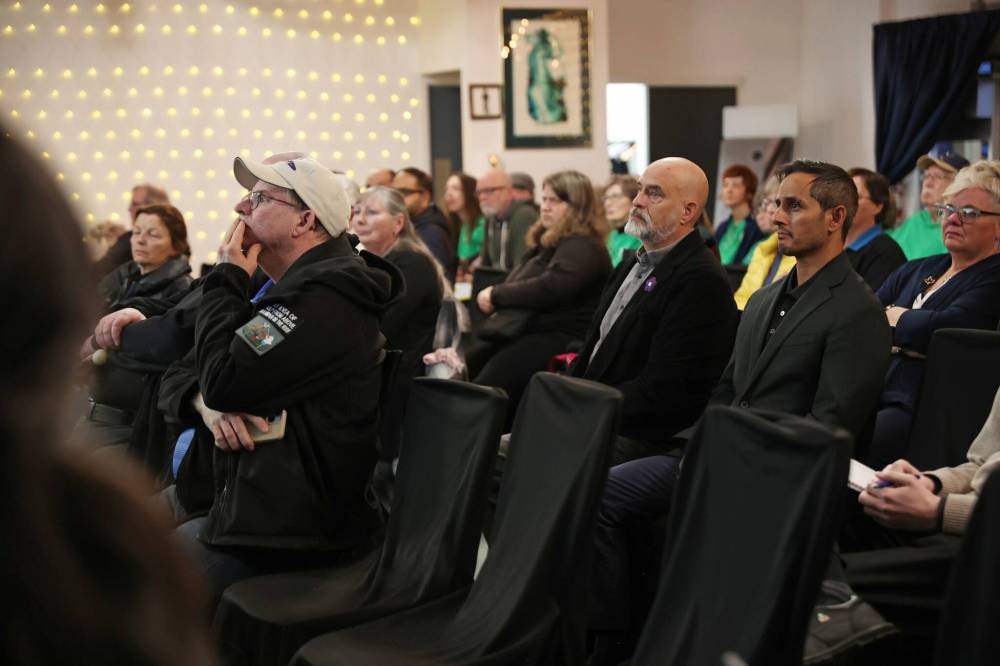
Westman residents listen as Sala speaks during Friday’s pre-budget consultation.
“This may seem wonderful, but Manitoba is falling behind for two reasons.”
The first, she said, is that most provinces permit their pharmacists to assess patients for 45 to 65 different conditions.
“The second reason — the conditions that you do allow us to prescribe for and assess, you don’t pay us,” Ludwig said. “Nearly every other province pays pharmacists to assess patients and does it for more than triple the number of medical conditions.”
She asked why other provinces should have better access to health care.
This should matter to the finance minister for several reasons, she said, including that pharmacists could help fill the shortage in primary care, especially in rural communities, and it costs the government less for a pharmacist to assess a patient than it would if the patient had to go to the hospital.
“Maybe most crucially, the Canada Health Act now says that as of April 1, 2026, if you do not pay a pharmacist for the things that you would pay a physician, your government would be in violation of the Canada Health Act.”
She asked that money be set aside for pharmacists to be paid to provide the care they are trained to give.
Tara Leach with Sustainable Brandon said the 2026 budget needs to fund universal access to composting, food rescue and education to “sustain each Manitoban and the future we will all share.”
Every community in the province needs a curbside composting programming, she said.
“The city of Brandon has had citywide composting since 2011. We are just starting a pilot program to allow folks in multiplex buildings to compost,” she said. “Every composting program needs to accommodate every household, single dwelling and those who live in multiplexes.”
She said there also needs to be composting for schools and hospitals.
Almost half of the food Canada’s agriculture sector produces ends up in landfills, Leach said, adding that if the food can’t be saved, the least that can be done is composting it.
Madelyn Robinson, chair of Sustainable Brandon, said the government should consider using climate change as a lens when looking at any policy decisions that are made.
“What we do and don’t do about climate affects every single aspect of our lives,” she said.
She said the province needs a broader transportation strategy, which includes “getting serious about the growing public transit network in urban and rural areas.”
Getting more people on public transit will be the fastest way to lower transportation emissions and relieve traffic congestion, Robinson said.
She said in the 2026 budget, the province should “recommit to sharing the cost of public transit on a 50-50 basis and dedicate $100 million for municipalities specifically for the purpose of enhancing public transit.
» sanderson@brandonsun.com