
Beef producers push for action on deer, elk
Advertisement
Read this article for free:
or
Already have an account? Log in here »
We need your support!
Local journalism needs your support!
As we navigate through unprecedented times, our journalists are working harder than ever to bring you the latest local updates to keep you safe and informed.
Now, more than ever, we need your support.
Starting at $15.99 plus taxes every four weeks you can access your Brandon Sun online and full access to all content as it appears on our website.
Subscribe Nowor call circulation directly at (204) 727-0527.
Your pledge helps to ensure we provide the news that matters most to your community!
To continue reading, please subscribe:
Add Brandon Sun access to your Free Press subscription for only an additional
$1 for the first 4 weeks*
- Enjoy unlimited reading on brandonsun.com
- Read the Brandon Sun E-Edition, our digital replica newspaper
*Your next Free Press subscription payment will increase by $1.00 and you will be charged $20.95 plus GST for four weeks. After four weeks, your payment will increase to $24.95 plus GST every four weeks.
Read unlimited articles for free today:
or
Already have an account? Log in here »
Manitoba Beef Producers members voted overwhelmingly on Thursday to lobby the province and the Manitoba Agricultural Services Corporation for action on deer and elk populations that are costly to farmers.
The organization tabled a resolution focused on reducing the damage that wild deer and elk cause by entering onto farms and consuming feed.
It passed with a significant show of support, said CEO Carson Callum.
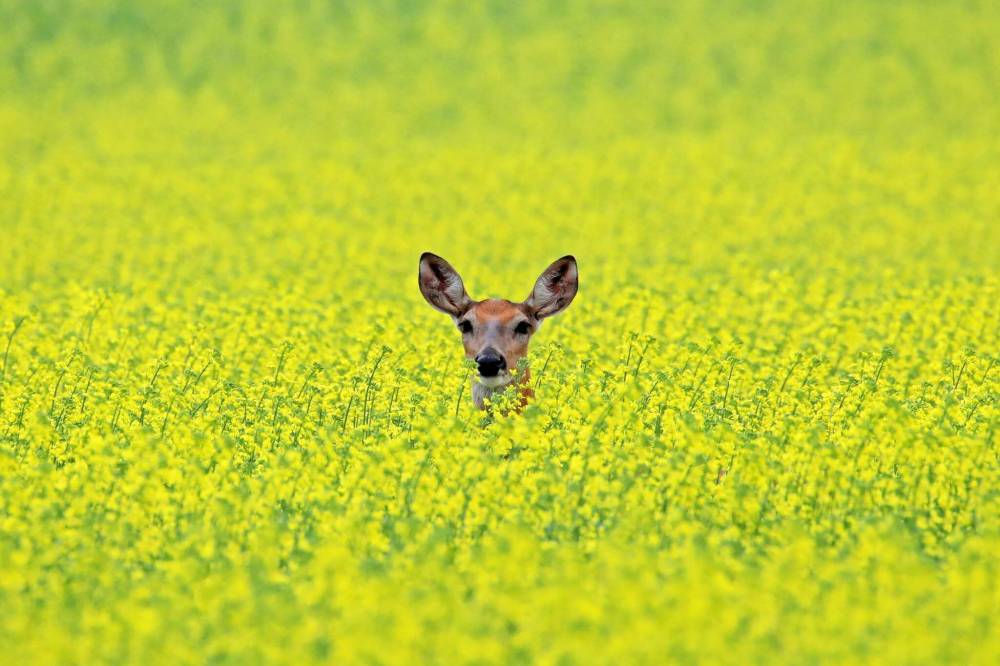
A white-tailed deer peers out from a crop of canola along Grand Valley Road west of Brandon. (Tim Smith/The Brandon Sun files)
“I would say all those in the room supported it,” Callum said. “This gives us really good direction to take this forward to the provincial government and advocate.”
The resolution highlighted three key areas for the organization to push the provincial government to act on:
• To analyze deer and elk populations in agricultural areas to determine if overpopulation needs to be addressed.
• To provide financial assistance for fencing and other practices that prevent wildlife from accessing feed areas.
• To increase compensation when deer eat farmers’ feed.
The vote took place during the association’s 47th annual general meeting at the Victoria Inn in Brandon. The event ran on Wednesday and Thursday.
The resolution pointed out that elk and deer populations have risen in agricultural areas of the province and are congregating on farms, that there are concerns for disease transmission and that compensation available to farmers is limited in the case of extended grazing forages.
Deer and elk population numbers are unknown, Callum said, but with farmers lodging more and more complaints, the organization is looking to pin down data that can drive change.
“I think the reality is, some of these elk herds in agro-Manitoba are getting pretty large and challenging,” Callum said. “We need to ensure we’re advocating for strategies to help our producers out.”
Manitoba Beef Producers president Matthew Atkinson said the region around Riding Mountain National Park is a hot spot for deer and elk, as well as south-central Manitoba near MacGregor.
“It’s been a growing issue because they cause a lot of damage,” he said. “They are really big herds, so if they choose your yard, they can do a lot of damage.”
Several farmers told the Sun that it is nearly impossible to dissuade deer from coming onto property and eating feed — farmers cannot shoot the protected animals and they acclimatize themselves to things like noise, scarecrows and guard dogs.
MASC chief product officer David Van Deynze said he has heard from farmers complaining of an increased presence of elk and deer, but that there are likely several causes for the increase in claims surrounding the wild animals.
“Our claim numbers are increasing, based on what I’m hearing from farmers, partially because of the number of deer and elk that are around, but also, I think, just more awareness that the program exists, and the actual economics of farming these days.”
Van Deynze said he understands where farmers are coming from in seeking the population counts, as it would provide clarity on the issue.
Ben Waddle, a cattle farmer near Austin, told the Sun that he saw a herd of deer grow from 40 to 80 on his farm over the last two years. Waddle said the best of the three options to counteract wildlife damage is to increase the compensation farmers can apply for when deer eat their feed.
Affected farmers can apply to recoup 45 per cent of the total value of loss for extended grazing forages.
Fences are “not the right fit for everybody,” because they are labour intensive, and wouldn’t protect people who use a variety of farm practices like extended foraging, Waddle said.
A member from the Glenboro-South Cypress region told the Sun he also supported compensation as the best solution.
“The compensation is way too low right now,” said the farmer, who wouldn’t share his name for fear of retaliation when he applies for claims. “I’ve been filing a claim for the last 15 years, every year. I’ll probably get a cheque for $3,500 a year, but it’ll probably cost me $15,000.”
He said he wants Manitoba Beef Producers to push for 80 per cent compensation on losses for extended grazing forages.
» cmcdowell@brandonsun.com