
Fire on Ice: Curling tension, profanity-laced exchange gets international attention
Advertisement
Read this article for free:
or
Already have an account? Log in here »
We need your support!
Local journalism needs your support!
As we navigate through unprecedented times, our journalists are working harder than ever to bring you the latest local updates to keep you safe and informed.
Now, more than ever, we need your support.
Starting at $15.99 plus taxes every four weeks you can access your Brandon Sun online and full access to all content as it appears on our website.
Subscribe Nowor call circulation directly at (204) 727-0527.
Your pledge helps to ensure we provide the news that matters most to your community!
To continue reading, please subscribe:
Add Brandon Sun access to your Free Press subscription for only an additional
$1 for the first 4 weeks*
*Your next subscription payment will increase by $1.00 and you will be charged $20.00 plus GST for four weeks. After four weeks, your payment will increase to $24.00 plus GST every four weeks.
Read unlimited articles for free today:
or
Already have an account? Log in here »
CORTINA D’AMPEZZO – In a sport known for gentlemanly play and esteemed conduct, the unusual scene of on-ice tension at the Cortina Curling Olympic Stadium was downright jarring for some and lapped up by others.
Toss in a few F-bombs during a testy exchange and you have the perfect storm for a Roaring Game brouhaha that has generated international attention.
“I think it was the boys being boys,” said Canadian women’s team coach Heather Nedohin. “It’s a battle.”
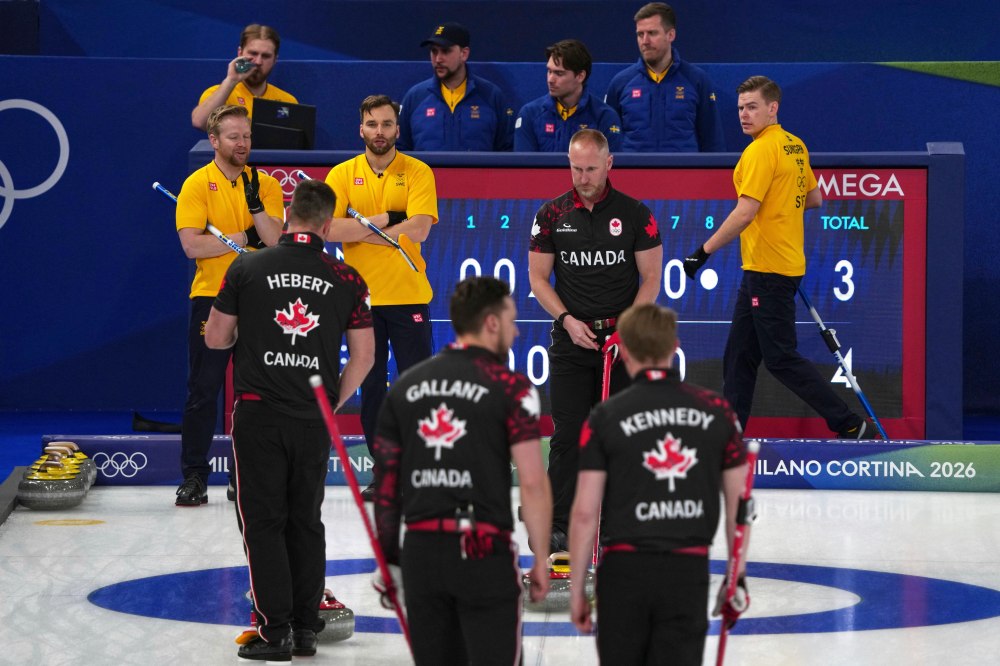
As players cleared rocks after the ninth end of a Canada-Sweden game on Friday night, Sweden’s Oskar Eriksson shared that he felt some Canadian players were touching the stone a second time after releasing the handle during the game.
Canadian vice Marc Kennedy bristled at the accusation and lobbed a profanity-laced retort Eriksson’s way. The tense scene — picked up for broadcast via player microphones — made for buzzy Olympic story fodder around the world.
“Cheating allegations rock Canada-Sweden curling match in profane Olympic scene: ‘You can f — k off,” a New York Post headline blared.
“‘I told him where to stick it’: Cheating claims fly in Canada v Sweden Winter Olympics curling clash,” the Guardian’s web headline read.
The New York Times, BBC, Fox Sports and several other outlets — throughout Canada and around the world — picked up the story.
“They say it in hockey a hundred million times,” said Nedohin. “We say it once and we’re in an uproar. Like, I have to giggle.”
The Canadian team, which includes Kennedy, skip Brad Jacobs, second Brett Gallant and lead Ben Hebert, went on to win the game 8-6 to improve to 3-0.
“We’re fully supportive of Team Jacobs,” said Curling Canada chief executive officer Nolan Thiessen. “I stand behind those guys. They always play with a lot of integrity and they would never knowingly do anything that was offside from the rules.”
World Curling issued a rule violations clarification later in the day.
It said that during forward motion, touching the granite of the stone was not allowed and “infractions would result in the stone being removed from play,” per rule R. 5 (d).
The organization also said that starting Saturday afternoon, two officials would move between all four sheets and observe deliveries.
World Curling also issued a verbal warning to Canadian team officials regarding the language used in the game. A future violation could result in a player suspension.
The Canadians returned to the ice Saturday afternoon for a game against Switzerland’s Yannick Schwaller. Sweden’s side, skipped by Niklas Edin, took an 0-3 mark into its game against China’s Xiaoming Xu.
Video-assisted review is not used in curling, a sport where players usually iron out on-ice issues on their own. At the Olympics, an umpire is stationed at the end of the sheet and can be consulted as required.
If a stone is touched after the hog line, sensors will light on the rock and it will be pulled from play.
“The issue of second touches of the stone, specifically the granite, during the delivery was brought to the umpire’s attention,” World Curling communications chief Chris Hamilton said in an email.
“Officials spoke with both teams and set game umpires at the hog line to monitor deliveries for three ends, which is the official protocol following this type of complaint. There were no hog-line violations or retouches of the stone during that observation period.”
An interview request with World Curling’s chief umpire was declined.
Curlers occasionally utter the odd swear word in competition, which can make it to air since a delay is not used on curling broadcasts. However, profanity-laced exchanges are rare.
Nedohin famously uttered a different profanity while competing at the Canadian women’s playdowns in 2012. After it became a talking point, she would occasionally utter the word “Sugarballs” — a slight alteration from the original — when frustrated on the ice.
“Hallelujah, we’re getting attention for curling,” Nedohin said of the latest controversy. “Really. Like if that’s what it takes to create a buzz, like a nail on granite that’s doing nothing — perfect. We got attention.”
A Swedish team official said the federation was planning to make a statement later Saturday.
Play continues until the final day of the Games on Feb. 22.
This report by The Canadian Press was first published Feb. 14, 2026.