
UPDATED: BU prof part of landmark fossilized vomit discovery
Advertisement
Read this article for free:
or
Already have an account? Log in here »
We need your support!
Local journalism needs your support!
As we navigate through unprecedented times, our journalists are working harder than ever to bring you the latest local updates to keep you safe and informed.
Now, more than ever, we need your support.
Starting at $15.99 plus taxes every four weeks you can access your Brandon Sun online and full access to all content as it appears on our website.
Subscribe Nowor call circulation directly at (204) 727-0527.
Your pledge helps to ensure we provide the news that matters most to your community!
To continue reading, please subscribe:
Add Brandon Sun access to your Free Press subscription for only an additional
$1 for the first 4 weeks*
- Enjoy unlimited reading on brandonsun.com
- Read the Brandon Sun E-Edition, our digital replica newspaper
*Your next Free Press subscription payment will increase by $1.00 and you will be charged $20.95 plus GST for four weeks. After four weeks, your payment will increase to $24.95 plus GST every four weeks.
Read unlimited articles for free today:
or
Already have an account? Log in here »
Hey there, time traveller!
This article was published 18/02/2026 (251 days ago), so information in it may no longer be current.
A Brandon University paleontologist has helped identify animal vomit that’s nearly 290 million years old — and could be the oldest known example of fossilized “barf” from a land-dwelling predator.
Assistant biology professor Mark MacDougall was part of a research team that identified 41 bones from at least three different animals inside the regurgitated cluster by using CT scans and chemical analysis, the university said in a news release.
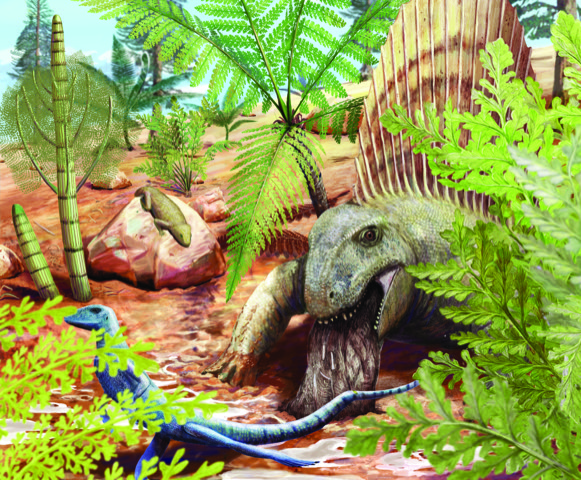
Signs point to the vomit coming from a top predator — likely an early relative of mammals such as Dimetrodon — that gulped down a mixed meal that included a small reptile, a fast-moving lizard-like animal and part of a much larger plant-eater, and later coughed it back up.

Brandon University assistant biology professor Mark MacDougall was one of the scientists who helped identify the nearly 290-million-year-old dinosaur barf, known as regurgitalite. (Supplied)
“It’s rare to get such direct evidence of who was eating whom nearly 300 million years ago,” said MacDougall, co-author of the international study published last month in the journal Scientific Reports.
“In this case, the predator clearly bit off more than it could stomach,” he said.
Evidence of the behaviour from so many millennia ago gives scientists “a rare snapshot” of feeding behaviour, predator-prey relationships and food webs, the university said.
“This is like a prehistoric time capsule,” MacDougall said. “These animals lived together, died together, and ended up in the same regurgitated pile, probably within days of each other. That kind of detail is incredibly rare in the fossil record.”
The fossil, known as a regurgitalite, was discovered at the Bromacker fossil site in central Germany.
The study was led by researchers from Germany’s Museum für Naturkunde and France’s National Centre for Scientific Research. BU played a key role in interpreting the fossil and its ecological meaning, the university said.
Chris LeMoine, BU’s dean of science, said the discovery showcases the university’s global impact.
“This project highlights how Brandon University researchers are collaborating with colleagues around the world to contribute to significant fundamental discoveries,” LeMoine said in the news release.
“It’s rigorous science, creative thinking, and yes, sometimes a bit messy. That’s how we expand our understanding of the natural world past and present.”
» The Brandon Sun
History
Updated on Wednesday, February 25, 2026 11:45 AM CST: This is a corrected version of the original story that mistakenly attributed the fossilized vomit to a dinosaur.