
Met Opera’s 2026-27 season has 17 productions, its fewest in at least 60 years
Advertisement
Read this article for free:
or
Already have an account? Log in here »
We need your support!
Local journalism needs your support!
As we navigate through unprecedented times, our journalists are working harder than ever to bring you the latest local updates to keep you safe and informed.
Now, more than ever, we need your support.
Starting at $15.99 plus taxes every four weeks you can access your Brandon Sun online and full access to all content as it appears on our website.
Subscribe Nowor call circulation directly at (204) 727-0527.
Your pledge helps to ensure we provide the news that matters most to your community!
To continue reading, please subscribe:
Add Brandon Sun access to your Free Press subscription for only an additional
$1 for the first 4 weeks*
*Your next subscription payment will increase by $1.00 and you will be charged $20.00 plus GST for four weeks. After four weeks, your payment will increase to $24.00 plus GST every four weeks.
Read unlimited articles for free today:
or
Already have an account? Log in here »
NEW YORK (AP) — Despite encouraging box office figures for the season’s first half, the financially strapped Metropolitan Opera scaled back its 2026-27 schedule with its fewest productions in at least 60 years.
The Met announced Thursday it will present 17 productions, its lowest total in a non-truncated season since the company moved to Lincoln Center in 1966. There are just five new stagings, and revivals of three popular operas account for 71 of the 187 individual opera performances (38%): Puccini’s “Tosca” and “La Bohème,” and Verdi’s “Aida.”
“It makes more sense for us, and this is an experiment — to present these works in extended runs,” Met general manager Peter Gelb said. “And by double-casting them, it also is more economic in terms of how many different shows are playing in one week.”
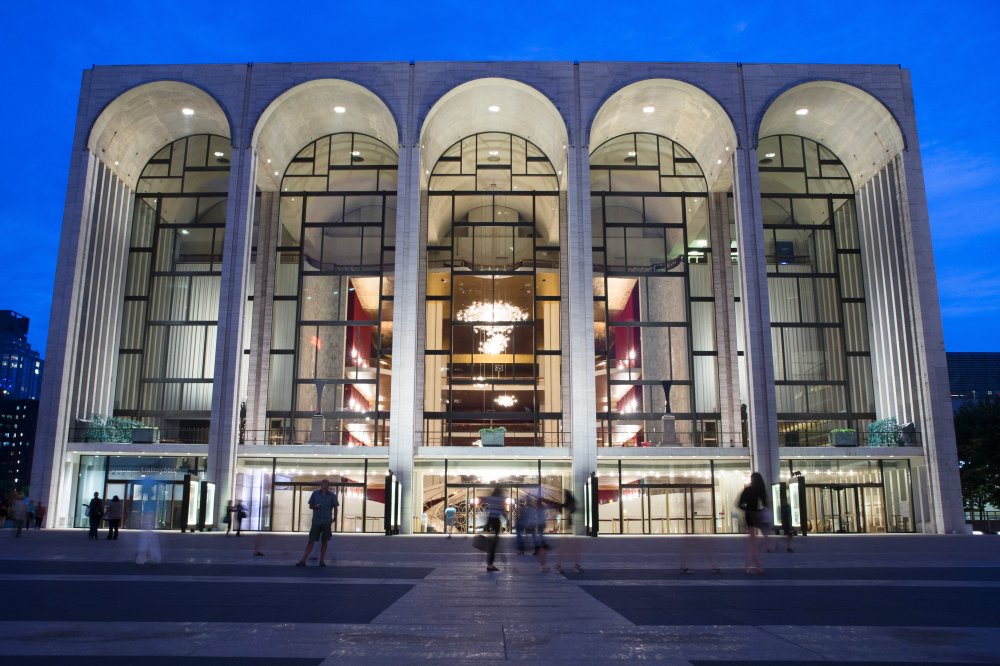
Ticket sales of 72% this season are up from 70% in the first half of 2024-25.
“Basically, it’s back to pre-pandemic levels,” Gelb said. “We’re not grossing as much money because the average price per ticket is slightly less than it was, because we have a younger audience and more discounted tickets.”
Mason Bates’ “The Amazing Adventures of Kavalier & Clay,” which opened the current season in its world premiere, sold 84% of tickets in a success rate that prompted the Met to schedule an extra four performances this month.
“One of my goals at the Met is to stimulate new audiences with new works,” Gelb said. “This one was one of the most successful we’ve presented so far.”
“Kavalier” was followed by an English-language holiday time staging of Mozart’s “The Magic Flute” (83%), Bellini’s “I Puritani” (82%), Puccini’s “Turandot” (77%), Puccini’s “Madama Butterfly” (74%), “The Gershwin’s Porgy and Bess” (73%), and Donizetti’s “La Fille du Régiment,” Bizet’s “Carmen,” Bellini’s “La Sonnambula” and “Bohème” (68% each).
Lagging were Mozart’s “Don Giovanni” and Strauss’ “Arabella” (64% each) and Giordano’s “Andrea Chenier” (57%).
Next season opens on Sept. 22 with a new production of Verdi’s “Macbeth” starring soprano Lise Davidsen and directed by Louisa Proske.
Composer Missy Mazzoli’s “Lincoln in the Bardo,” based on George Saunders’ novel, has its world premiere on Oct. 19 and stars Christine Goerke, Stephanie Blythe, Anthony Roth Costanzo and Peter Mattei in a staging directed by Lileana Blain-Cruz.
There are three new-to-the Met productions: Janáček’s “Jenůfa” starring Asmik Grigorian in a Claus Guth staging that debuted at London’s Royal Opera in 2021 (Nov. 16); Puccini’s “La Fanciulla del West” with Sondra Radvanovsky and SeokJong Baek in a Richard Jones staging that premiered at the English National Opera in 2014 (Dec. 31); and the company premiere of Kevin Puts’ “Silent Night” featuring Elza van den Heever and Rolando Villazon in a James Robinson staging first seen at the Houston Grand Opera last month (March 8, 2027).
A gala with more than two dozen stars is scheduled for May 25, 2027, to mark the company’s 60th season at Lincoln Center.
“We’re in a kind of golden age of opera singing,” Gelb said. “The only difference between today and 30 or 40 years ago is that 30 or 40 years ago opera was much more in the cultural mainstream.”
“Lincoln” was not included among the eight simulcasts to move theaters due to a post-pandemic drop in audience.
“A title that is unknown, even with whatever maximum efforts of marketing and publicity that are done, will underperform to a degree where it is not really financially viable for the movie theaters or for us,” Gelb said.
A Simon McBurney staging of Mussorgsky’s “Khovanshchina” was postponed as part of budget tightening that included 22 layoffs and 4-15% temporary salary cuts.
“Unfortunately, I have to wear two hats,” Gelb said. “I have to wear my artistic hat, and I have to wear my financial hat.”
Next season will be Gelb’s 20th anniversary season as general manager, and he says he intends to retire when his current contract expires in 2030.
“That certainly is our current plan,” Gelb said.