
First Nations people urged to carry passports to U.S.
Advertisement
Read this article for free:
or
Already have an account? Log in here »
We need your support!
Local journalism needs your support!
As we navigate through unprecedented times, our journalists are working harder than ever to bring you the latest local updates to keep you safe and informed.
Now, more than ever, we need your support.
Starting at $15.99 plus taxes every four weeks you can access your Brandon Sun online and full access to all content as it appears on our website.
Subscribe Nowor call circulation directly at (204) 727-0527.
Your pledge helps to ensure we provide the news that matters most to your community!
To continue reading, please subscribe:
Add Brandon Sun access to your Free Press subscription for only an additional
$1 for the first 4 weeks*
*Your next subscription payment will increase by $1.00 and you will be charged $20.00 plus GST for four weeks. After four weeks, your payment will increase to $24.00 plus GST every four weeks.
Read unlimited articles for free today:
or
Already have an account? Log in here »
The federal government is advising First Nations people to carry a passport in addition to a secure status card when crossing the border to the United States.
The updated advisory comes as one First Nation chief in Westman says his members are already hesitant about travelling south.
The update on Thursday replaced the government’s previous advisory that stated First Nations “may freely” enter the U.S. for the purposes of employment, study, retirement, investing or immigration.
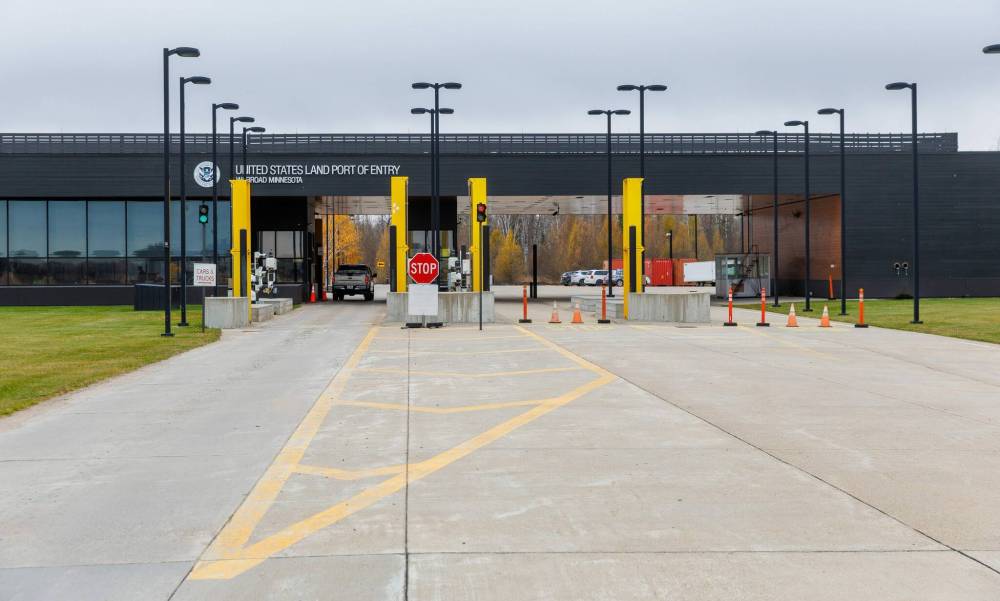
The United States port of entry at Warroad, Minn. Ottawa is advising First Nations people that status cards may not be enough identification to enter the United States, since “the acceptance of all status cards is entirely at the discretion of U.S. officials.” (Mike Deal/Winnipeg Free Press files)
The advisory is now cautioning travellers to be prepared at the border.
“You may be asked to provide documentation to prove the percentage of Indian blood required under U.S. law,” the advisory reads. “It is strongly recommended to use a valid machine-readable secure status card, and carry a valid passport.”
Status cards may not be enough identification, it adds, since “the acceptance of all status cards is entirely at the discretion of U.S. officials.”
First Nations have been growing concerned that members will be increasingly scrutinized as they travel between Canada and the U.S. Free mobility was granted to them in a 1794 agreement called the Jay Treaty.
The Assembly of First Nations in January warned of reports of increased questioning and detainment by U.S. Immigration and Customs Enforcement and urged citizens to carry identification, like a passport. It also reaffirmed its support of the cross-border mobility rights.
The U.S. Embassy and Consulates in Canada website states that proof will be required to exercise those rights. It says, “In order to qualify for these (Jay Treaty) privileges, eligible persons must provide evidence of their American Indian background at the port of entry. The documentation must be sufficient to show the bearer is at least 50 per cent of the American Indian race.”
Long Plain First Nation Chief David Meeches said no one in his community has reported being unreasonably searched or treated with suspicion at the border. But the threat still lingers and causes people to second guess their travel plans, he said.
“It is a common practice to go down there to do traditional ceremonies with our relatives, in particular South Dakota, North Dakota and even further. We would cross the border, we would just simply say we’re going down for ceremonial purposes,” he said. “Now, we hesitate to do that.”
Several community members have asked for a letter — which is encouraged by the U.S. Embassy & Consulates in Canada — that the First Nation can issue identifying the person and supporting their identity to make the border crossing easier, he said.
“We basically give them the same advice,” he said. “I’m encouraging people … just don’t travel right now.”
Meeches personally missed a trip to the United States in the summer of 2025. He said the best option is to wait until the sitting U.S. government leaves office.
It is understandable why Canada would update its travel advisory at this time, he said.
“It’s no surprise, and I can appreciate the fact that they did do that,” he said. “We’ve done it locally. Our grand chiefs of the Assembly of Manitoba Chiefs and the Southern Chiefs Organization have been doing this all along.”
Another Westman chief told the Sun on Friday that he has not experienced an issue despite the fact that he crosses the border on a monthly basis.
“I got no problems going into the U.S.,” said Waywayseecappo First Nation Chief Murray Clearsky.
“They welcome me, in fact, when I go to the U.S. But Canada, Canada has to do something,” he said.
“I had problems coming into Canada. We get more hassle coming into Canada.”
Clearsky added that he also hasn’t heard any reports of people from his community being mistreated by U.S. border enforcement.
Despite Meeches’ warning of the risk of immigration and customs enforcement both inside the U.S. and at the border, he agreed that Canadian border enforcement has been more difficult to deal with at the port of entry.
» cmcdowell@brandonsun.com