
Ukraine Olympian’s banned skeleton helmet a rallying symbol at Ottawa demonstration
Advertisement
Read this article for free:
or
Already have an account? Log in here »
We need your support!
Local journalism needs your support!
As we navigate through unprecedented times, our journalists are working harder than ever to bring you the latest local updates to keep you safe and informed.
Now, more than ever, we need your support.
Starting at $15.99 plus taxes every four weeks you can access your Brandon Sun online and full access to all content as it appears on our website.
Subscribe Nowor call circulation directly at (204) 727-0527.
Your pledge helps to ensure we provide the news that matters most to your community!
To continue reading, please subscribe:
Add Brandon Sun access to your Free Press subscription for only an additional
$1 for the first 4 weeks*
*Your next subscription payment will increase by $1.00 and you will be charged $20.00 plus GST for four weeks. After four weeks, your payment will increase to $24.00 plus GST every four weeks.
Read unlimited articles for free today:
or
Already have an account? Log in here »
OTTAWA – As the Winter Olympics drew to a close on Sunday in Milan, Ukrainian slider Vladyslav Heraskevych’s disqualification for wearing a helmet commemorating fallen Ukrainian athletes and coaches was a rallying point for some 300 demonstrators on Parliament Hill in Ottawa.
The Ukrainian Canadian Congress held an event to mark the fourth anniversary of Russia’s full-scale invasion of Ukraine. It was one of 60 gatherings planned for across the country in the days around the anniversary.
On Feb. 24, 2022, Russia launched an unprovoked attack on Ukraine, by land, sea and air. Four years later, more than a million people have been killed and millions more displaced.
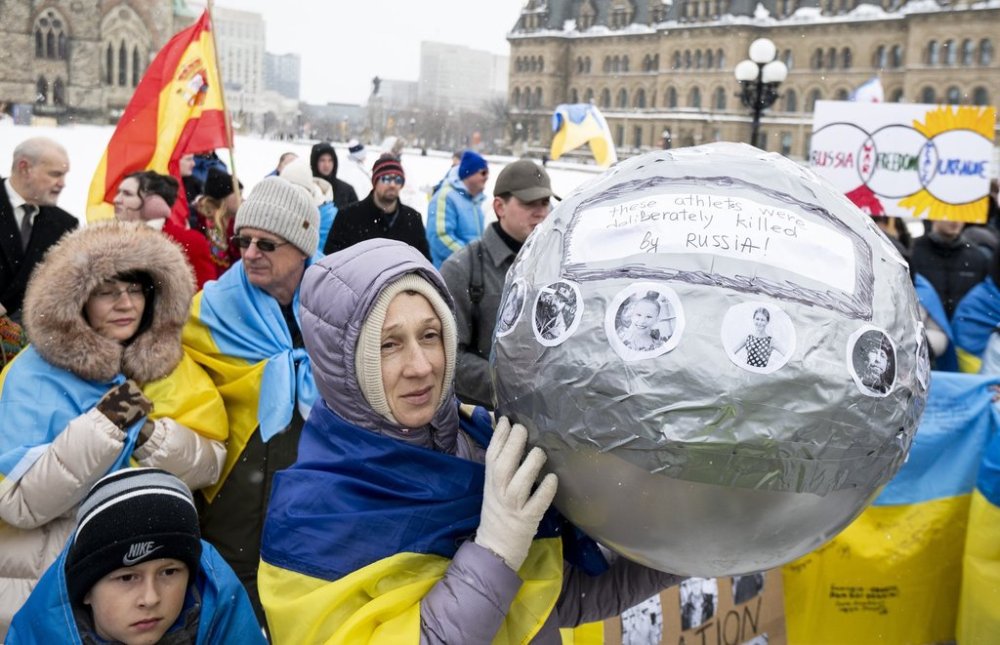
Maryna Shum moved from Kyiv to Canada in 2022, and was among the demonstrators on Parliament Hill on Sunday.
Off the side of the stage, she held a large makeshift helmet replicating the one Heraskevych planned to wear, which led to his disqualification from the Olympic skeleton competition
“It’s about honour. It’s about courage,” Shum told The Canadian Press on why the helmet — which took her two days, a balloon, and a roll of duct tape to make — was an important symbol to bring to the rally.
“He was brave enough to just sacrifice his possible medals. It’s not a surrender.”
The International Olympic Committee, and the sport’s international governing body, barred Heraskevych from competing after ruling his helmet — depicting more than 20 athletes and coaches killed since Russia’s invasion — violated the IOC’s rules on athlete expression.
“An athlete who chose the remembrance versus the medals … this too is the cost of this war,” said Maryna Vyatkina, the president of the Ottawa branch of the Ukrainian Canadian Congress.
“When we are talking about Olympics, bans on participation, about neutrality in sport, you must remember this helmet. There is no neutrality in aggression. And there is no neutrality in injustice.”
Sen. Rebecca Patterson was one of several Canadian political figures at Sunday’s rally.
Representatives — some among them ambassadors — from the embassies of Spain, Latvia, Sweden, Bulgaria, Romania, Portugal, Slovakia, Lithuania, Denmark and Greece were also in attendance, organizers said.
Patterson pointed to Shum’s makeshift helmet as a “vital message of truth” that “war is devastating.”
“Honouring the dead should not be controversial. Remembering fallen teammates is not propaganda or political,” Patterson told the crowd.
“It is actually grief made visible. And that helmet, this helmet, carries a truth that statistics cannot convey: that every loss is personal, every face is a life interrupted. Shame on the IOC for such a disgraceful decision.”
Last week marked the third round of negotiations between Russia and Ukraine, which the U.S. has helped organize. Central to a peace deal for Russia is control of land in Ukraine, which Ukrainian President Volodymyr Zelenskyy has previously said his country would not surrender.
“Sustained peace is far more complex than a real estate deal,” Patterson told the crowd on Parliament Hill.
Liberal MP Mona Fortier was also among the speakers at the event, highlighting the more than $20 billion the Canadian government has provided in support for Ukraine. Fortier called Russia’s targeting of Ukrainian energy infrastructure “abhorrent.”
Conservative MP Shuvaloy Majumdar followed Fortier, and said Canada’s support for Ukraine “remains unwavering and absolute.”
This report by The Canadian Press was first published Feb. 22, 2026.
— With files from Catherine Morrison and The Associated Press.