
NDP names task force to tackle drug trade
Advertisement
Read this article for free:
or
Already have an account? Log in here »
We need your support!
Local journalism needs your support!
As we navigate through unprecedented times, our journalists are working harder than ever to bring you the latest local updates to keep you safe and informed.
Now, more than ever, we need your support.
Starting at $15.99 plus taxes every four weeks you can access your Brandon Sun online and full access to all content as it appears on our website.
Subscribe Nowor call circulation directly at (204) 727-0527.
Your pledge helps to ensure we provide the news that matters most to your community!
To continue reading, please subscribe:
Add Brandon Sun access to your Free Press subscription for only an additional
$1 for the first 4 weeks*
*Your next subscription payment will increase by $1.00 and you will be charged $20.00 plus GST for four weeks. After four weeks, your payment will increase to $24.00 plus GST every four weeks.
Read unlimited articles for free today:
or
Already have an account? Log in here »
WINNIPEG — Manitoba’s justice minister acknowledged law enforcement is playing catch-up to drug dealers and gangs as he helped launch a task force Wednesday to crack down on trafficking.
“Manitobans have been clear, the meth crisis needs to end and the people profiting off of creating misery in our communities need to be held to account,” Matt Wiebe said at a news conference to announce the formation of the task force.
The group includes senior officials from the provincial justice department, RCMP, Canada Border Services Agency, Manitoba Criminal Intelligence Centre, Manitoba First Nations Police Service and police services in Winnipeg, Brandon, Altona, Winkler and Morden.
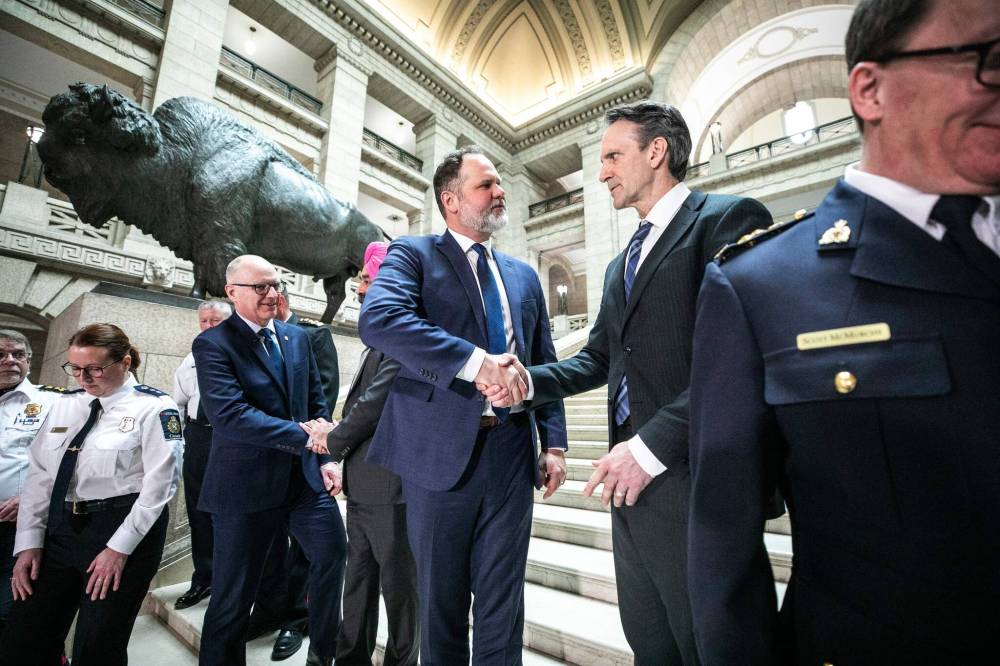
Justice Minister Matt Wiebe (left) and Kevin Brosseau, the federal government’s “fentanyl czar,” shake hands after announcing a new drug enforcement task force on Wednesday at the Manitoba legislature. (Mikaela MacKenzie/Winnipeg Free Press)
“This is an opportunity for us to bring everyone to one table, to bring the expertise and develop the opportunities together … and to really go after those organized crime groups,” the minister said.
“What I will learn and what information will be shared, at least at my level, is information that then translates into the work that the (criminal intelligence centre) does, the work that we do in Manitoba Justice to support law enforcement across the province and the work nationally.”
Kevin Brosseau, the federal government’s “fentanyl czar,” will advise the task force, which met for the first time Wednesday, and plans to meet again next month.
Brosseau, who attended the news conference at the legislature, said no single law enforcement agency can tackle the complexity of today’s drug trade alone.
“It is an important and timely step,” Brosseau, a longtime RCMP officer in Manitoba, said about the new front in the fight against drugs.
“The realities we face today are that they’re multi-commodity trafficking, complex organized crime groups, synthetic drugs that are cheaper, more potent and more lethal, that require a response that is equally sophisticated, co-ordinated and united.”
Members will discuss local experiences, set priorities and begin planning a provincewide strategy to disrupt the supply chains of illicit drugs, including a “targeted meth sweep” focused on producers and distributors.
Assistant Commissioner Scott McMurchy, commanding officer of the Manitoba RCMP, said he has not seen evidence of large-scale meth production in the province, but it can be assumed there is small-scale production.
“That would be common sense,” he said. “And it’s not only meth, it’s fentanyl, it’s cocaine, it’s prescription narcotics and all the other things that come to bear.”
A provincial staffer later clarified that while authorities are not aware of meth labs operating at scale in Manitoba, some production-related activities — such as cutting and mixing methamphetamine — do occur.
Progressive Conservative justice critic Wayne Balcaen, the MLA for Brandon West and a former Brandon police chief, said the announcement resembles a similar task force launched by the former PC government in 2018, alongside then-Liberal MP Robert-Falcon Ouellette and former Winnipeg mayor Brian Bowman.
“This is just another example of the NDP recycling PC promises,” said Balcaen, who didn’t attend the news conference. “Absolutely no meat on the bone and all window dressing again.”
Balcaen argued the province should instead push the federal government to reform the bail system.
“Literally dozens and dozens of people are arrested with large amounts of drugs, some with guns, some with violence, and they’re all released on promises to appear or undertakings,” he said. “So if (the justice minister) wants to crack down on drug dealers, stop releasing the drug dealers. Let’s work with the feds. Let’s get a proper bail system in order, something that they failed to do since they got in government.”
Joseph Fourre, whose son Harlan died of fentanyl poisoning in 2023 and who has become an advocate for drug awareness, said he hopes the task force is not another “illusion of action” — a phrase Premier Wab Kinew used in 2018 when criticizing the Tory task force.
“It’s almost déjà vu,” Fourre said. “This one is a little different in that it’s police forces … They just didn’t give me anything on the ‘how.’ What’s going to be different?”
Fourre said governments often talk tough about the drug trade but struggle to make meaningful progress.
“But more often than not, they have a hard time getting up the very first rung of the ladder,” he said.
The task force aims to reduce the supply of drugs, disrupt criminal networks and co-ordinate law enforcement efforts across communities. It will report to the provincial justice minister and support information sharing and joint operations.
It will look at ways to disrupt criminal organizations, including by using civil courts and unexplained wealth orders. The orders, which must be approved by a judge, can force individuals to explain the source of their money in court.
The province said the group will examine strategies used in other jurisdictions to determine best practices.
Illicit drugs in Manitoba are largely tied to organized crime groups operating both within the province and across borders. Law enforcement officials have long pointed to Mexican cartels as a major source of methamphetamine.
McMurchy said drugs flow into Manitoba from the United States as well as east and west across provincial lines, and historical trends have disappeared as criminals follow the product and the money, and work together to do so.
The community impact is especially evident in First Nations, said Manitoba First Nations Police Service Chief Jason Colon.
“We see first-hand how opioids and meth fuel violence, drive property crimes and put overwhelming pressure on health-care and social services,” Colon said.
“Criminal networks operating outside of our communities exploit marginalized individuals struggling with addictions and profit from the pain and suffering of our people.”
» Winnipeg Free Press