
Poilievre calls for all-party working group on renewing trade deal with U.S.
Advertisement
Read this article for free:
or
Already have an account? Log in here »
We need your support!
Local journalism needs your support!
As we navigate through unprecedented times, our journalists are working harder than ever to bring you the latest local updates to keep you safe and informed.
Now, more than ever, we need your support.
Starting at $15.99 plus taxes every four weeks you can access your Brandon Sun online and full access to all content as it appears on our website.
Subscribe Nowor call circulation directly at (204) 727-0527.
Your pledge helps to ensure we provide the news that matters most to your community!
To continue reading, please subscribe:
Add Brandon Sun access to your Free Press subscription for only an additional
$1 for the first 4 weeks*
*Your next subscription payment will increase by $1.00 and you will be charged $20.00 plus GST for four weeks. After four weeks, your payment will increase to $24.00 plus GST every four weeks.
Read unlimited articles for free today:
or
Already have an account? Log in here »
OTTAWA – Conservative Leader Pierre Poilievre laid out his vision for the Canada-U.S. relationship on Thursday, directly denouncing U.S. President Donald Trump’s rhetoric about Canada while insisting on a stable relationship with our southern neighbour.
“The lesson in this moment is simple: the path to sovereignty is focusing relentlessly on what is within our power,” Poilievre said in a speech at the Economic Club of Canada in Toronto.
Poilievre called for the creation of an all-party working group on the Canada-U.S.-Mexico Agreement on trade as the two countries begin a review of the deal.
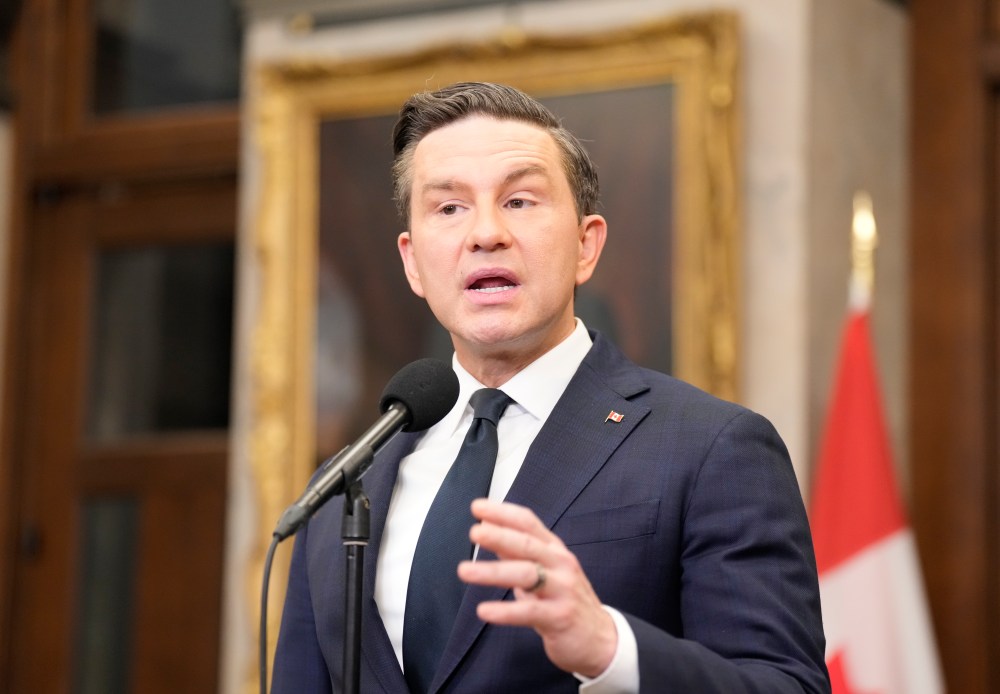
He pledged to work with the Liberal government, while noting the Official Opposition has “a constitutional and patriotic duty to scrutinize the government.”
The Conservative leader did find common ground with the Liberals on Thursday, at least rhetorically.
A central theme of his speech was control. “We must divide the problem into what we control and what we do not control,” he said.
As Poilievre was delivering his speech on Thursday afternoon, Canada-U.S. Trade Minister Dominic LeBlanc was speaking elsewhere in Toronto.
“We have to control what we can control” when it comes to managing the fallout from U.S. tariffs, LeBlanc told the Canadian Club.
While Poilievre declined to name the Conservative MPs he would select for the proposed all-party group, he said they’d operate “in good faith” and put the country ahead of the party.
His address to the Toronto business crowd framed Canada’s path through the trade war as one of building resilience and strength at home.
He returned to a message he repeated often ahead of last April’s election — that the federal government needs to get out of the way of resource development and growth.
“The most effective response to uncertainty is not outrage, it is results,” he said.
Poilievre did mention Trump by name multiple times in the speech, a notable departure from the address he gave to Conservative delegates at the party’s convention in Calgary just last month, which did not name the president at all.
“The president’s talk of 51st statehood, whether it is a joke or not, is unacceptable. It goes without saying there is zero chance of Canada ever being a part of the United States,” he said.
The Conservative leader was broadly criticized for failing to talk enough about Trump’s trade war and annexation threats during the election campaign, even as it became clear that was becoming the dominant issue for voters.
He has said repeatedly that he believes Prime Minister Mark Carney needs to secure an agreement that restores tariff-free trade with America — even though the president has insisted he will not end tariffs.
U.S. Trade Representative Jamieson Greer said Tuesday if Ottawa wants a deal with Washington, it will have to accept “some level of higher tariff.”
On Thursday, Poilievre insisted that tariff-free trade is the goal.
“By unblocking our resources and unleashing our economy, we can become affordable and autonomous, and build the leverage to fight for tariff-free trade with the United States,” he said.
That leverage should include Canada tying its purchases of American military equipment to free trade, and creating a strategic energy and mineral reserve, he said.
Poilievre’s speech suggested that Canadians “leverage our friendship with the American people” as an asset in the CUSMA review.
He also took aim at the Liberal government’s efforts to improve relations with China, and at Carney’s widely praised speech at the World Economic Forum in Davos in January.
“We should not declare a permanent rupture from our biggest customer and closest neighbour in favour of a strategic partnership for a new world order with Beijing, a regime the prime minister himself said was the biggest threat to Canada just a year ago,” he said, paraphrasing some of Carney’s recent speeches.
Carney’s Davos speech made it clear he believes the Americans have permanently altered their relationships with other nations, Canada included.
“We are in the midst of a rupture, not a transition,” the prime minister said.
Carney travelled to China last month to meet with Xi Jinping — the first meeting between the two national leaders since 2017 — and secured a deal to end retaliatory tariffs on Canadian agricultural goods in exchange for dropping tariffs on some Chinese EVs.
Poilievre proposed Thursday that Canada should instead negotiate an auto pact with the U.S. that agrees to “keep Chinese vehicles out” of the Canadian market in exchange for tariff-free production in North America.
On India — where Carney is headed this week to meet with Prime Minister Narendra Modi — the Conservative leader took a much different tone.
Poilievre said he supports a free-trade deal with India, a country Canadian security officials have accused of carrying out a campaign of extortion and intimidation against Canadian citizens.
In a fireside chat with former MP Lisa Raitt after his speech, Poilievre was asked why he isn’t angrier with the U.S., as so many Canadians are.
“This is, by the way, something that Mark Carney has said — and I agree with him. He has said that we cannot control what the U.S. president says or does, we can control what we do on this side of the border,” he said.
The difference, he argued, is that Carney isn’t getting things done.
Fred DeLorey, a former Conservative campaign manager and the chair of NorthStar Public Affairs, said it was a good speech for Poilievre and for “the country as a whole.”
“I think the all-party working group was a really good idea, I’m surprised it took this long for anyone to propose that,” he said.
DeLorey, who was critical of Poilievre’s election campaign last spring, said Thursday the Conservative leader laid out a clear plan for dealing with the tariff issue that also stayed true to his values.
This report by The Canadian Press was first published Feb. 26, 2026.