
Pandering to the U.S. bad look for Poilievre
Advertisement
Read this article for free:
or
Already have an account? Log in here »
We need your support!
Local journalism needs your support!
As we navigate through unprecedented times, our journalists are working harder than ever to bring you the latest local updates to keep you safe and informed.
Now, more than ever, we need your support.
Starting at $15.99 plus taxes every four weeks you can access your Brandon Sun online and full access to all content as it appears on our website.
Subscribe Nowor call circulation directly at (204) 727-0527.
Your pledge helps to ensure we provide the news that matters most to your community!
To continue reading, please subscribe:
Add Brandon Sun access to your Free Press subscription for only an additional
$1 for the first 4 weeks*
- Enjoy unlimited reading on brandonsun.com
- Read the Brandon Sun E-Edition, our digital replica newspaper
*Your next Free Press subscription payment will increase by $1.00 and you will be charged $20.95 plus GST for four weeks. After four weeks, your payment will increase to $24.95 plus GST every four weeks.
Read unlimited articles for free today:
or
Already have an account? Log in here »
“Canada’s prosperity and security are inseparable from a stable relationship with the U.S. And that is why we should not declare a permanent rupture with our biggest customer and closes neighbour in favour of a strategic partnership for a new world order with Beijing — a regime the prime minister himself said was the biggest threat to Canada just a year ago.
— Conservative Party of Canada Leader Pierre Poilievre, Feb. 26.
The leader of His Majesty’s Loyal Opposition really needs to read the room.
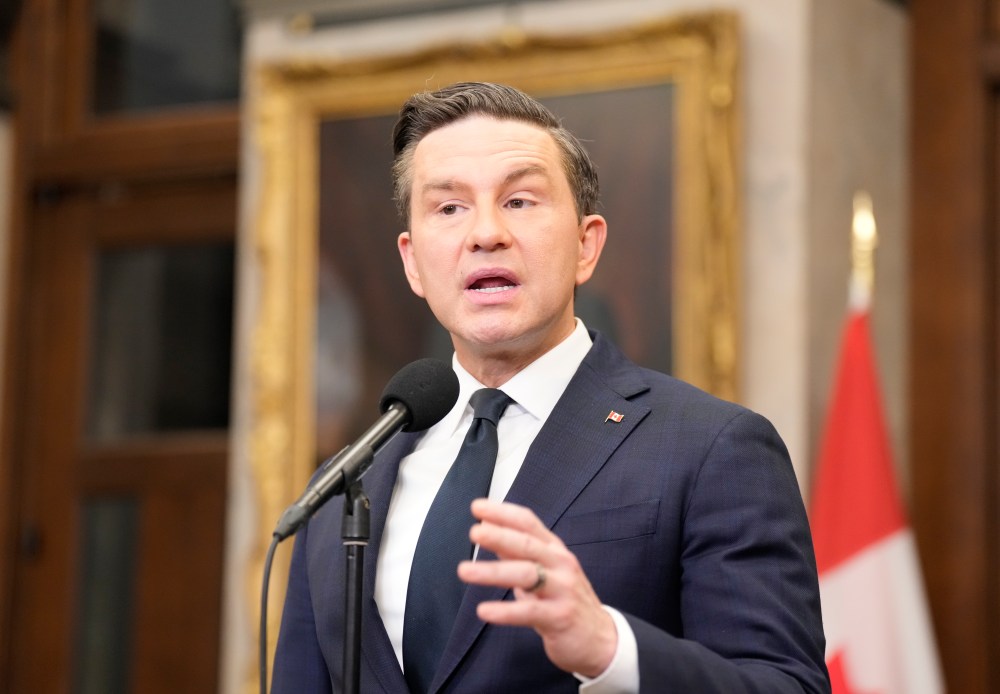
And no, I don’t mean the Economic Club of Canada in Toronto, where Poilievre made the comment above on Thursday morning.
A few months back, Canadian polling firm Abacus Data released the results of a survey, which suggested that a strong majority of Canadians — about 63 per cent — wanted Prime Minister Mark Carney to prioritize finding new trading relationships beyond the United States.
By comparison, only 27 per cent of respondents preferred to focus on preserving ties with the United States, with 11 per cent stating they were unsure either way.
While there was a partisan divide, it was not as extreme as it could have been, with 73 per cent of Liberals and 55 per cent of Conservatives backing further diversification of the economy.
Even more striking was the finding that 70 per cent of Canadians were willing to accept lower economic growth if it meant greater economic independence from the United States, with 31 per cent strongly in favour and 40 per cent somewhat in agreement.
The authors of the poll, which was conducted in conjunction with The Logic, stated that the results suggested “a shared appetite for economic resilience amid U.S. political uncertainty.”
Less than four months later, a Nanos Research poll conducted for the Globe and Mail and published this week, suggests Canadians currently view the United States as more of a risk than a partner. Respondents were asked whether they agreed with the statement, “The U.S. is a trustworthy ally of Canada,” to which more than 49 per cent disagreed and nearly 30 per cent “somewhat” disagreed. Only 9.2 per cent fully agreed with the statement.
“These are probably the worst numbers in any era where polling was done,” pollster Nik Nanos said to the Globe.
And we’re only a week past another Nanos Research Group poll for Bloomberg News that found 55 per cent of respondents believe that the U.S. poses the most risk to Canada’s security. Only 15 per cent of respondents said China was the greatest threat, and 14 per cent pointed to Russia instead.
In short, a majority of Canadians are fed up with the ongoing threats to Canada’s sovereignty and economy by U.S. President Donald Trump and the many GOP sycophants that he has surrounded himself with.
It was only Tuesday this week when United States Trade Representative Jamieson Greer told CBC News that if Canada wants a deal with Washington, our country would have to accept “some level of higher tariff” and also help to reshore American industries.
“If Canada wants to agree that we can have some level of higher tariff on them, while they open up their market to us in things like dairy and other things, then that’s a helpful conversation,” he said.
Those aspects of our economy that are not currently protected by CUSMA — steel and aluminum, alcohol, furniture, manufacturing, etc. — have been feeling the effects of ongoing tariff pressure imposed by Trump last year.
There is little doubt that Canada and the United States will continue to conduct trade between our two nations in some form or another, come what may with the Trump-imposed tariff threats. But it has become rather apparent that a great many of us really don’t feel like becoming the 51st U.S. state.
Go figure.
And to be frank, it’s worth restating that we have not joined a so-called “new world order” with China. Rather, Canada has been forced to respond to a new world order, and a rupture in our friendly with our southern neighbour that has been created and imposed upon the planet by a wayward and unpredictable U.S. administration.
We get that Poilievre is trying to offer an alternative view to Carney’s rather stark reality check that he offered the world at Davos last month, but he would have been better advised to urge caution when dealing with China and support diversification instead of pushing false narratives.
Pandering to the United States is not a good look for any Canadian leader right now — not when public sentiment is overwhelmingly negative against it. As such, this feels more like the Conservative leader is merely offering red meat to satiate — or placate — those elements of his political base that are Trump supporters.
This is important to note — according to a recent study by EKOS, at least half of self-described Conservative voters in Canada are significantly more likely to say they approve of Donald Trump. And a study by Angus Reid last June found that only 50 per cent of Conservative party voters say they’re proud to be Canadian.
Little wonder then that Poilievre has adopted Trump’s rhetoric, and taken a U.S.-friendly stance when it comes to Canada’s decisions on trade and commerce.
While it may keep hardline party faithful in line, this kind of political statement won’t get him into the prime minister’s office.
» Matt Goerzen, editor