
IAEA says Iran’s Natanz nuclear site suffered some damage, no radiological consequence expected
Advertisement
Read this article for free:
or
Already have an account? Log in here »
We need your support!
Local journalism needs your support!
As we navigate through unprecedented times, our journalists are working harder than ever to bring you the latest local updates to keep you safe and informed.
Now, more than ever, we need your support.
Starting at $15.99 plus taxes every four weeks you can access your Brandon Sun online and full access to all content as it appears on our website.
Subscribe Nowor call circulation directly at (204) 727-0527.
Your pledge helps to ensure we provide the news that matters most to your community!
To continue reading, please subscribe:
Add Brandon Sun access to your Free Press subscription for only an additional
$1 for the first 4 weeks*
*Your next subscription payment will increase by $1.00 and you will be charged $20.00 plus GST for four weeks. After four weeks, your payment will increase to $24.00 plus GST every four weeks.
Read unlimited articles for free today:
or
Already have an account? Log in here »
VIENNA (AP) — The United Nations’ nuclear watchdog said Tuesday Iran’s Natanz nuclear enrichment site sustained “some recent damage” amid a U.S.-Israeli airstrike campaign, though there was “no radiological consequence expected” from it.
The International Atomic Energy Agency said the damage was focused on “entrance buildings” to the underground portion of the atomic site.
Natanz earlier came under attack by the U.S. in the 12-day Iran-Israel war in June.
THIS IS A BREAKING NEWS UPDATE. AP’s earlier story follows below.
DUBAI, United Arab Emirates (AP) — Iran struck the U.S. Embassy in Saudi Arabia’s capital with a drone early Tuesday as it kept hitting targets around the region, while the United States and Israel pounded Iran with airstrikes in what U.S. President Donald Trump suggested was just the start of a relentless campaign that could last more than a month.
The attack from two drones on the U.S. Embassy in Riyadh caused a “limited fire” and minor damage, according to Saudi Arabia’s Defense Ministry, and the embassy urged Americans to avoid the compound. It followed an attack on the U.S. Embassy in Kuwait, which announced Tuesday it had been closed until further notice. The U.S. State Department also ordered the evacuation of non-emergency personnel and family in Kuwait, as well as Bahrain, Iraq, Qatar, Jordan and the United Arab Emirates as a precaution.
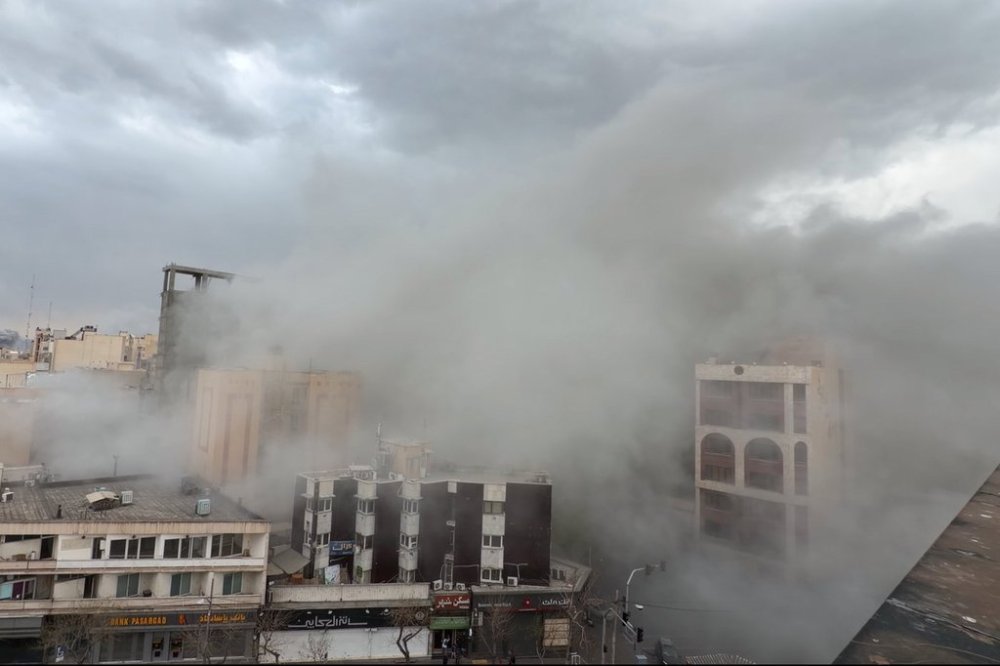
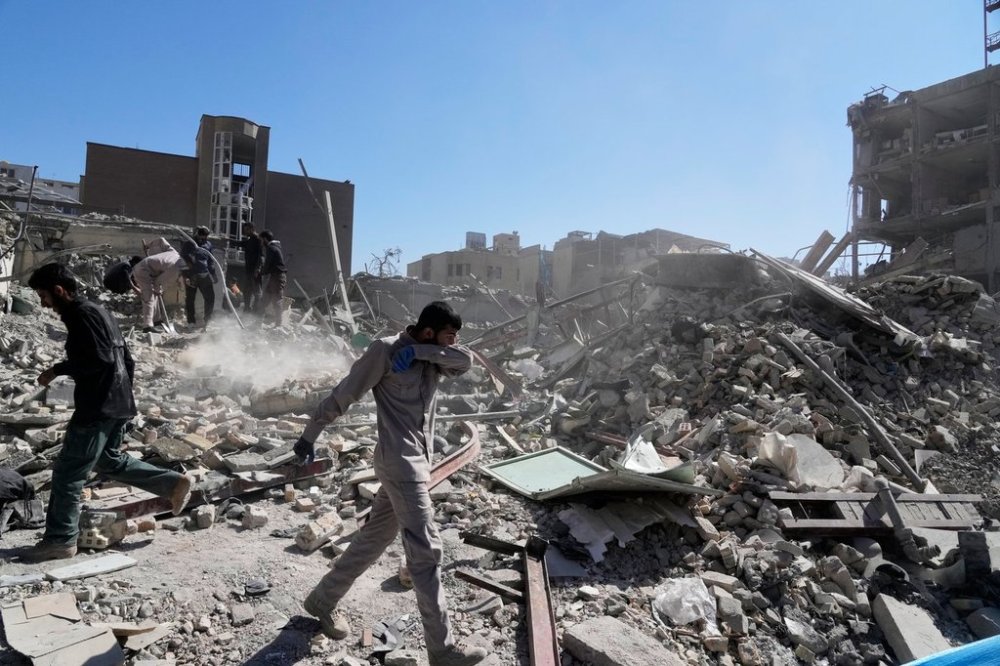
Across Iran’s capital, explosions rang out throughout the night into the early morning, with witnesses describing hearing aircraft overhead. It was not immediately clear what had been hit. And in Lebanon, Israel launched more strikes on Hezbollah, the Iran-backed militia group. Explosions could be heard and smoke seen in a southern suburb of Beirut. Israel also said its soldiers are “operating in southern Lebanon.” Lebanon’s state-run National News Agency said the Lebanese army was evacuating some of its positions along the border.
The conflict could have far-reaching consequences
The expansion of Iranian retaliation across the Gulf and the intensity of the Israeli and American attacks, the killing of Iranian Supreme Leader Ayatollah Ali Khamenei and the lack of any apparent exit plan portend a possibly prolonged conflict with far-reaching consequences.
Iran has hit many countries deemed safe havens in the Mideast in retaliation for the U.S. and Israeli strikes. Recent targets include two Amazon data centers in the UAE and a drone impact near another in Bahrain that caused damage, the company said Tuesday. Iran has also hit energy facilities in Qatar and Saudi Arabia, and attacked several ships Strait of Hormuz, the narrow mouth of the Persian Gulf through which a fifth of all oil traded passes, sending global oil and natural gas prices soaring.
“The Strait of Hormuz is closed,” declared Iranian Brig. Gen. Ebrahim Jabbari, an adviser to the paramilitary Revolutionary Guard, threatening to set fire to any ships attempting to transit. “Don’t come to this region.”
US citizens urged to leave
The U.S. State Department urged U.S. citizens to leave more than a dozen Middle Eastern countries due to safety risks, as have many other countries, though with much of the airspace closed many remain stranded.
Trump said operations are likely to last four to five weeks but that he was prepared “to go far longer than that.” He later added that the U.S. had a “virtually unlimited supply” of munitions and pre-positioned “high grade weaponry.”
“Wars can be fought ‘forever,’ and very successfully, using just these supplies,” he wrote on social media.
Hundreds dead in Iran and dozens in Lebanon along with 11 in Israel
The Iranian Red Crescent Society said the U.S.-Israeli operation has killed at least 787 people. In Israel, where several locations were hit by Iranian missiles, 11 people were killed. The semiofficial Tasnim news agency reported airstrikes killed 13 Iranian troops in Kerman, 800 kilometers (500 miles) southeast of Iran’s capital, Tehran.
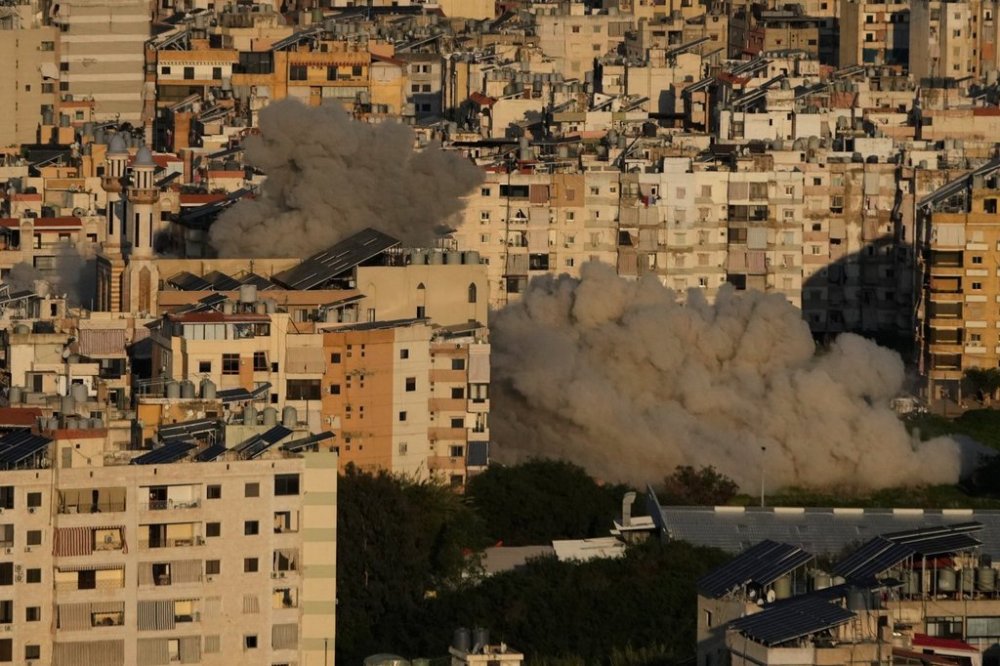
Israel’s retaliatory strikes against Hezbollah killed 52 people in Lebanon.
“Military escalation would force more families from their homes and hit civilians hard,” said Amy Pope, director general of the International Organization on Migration, calling for the international community to press for de-escalation. “Millions are already displaced in the region.”
The U.S. military has confirmed six deaths of American service members. All six were Army soldiers in a logistics unit in Kuwait, according to a U.S. official who was not authorized to comment publicly and spoke on condition of anonymity.
Three people were killed in the United Arab Emirates, and one each in Kuwait and Bahrain.
The chaos of the conflict became apparent when the U.S. military said Kuwait had “mistakenly shot down” three American fighter jets while Iran was attacking it with aircraft, ballistic missiles and drones. U.S. Central Command said all six pilots ejected safely.
Israel and US target nuclear facilities and missile infrastructure
Iranian state TV said strikes caused two explosions early Tuesday at a broadcasting facility in Tehran, but said no one was injured.
Reza Najafi, Iran’s ambassador to the International Atomic Energy Agency, told reporters that airstrikes targeted the Natanz nuclear enrichment site on Sunday.
“Their justification that Iran wants to develop nuclear weapons is simply a big lie,” he said.
Israel and the U.S. have not acknowledged strikes at the site, which the U.S. bombed in the 12-day war between Iran and Israel in June. Israel has said it is targeting the “leadership and nuclear infrastructure.”
Trump said the military campaign’s objectives are to destroy Iran’s missile capabilities, wipe out its navy, prevent it from obtaining a nuclear weapon and ensure that it cannot continue to support allied groups like Lebanon’s Hezbollah, which fired missiles at Israel on Monday.
Iran has said it has not enriched uranium since June, though it has maintained its right to do so and says its nuclear program is peaceful.
Israeli Prime Minister Benjamin Netanyahu maintained, however, that Iran was rebuilding “new sites, new places” underground for making atomic bombs. He offered no evidence to support his claim.
“We had to take the action now and we did,” Netanyahu told Fox News Channel’s Hannity.
Satellite photos analyzed by The Associated Press showed limited activity at two nuclear sites in Iran before the war. Analysts said Tehran was likely assessing damage from the 2025 U.S. strikes and possibly salvaging what remained.
Attacks on Iran have drawn in proxy forces from around region
The conflict has also spread to Lebanon, where the Iranian-supported militant group Hezbollah fired missiles at Israel on Monday, prompting Israel to retaliate.
At least 52 people have been killed and 154 wounded, Lebanese authorities said.
Israel hit Beirut with more airstrikes early Tuesday, saying it was targeting “Hezbollah command centers and weapons storage facilities.”
Hezbollah also said it launched drones targeting an Israeli air base. The Israeli military said it downed two drones.
An Iranian-linked militant in Iraq has also claimed strikes on U.S. military facilities there. The Israeli military said its troops operating in southern Lebanon were positioned at several points near the border in what it described as a “forward defense posture.”
It said the deployment is part of a broader effort to increase security for residents in northern Israel near the border with Lebanon. It has also beefed up troops and air defenses in the area.
The army said there are no plans to evacuate Israeli residents of border areas.
___
David Rising in Bangkok, Melanie Lidman in Tel Aviv, Israel, Hallie Golden in Seattle, and Giovanna Dell’Orto in Miami contributed to this report. Becatoros reported from Athens, Greece, and Magdy reported from Cairo.