
Carney in Australia to deepen trade and defence ties with ‘natural partner’
Advertisement
Read this article for free:
or
Already have an account? Log in here »
We need your support!
Local journalism needs your support!
As we navigate through unprecedented times, our journalists are working harder than ever to bring you the latest local updates to keep you safe and informed.
Now, more than ever, we need your support.
Starting at $15.99 plus taxes every four weeks you can access your Brandon Sun online and full access to all content as it appears on our website.
Subscribe Nowor call circulation directly at (204) 727-0527.
Your pledge helps to ensure we provide the news that matters most to your community!
To continue reading, please subscribe:
Add Brandon Sun access to your Free Press subscription for only an additional
$1 for the first 4 weeks*
*Your next subscription payment will increase by $1.00 and you will be charged $20.00 plus GST for four weeks. After four weeks, your payment will increase to $24.00 plus GST every four weeks.
Read unlimited articles for free today:
or
Already have an account? Log in here »
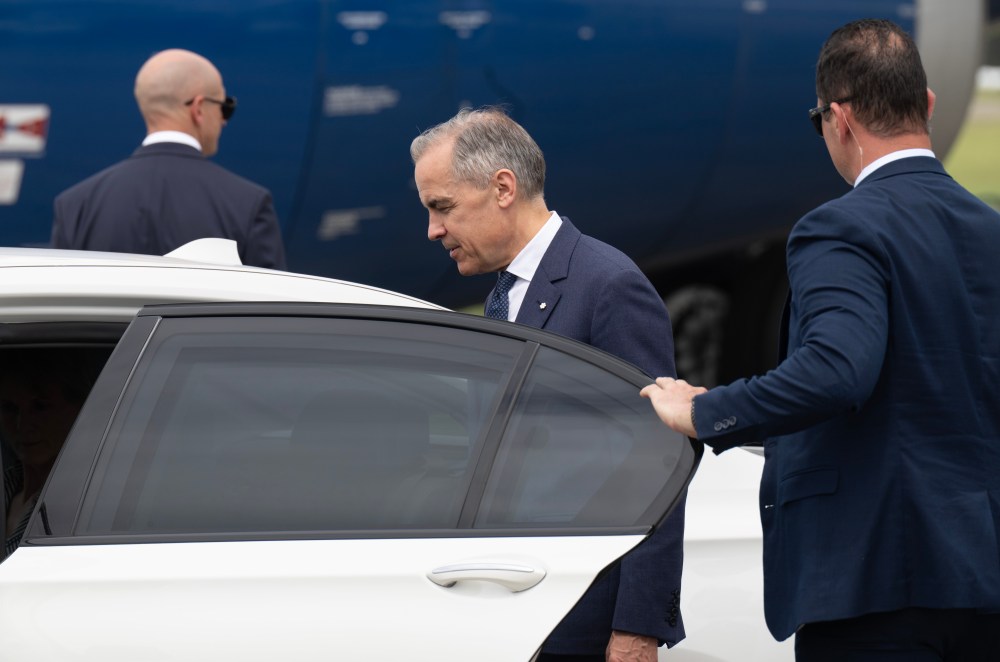
SYDNEY – Prime Minister Mark Carney is in Australia, where he says his government is focused on forging new partnerships in investment, defence, security, critical minerals and artificial intelligence.
“Australia is a natural partner for Canada in these areas and many, many more, areas that will deliver enormous benefits to both our peoples,” Carney said at a media availability in Sydney.
Finance Minister François-Philippe Champagne told reporters it was a “strategic visit at a strategic moment in history.”
Earlier in the day, he announced a co-operation agreement between Canadian and Australian pension funds.
The prime minister arrived in Sydney midday Tuesday local time, which was Monday evening in Canada. He is expected to meet with business leaders in Sydney — part of his government’s efforts to build on already strong intelligence ties through broader collaboration in trade and defence.
“This is a very important relationship for Canada to continue to build on. It is one that’s predicated on years of co-operation,” said Defence Minister David McGuinty, who is in Sydney with Carney.
He told reporters Canada is building the relationship with Australia on two tracks — a deeper economic connection and defence and security.
McGuinty said there is a “new openness here in Australia to work with Canada.”
“I would say that the prime minister’s outreach and indicating that there is another way for middle powers to come together and collaborate on the economy, on defence, on security, is a message that resonates very strongly,” he said.
While McGuinty held a media availability shortly after arriving in Sydney, Carney last held a news conference on Feb. 17, when he announced the new defence industrial strategy in Montreal.
It is unusual for prime ministers travelling abroad to not hold a news conference with accompanying journalists five days into a trip.
His silence comes as questions mount about transnational repression by India and after American strikes in Iran have set off a war involving multiple countries.
Carney’s office cancelled a Monday press conference in India following his meeting there with Prime Minister Narendra Modi. His office declined reporters’ requests to make him available to answer questions Tuesday.
On Thursday, Carney will head to Canberra to address the Australian Parliament. The prime minister will then leave for Tokyo.
Carney is set to meet with Australian Prime Minister Anthony Albanese, who has been in power since 2022. Both countries are Commonwealth nations and partners in the Five Eyes intelligence-sharing alliance, along with the U.S., U.K. and New Zealand.
“Australia obviously is a natural partner for Canada in the Indo-Pacific,” Asia Pacific Foundation vice-president Vina Nadjibulla said in a recent interview.
Both countries are commodity exporters. Nadjibulla noted that Beijing has swapped imports from one country to the other during times of friction — it bought Australian canola products when it restricted Canadian imports during a recent diplomatic row.
Among Indo-Pacific nations, Australia has been “by far the leading source” of foreign direct investment in both directions for Canada, particularly for Canadian pension funds, Nadjibulla said.
Canberra also has signed on to a handful of initiatives Canada has launched to shore up critical mineral supply chains and reduce western countries’ dependence on China. Nadjibulla said Canada could learn from an Australian initiative to stockpile certain strategically important critical minerals.
At the G20 summit in South Africa last November, Carney launched a partnership on emerging technologies with India and Australia. The three countries have offered little information on what that work will entail.
Ottawa and Canberra signed an agreement last year for Canada to buy an Australian over-the-horizon radar system for use in the Arctic. Nadjibulla said both countries could build on this through defence-industrial projects touching on cybersecurity or quantum technology.
Australia was among the nations Canada singled out last month in a new strategy to spend billions on defence.
The prime minister’s visit comes as he leads a push to get the European Union into some form of partnership with the Comprehensive and Progressive Agreement for Trans-Pacific Partnership, or CPTPP, a massive Pacific Rim trade bloc that includes Australia. Canada is a member of the CPTPP and has a trade agreement with the EU.
The idea is to sidestep the dysfunction Beijing and Washington have created at the World Trade Organization and have most other large economies trading with predictable rules, Nadjibulla said.
“In the absence of an overall multilateral framework, the best next option is this kind of smaller coalition of countries that are still interested in rules-based trade, and interested in upholding these values,” she said.
While Australia has been grappling with the erratic policies of U.S. President Donald Trump, Nadjibulla said it’s important to remember that Canada is far more integrated into the American economy by virtue of proximity.
“They’re less exposed to the volatility and unpredictability of Trump,” she said. “Public opinion is not as focused on President Trump in Australia. They’re much more focused on closer, regional issues vis-a-vis China and the threats of China in the Indo-Pacific.”
Nadjibulla said Canberra would be unlikely to take a strong stand against Washington. But she said Australia could be a guide for Canada as it seeks to boost economic and security ties with countries in Southeast Asia, where Ottawa has various trade deals signed or under negotiation.
“Australia has a lot more inroads in its relationships and Canada wants to do more. We can pool resources essentially, and bring more scale and more depth when we show up in that region, if we partner with Australia,” she said.
This report by The Canadian Press was first published March 3, 2026.
— With files from Dylan Robertson in Ottawa.