
Alberta teachers go to court seeking injunction on Charter notwithstanding case
Advertisement
Read this article for free:
or
Already have an account? Log in here »
We need your support!
Local journalism needs your support!
As we navigate through unprecedented times, our journalists are working harder than ever to bring you the latest local updates to keep you safe and informed.
Now, more than ever, we need your support.
Starting at $15.99 plus taxes every four weeks you can access your Brandon Sun online and full access to all content as it appears on our website.
Subscribe Nowor call circulation directly at (204) 727-0527.
Your pledge helps to ensure we provide the news that matters most to your community!
To continue reading, please subscribe:
Add Brandon Sun access to your Free Press subscription for only an additional
$1 for the first 4 weeks*
*Your next subscription payment will increase by $1.00 and you will be charged $20.00 plus GST for four weeks. After four weeks, your payment will increase to $24.00 plus GST every four weeks.
Read unlimited articles for free today:
or
Already have an account? Log in here »
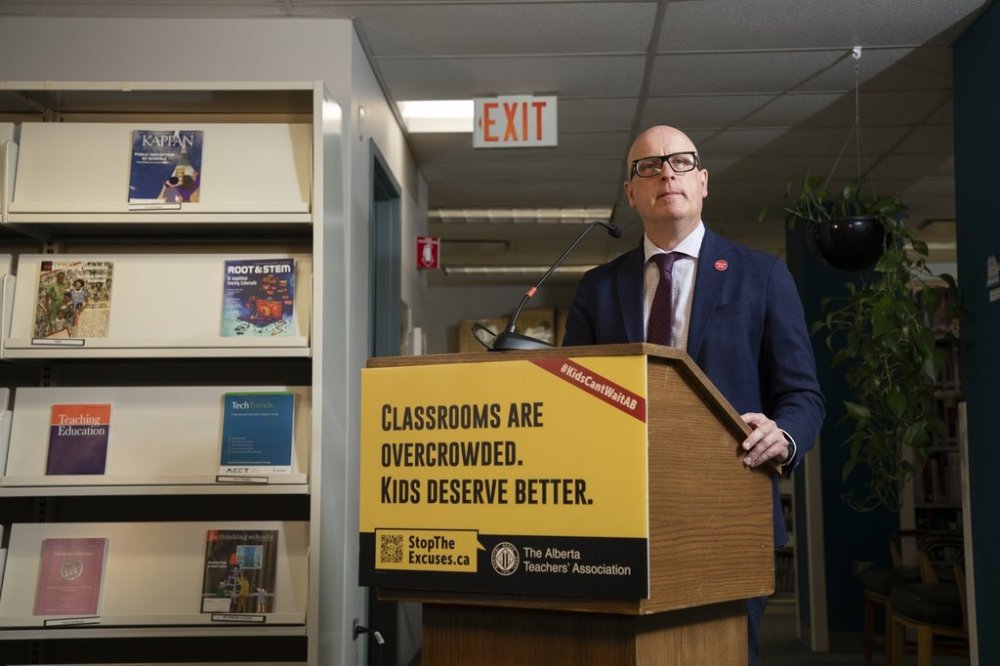
EDMONTON – Alberta’s teachers went to court Wednesday to fight the province’s back-to-work legislation, but their union president says if they win, it doesn’t necessarily mean their provincewide strike is back on.
Alberta Teachers’ Association president Jason Schilling says any decision on going back on strike would be up to the members.
The association was in court asking the judge to slap an interim injunction on legislation passed last fall by Premier Danielle Smith’s government to end the three-week strike.
The legislation also imposed on teachers a new deal with terms that rank and file members had previously rejected. And it invoked the Charter’s notwithstanding clause to override certain protected rights to ensure the legislation was not overturned in the courts.
The union argues that the use of the notwithstanding clause in this case was overly broad and invalid.
Outside court, Schilling said the government using the clause still stings.
“Teachers very much feel demoralized by the fact that this government took their Charter rights away,” Schilling told reporters.
“What steps (teachers) will want to take if we win this injunction, in terms of further job action to make sure that we are meeting the needs of our students, will be up to the membership when we get to that point.”
Schilling said the injunction would put teachers in the same legal position as they were before the strike.
He said an injunction would also mean the four-year contract imposed on them would be put on hold pending the full hearing of the constitutional challenge, which isn’t scheduled to take place until September.
Despite the court process for the union’s challenge just getting underway some four months after the government’s legislation passed, Schilling said teachers are still upset about how the strike ended and that he doesn’t think opposition to the bill has lost any momentum.
In court Wednesday, union lawyer Francesca Ghossein argued that Alberta’s use of the clause was invalid because it retroactively imposed a labour contract with a start date of September 2024, more than a year before the bill was tabled in the legislature.
The Supreme Court of Canada has ruled in the past, namely in a case involving the Quebec government in 1988, that the notwithstanding clause must only be used on a future-looking basis.
However, that same ruling upheld Quebec’s use of the notwithstanding clause, which involved the province tabling omnibus legislation that invoked the clause on every single existing law in Quebec.
Even so, Ghossein said in court that Alberta’s retroactive imposition of a labour contract “is an impermissible and invalid use of the notwithstanding clause.”
Ghossein and co-counsel Joël Michaud also touched on arguments that the government’s use of the notwithstanding clause impeded rights and freedoms that the clause isn’t allowed to touch, namely gender equality rights. The court heard that 75 per cent of teachers are women.
When it came to the argument that the government’s use of the clause was too broad, Michaud said Alberta had created a “constitutional black hole” by placing “the act and anything done pursuant to it beyond any review.”
The injunction hearing is expected to wrap up Thursday, after lawyers for the government make their arguments.
Heather Jenkins, the press secretary for Justice Minister Mickey Amery, said Wednesday the government will fully defend its position in court.
She pointed to a news release the government sent out last fall when it tabled the bill, and how Amery and Smith said invoking the clause was necessary as the province believed the strike was causing irreparable harm to students and parents.
“We stand by those statements and the legislation,” she said.
The union said it doesn’t expect a decision to be issued until later this month.
This report by The Canadian Press was first published March 4, 2026.