
VistaVision, a vintage format left for dead, is revived in ‘One Battle After Another’ and more
Advertisement
Read this article for free:
or
Already have an account? Log in here »
We need your support!
Local journalism needs your support!
As we navigate through unprecedented times, our journalists are working harder than ever to bring you the latest local updates to keep you safe and informed.
Now, more than ever, we need your support.
Starting at $15.99 plus taxes every four weeks you can access your Brandon Sun online and full access to all content as it appears on our website.
Subscribe Nowor call circulation directly at (204) 727-0527.
Your pledge helps to ensure we provide the news that matters most to your community!
To continue reading, please subscribe:
Add Brandon Sun access to your Free Press subscription for only an additional
$1 for the first 4 weeks*
- Enjoy unlimited reading on brandonsun.com
- Read the Brandon Sun E-Edition, our digital replica newspaper
*Your next Free Press subscription payment will increase by $1.00 and you will be charged $20.95 plus GST for four weeks. After four weeks, your payment will increase to $24.95 plus GST every four weeks.
Read unlimited articles for free today:
or
Already have an account? Log in here »
Hey there, time traveller!
This article was published 05/03/2026 (228 days ago), so information in it may no longer be current.
NEW YORK (AP) — When Paul Thomas Anderson told his cinematographer Michael Bauman that he wanted to shoot “One Battle After Another” on VistaVision — a large-scale film format born in the 1950s — he had some questions.
“Question one was: Is this even going to be reliable?” Bauman recalls.
For much of the past 60 years, the few remaining VistaVision cameras have been mostly collecting dust on shelves. Though the format was widely used in the 1950s, when Alfred Hitchcock shot “Vertigo” on it and Cecil B. DeMille used it for “The Ten Commandments,” VistaVision went dormant by the early 1960s.
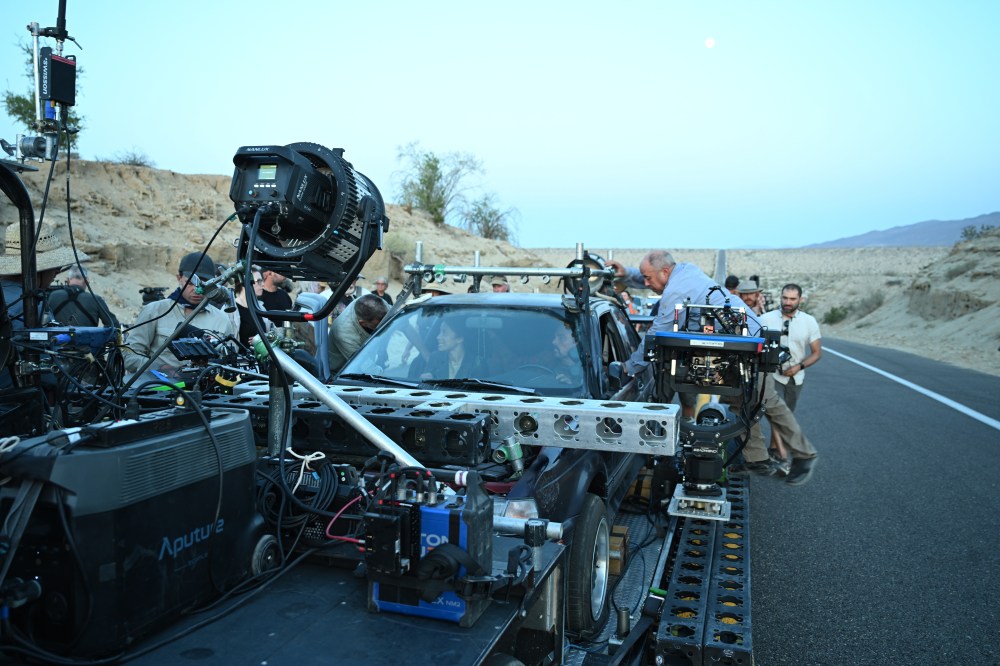
Yet at the March 15 Academy Awards, a movie made largely with decades-old antique cameras is poised to win best picture. Even in 2026, when most films are shot digitally and AI has begun filtering into moviemaking, “One Battle After Another” has — with film equipment borrowed from collectors and museums — showed that a vintage, analog film system can still astonish moviegoers.
“One Battle After Another” presented a major new test for an old format. A sprawling American epic filmed largely in dusty, rural locations, Bauman estimates it meant running 1.5 million feet of film through antique cameras.
But it turns out that VistaVision isn’t just holding up, it’s enjoying a big-screen revival. At last year’s Oscars, Lol Crawley won best cinematography for Brady Corbet’s “The Brutalist,” much of which was shot on VistaVision. This year, Bauman is nominated for the same award after shooting an even greater amount of “One Battle After Another” (he estimates 80%) on VistaVision.
First introduced by Paramount with 1954’s “White Christmas,” VistaVision has double the resolution of standard 35mm. Normal film stock is four perforations wide, but VistaVision is eight. To make a higher-resolution image, the film runs horizontally through the camera, instead of vertically.
Before “One Battle After Another,” the last film shot and projected on VistaVision was 1961’s “One-Eyed Jacks,” Marlon Brando’s sole directorial effort. But, with some notable exceptions (George Lucas shot the visual effects to 1977’s “Star Wars” in VistaVision), Hollywood moved on.
But now, VistaVision is back in a big way. After being impressed with it for parts of 2023’s “Poor Things” Yorgos Lanthimos and his cinematographer Robbie Ryan shot the best picture-nominated “Bugonia” on VistaVision. Emerald Fennell’s just-released “Wuthering Heights” was also made with VistaVision. Greta Gerwig turned to Vista for her upcoming “Narnia” movie. And Alejandro Iñárritu, with his celebrated director of photography Emmanuel “Chivo” Lubezki, shot the upcoming “Digger” with it.
“It’s a revitalization of a level of the craft of cinematography,” Bauman says. “Photochemical has got a strong voice in the room, still.”
The 1950s-set “The Brutalist” helped spark the revival.
“We were excited by the colors and the feeling and the weight of the camera,” Mona Fastvold, cowriter and producer of “The Brutalist,” said in an interview last year. “It limits how you move it and dictates the shots, which I think is something that also helps to transport you back to the period.”
VistaVision has its drawbacks. The camera (which looks sideways) is awkward and noisy. But for many filmmakers, the extra hassle is worth it for the beauty and clarity of the image it creates.
Just tracking down the equipment for “One Battle After Another” was a challenge, though. Much of “One Battle After Another” was shot on a camera owned by the actor Giovanni Ribisi. He’s long been enamored by the capabilities of the format and the tactile, vinyl-like nature of the camera. Years ago, Ribisi acquired a Beaumont VistaVision camera, a more mobile camera than traditional VistaVision cameras.
“It’s not something that you can just press a button and you just let it roll for two hours It fights back a little bit, maybe too much,” Ribisi says, chuckling. “You kind of have to earn it, and I like that.”
VistaVision and CinemaScope were both first introduced as way to combat the rise of television. VistaVision’s second life corresponds with a new age of anxiety for movies, where streaming and mega-sized flat-screen TVs have pushed films onto bigger and bigger screens.
Increasingly, film format is a selling point. Christopher Nolan and others have emphasized and promoted the use of IMAX cameras. Ryan Coogler’s “Sinners” was shot on 70mm. In the case of “One Battle After Another,” the movie was also projected in VistaVision, a first for a wide release movie in more than 60 years.
Only four theaters were able to do it. To project in VistaVision, the Coolidge Corner Theatre in Brookline, Massachusetts, went to unusual lengths, borrowing projectors that had been on display from the George Eastman Museum. At the Coolidge, audiences came in droves to see it on Vista, and “One Battle After Another” became the theater’s highest-grossing feature ever.
“People were incredibly interested to come out and see what the fuss was about,” says Mark Anastasio, artistic director at the Coolidge. “Everyone was asking to peak into the booth because we were truly using museum pieces.”
To fit the VistaVision projectors into the projection booth, the Coolidge had to remove every other piece of equipment. Electricians worked overnight to get the projectors ready in time.
“There were multiple spools carrying film all around the room,” says Anastasio. “Film was running up the wall, across the ceiling, across the projector horizontally. It just looks so wild and alien to everything we’ve seen before. It made the booth come alive.”