
US and Venezuela agree to reestablish diplomatic relations in major shift after Maduro’s ouster
Advertisement
Read this article for free:
or
Already have an account? Log in here »
We need your support!
Local journalism needs your support!
As we navigate through unprecedented times, our journalists are working harder than ever to bring you the latest local updates to keep you safe and informed.
Now, more than ever, we need your support.
Starting at $15.99 plus taxes every four weeks you can access your Brandon Sun online and full access to all content as it appears on our website.
Subscribe Nowor call circulation directly at (204) 727-0527.
Your pledge helps to ensure we provide the news that matters most to your community!
To continue reading, please subscribe:
Add Brandon Sun access to your Free Press subscription for only an additional
$1 for the first 4 weeks*
*Your next subscription payment will increase by $1.00 and you will be charged $20.00 plus GST for four weeks. After four weeks, your payment will increase to $24.00 plus GST every four weeks.
Read unlimited articles for free today:
or
Already have an account? Log in here »
CARACAS, Venezuela (AP) — The United States and Venezuela agreed to reestablish diplomatic relations in a major shift in a historically adversarial relationship, the State Department said on Thursday.
The move comes after rounds of Trump administration officials have visited the South American nation following a U.S. military operation that deposed former President Nicolás Maduro in January. Since then, the Trump administration has been stepping up pressure on Maduro loyalists now in power to accept its vision for the oil-rich nation.
Relations between the two countries were cut off in 2019, during the first Trump administration, in a decision by Maduro. They closed their embassies mutually after U.S. President Donald Trump gave public support to Venezuelan opposition lawmaker Juan Guaidó, who claimed to be the nation’s interim president in January that year. That prompted U.S. diplomatic staff to move to neighboring Colombia.
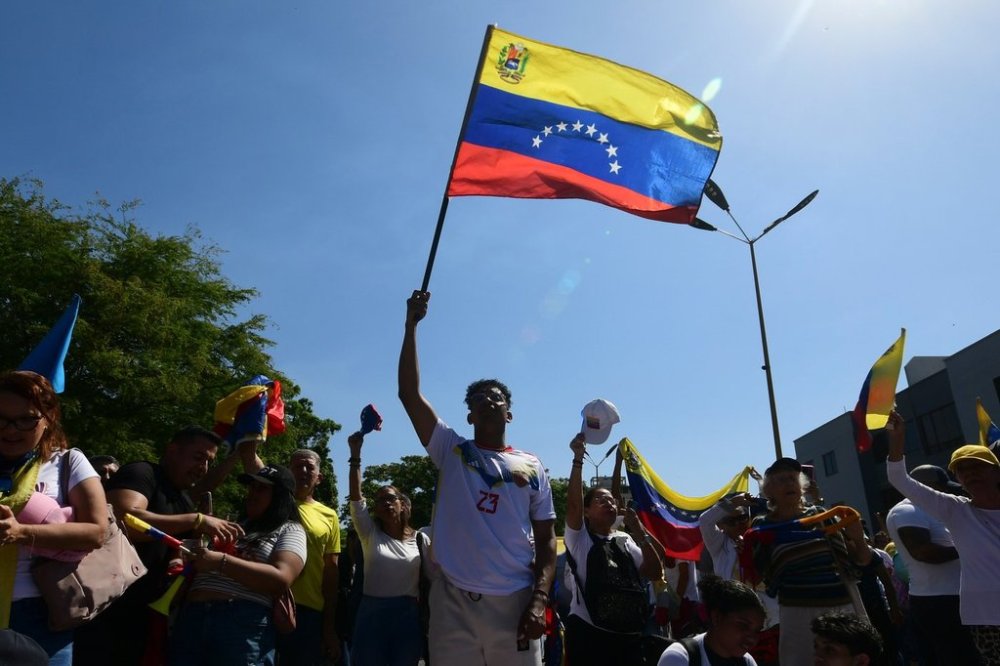
The State Department in a statement on Thursday said that talks between the countries were “focused on helping the Venezuelan people move forward through a phased process that creates the conditions for a peaceful transition to a democratically elected government.”
The announcement was made at the end of a two-day visit by U.S. Secretary of the Interior Doug Burgum to Venezuela. The visit largely focused on the country’s mining sector. It followed a February visit by Energy Secretary Chris Wright that centered on Venezuela’s oil potential. Both secretaries are aiming to shore up foreign investment to advance the administration’s phased plan to turn around the crisis-wracked nation.
Acting President Delcy Rodríguez, formerly Maduro’s vice president, said on state televisions that such steps “will strengthen relations between our two countries.”
Rodríguez’s government in a statement later expressed confidence that reestablishing diplomatic relations “will contribute to strengthening understanding and opening opportunities for a positive and mutually beneficial relationship.”
“These relations ought to result in the social and economic happiness of the Venezuelan people,” she said.
Since the unprecedented U.S. offensive in Venezuela, the Trump administration has pushed the government to make sweeping changes, including opening its oil sector to foreign companies. Rodríguez’s government also approved an amnesty law that has enabled the release of politicians, activists, lawyers and many others, effectively acknowledging that the government has held hundreds of people in prison for political motivations.
Trump stunned Venezuelans in and outside their home country with his decision to work with Rodríguez, instead of the political opposition, following Maduro’s ouster. On Sunday, Venezuela’s top opposition leader and winner of the 2025 Nobel Peace Prize María Corina Machado said that she will return to Venezuela in the coming weeks and that elections will be held in Venezuela.
Such seismic shifts would have been unthinkable just months before in the South American nation. Venezuela’s main political current, known as Chavismo, has been able to dodge curve balls thrown at it for years, from U.S. sanctions to spiraling economic crisis.
___
Janetsky reported from Mexico City.