
Oscar-winning ‘KPop Demon Hunters’ creator Maggie Kang wants Hollywood to get weirder
Advertisement
Read this article for free:
or
Already have an account? Log in here »
We need your support!
Local journalism needs your support!
As we navigate through unprecedented times, our journalists are working harder than ever to bring you the latest local updates to keep you safe and informed.
Now, more than ever, we need your support.
Starting at $15.99 plus taxes every four weeks you can access your Brandon Sun online and full access to all content as it appears on our website.
Subscribe Nowor call circulation directly at (204) 727-0527.
Your pledge helps to ensure we provide the news that matters most to your community!
To continue reading, please subscribe:
Add Brandon Sun access to your Free Press subscription for only an additional
$1 for the first 4 weeks*
*Your next subscription payment will increase by $1.00 and you will be charged $20.00 plus GST for four weeks. After four weeks, your payment will increase to $24.00 plus GST every four weeks.
Read unlimited articles for free today:
or
Already have an account? Log in here »
Still coming down from a marathon night of Oscars celebrations that stretched well past sunrise, Maggie Kang is already thinking about what her historic win could mean for filmmakers trying to break through.
“I have friends who have pitched movies that are very specific to their upbringing and their culture, and it’s a real struggle to get those films made,” Kang tells The Canadian Press.
“So I hope the success of our film allows studios to see that there’s space for this — and really big space. There’s a want. Audiences want to see something different.”
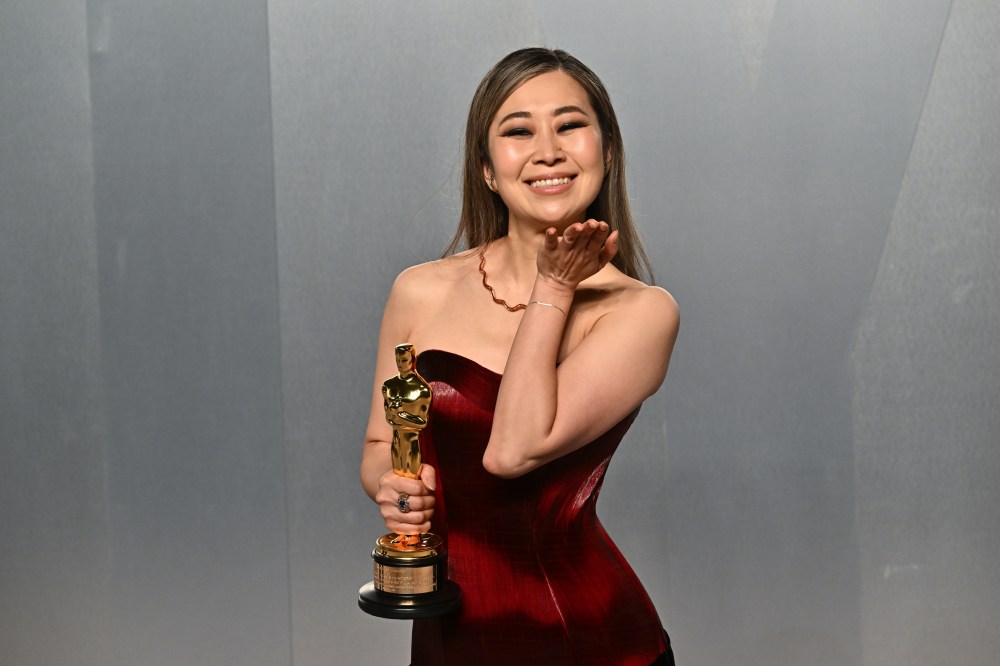
The Korean-Canadian filmmaker’s animated film “KPop Demon Hunters” won the Academy Award for best animated feature Sunday, making her the first woman of South Korean descent to ever win in the category.
The musical fantasy, which Kang wrote and co-directed, also made history with its hit single “Golden” — performed by Ejae, Audrey Nuna and Rei Ami as fictional group Huntrix — marking the first K-pop song to win best original song.
Kang celebrated the victory like she had a bone to pick with the morning sun.
“I didn’t get home until 5:30 in the morning,” she laughs in an interview Wednesday, recalling a string of after-parties following the ceremony.
She points to South Korean director Bong Joon Ho’s success with “Parasite,” which won the Oscar for best picture in 2020, as a moment that inspired her.
“To have done this in animation just feels like Korean artists have really solidified their space in Hollywood,” she says.
She’d now like to see more doors open for culturally specific storytelling in an industry that often treats it as a gamble. In December, Simu Liu told The Canadian Press he’s noticed representation backslide recently in Hollywood, with Asian-led projects once again deemed too “risky.”
Kang says she’s seen that hesitation “all across the board.”
“It’s not just Asian projects — when things get a little too specific, they’re just labelled as niche,” says Kang.
“It’s sad to hear that taking a risk on anything culturally specific, that’s not American culture, is a risk. But hopefully that starts to change. It’s difficult to get any movie made these days (when it’s) something that’s original.”
Kang adds studios are playing it safe “especially in animation, because our budgets are on the higher side of what gets produced in Hollywood.
“You’re asked to target every single demographic. But when you do that, you are appealing to nobody.”
She argues features like “KPop Demon Hunters” prove the payoff in risk-taking. Her film follows a K-pop girl group that moonlights as a secret defender of the world, slaying demons that feast on human souls.
The animated smash has become Netflix’s most-watched film of all time, totalling more than 540 million views since premiering last June.
Growing up as an immigrant in 1990s Toronto, Kang kept her love of K-pop to herself. She says the film sprang from her desire to tell a story rooted in her Korean heritage, mixing mythology, demonology and K-pop into an eccentric, visually distinctive tale.
“Pop music saving the world is pretty wackadoo. So I just wish studios were more willing to take chances on weird ideas,” says Kang, who studied animation at Sheridan College and was recruited as a story artist for DreamWorks in her third year.
“I always think, there’s no way a movie entitled ‘Teenage Mutant Ninja Turtles’ would ever be picked up these days. And look how long that franchise has sustained… We need more of that ’90s weirdness.”
Kang says plenty of opportunities are coming her way. She’s focused on making the “KPop Demon Hunters” sequel, which Netflix has greenlit.
With it, she aims to lean even more into her singular sensibility, which her directing partner Chris Appelhans describes as “a mashup of Kurosawa and Homer Simpson.” Kang and Appelhans accepted the best animated feature award alongside producer Michelle L.M. Wong.
“What we strive to do with this film is make people feel all the emotions — the deep, dark ones as well as the very sweet ones — but also do stuff that’s really stupid and silly,” she explains.
“The success of this makes me want to push the boundaries of that more and take more risks and do something even weirder.
“There’s so much more that we can do with these characters, with the mashup of the different tones.”
While some reports say the sequel is set to arrive in 2029, Kang wouldn’t confirm a date, saying “we don’t want to rush it.”
“It’s going to take as long as it needs to take. I think everybody can look to the ‘Spider-Verse’ movies — they’re great for a reason, because they take a long time to cook. We want this film to be just as amazing or even more so than the first one. And to do that, it takes time.”
Looking back, Kang says her younger self might not be entirely surprised by where she’s landed.
“I think deep down, she would have known that she could do something like this. I’ve always believed and manifested things in my life… There was a spark there.”
Now, she wants that belief to carry forward.
“I hope other girls seeing me in this position can believe that they can do things too.”
This report by The Canadian Press was first published March 19, 2026.