
City’s pothole season in full swing
Advertisement
Read this article for free:
or
Already have an account? Log in here »
We need your support!
Local journalism needs your support!
As we navigate through unprecedented times, our journalists are working harder than ever to bring you the latest local updates to keep you safe and informed.
Now, more than ever, we need your support.
Starting at $15.99 plus taxes every four weeks you can access your Brandon Sun online and full access to all content as it appears on our website.
Subscribe Nowor call circulation directly at (204) 727-0527.
Your pledge helps to ensure we provide the news that matters most to your community!
To continue reading, please subscribe:
Add Brandon Sun access to your Free Press subscription for only an additional
$1 for the first 4 weeks*
*Your next subscription payment will increase by $1.00 and you will be charged $20.00 plus GST for four weeks. After four weeks, your payment will increase to $24.00 plus GST every four weeks.
Read unlimited articles for free today:
or
Already have an account? Log in here »
Brandon crews are at work repairing potholes with brooms, shovels and asphalt as fluctuating weather causes havoc on city streets.
Workers started repairing potholes about three weeks ago and will likely continue at a steady pace into June.
One or two trucks, each with two workers doing repairs, are out each weekday fixing roads.
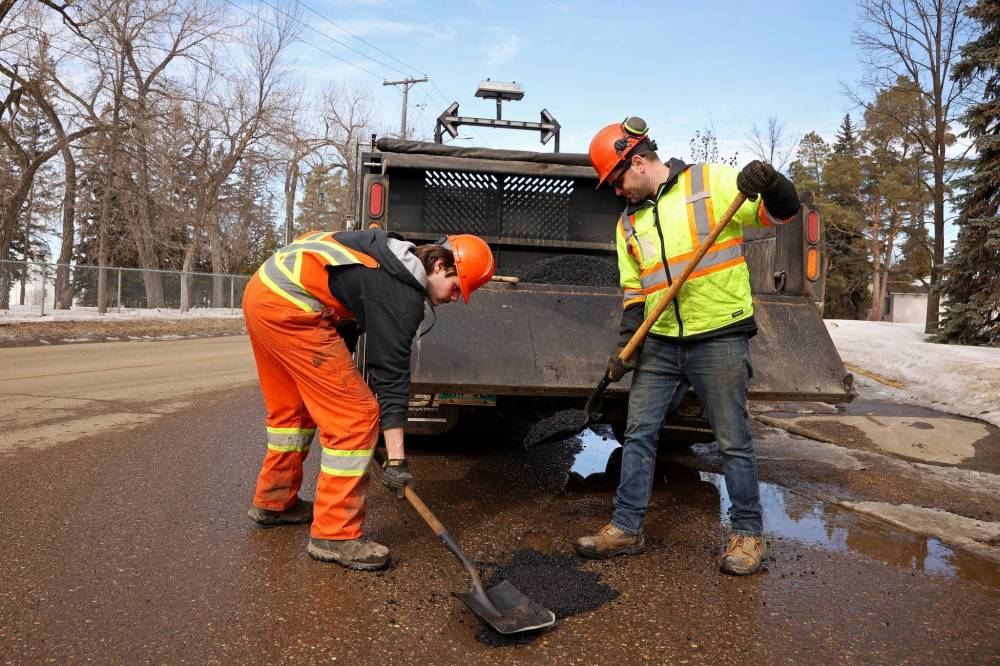
Cole Mulligan, a casual labourer for the City of Brandon, and Jordan Werbowski, an E2 operator with the city, fill potholes along Queens Avenue at 13th Street on a mild Thursday. City crews are in their third full week of pothole repairs. (Tim Smith/The Brandon Sun)
“I think we’re keeping up with things pretty good,” chargehand of streets and roads Chris Jolliffe said on Thursday, standing next to a two-man crew filling potholes along Queens Avenue.
“But with this nice weather and all this moisture, you’re going to see them popping up a lot (and) quickly,”
Workers apply cold-patch mix during the spring. During the warmer season, they use hot mix for longer-lasting repairs.
A worker will sweep water and moisture out of the hole and shovel in the mix before gently pressing it inside. Crews will later “tire-pack” the pothole, Jolliffe said.
“Basically, the drier it can be, the more fighting chance is there that that’ll stay in there,” he said.
“That’s just the best we can do, unfortunately, with all the moisture running off the road. But sweeping out just gives it the best shot to hold them up for as long as possible.”
Cold-patching can sometimes last a long time if set in a completely dry hole, but often will pop back out and need to be redone, with leftover excess material needing to be scraped away from the edges of the pothole. The process of scraping material out is more common on busier streets.
Crews typically start the morning with a meeting, where they outline which streets will be fixed during the day. Priority is given to main roads, including 26th and 34th streets, and Park Avenue.
“Any busy street you can think of, really, that’s kind of what comes as a priority, not that we don’t check out the secondary streets, because they can become an issue as well,” Jolliffe said.
Provincial highways, including 18th Street and part of First Street, along with parts of Victoria and Richmond avenues, are repaired by the province.
Jolliffe said the city will communicate with the province if it receives a complaint about a pothole on a provincial road.
This year’s pothole season “isn’t bad” so far, he said, adding that the city isn’t in the thick of it yet.
“Things will get a bit worse here, for sure, but I don’t expect it to be anything out of the ordinary, really,” he said.
“We’re ready for it, you know — mentally prepared, physically prepared for it. So, it’s no real surprise … Just more or less a waiting game until it happens.”
Jordan Werbowski, an E2 operator with the city who was out fixing potholes Thursday afternoon, said the cold patches needing to be redone is “the name of the game.”
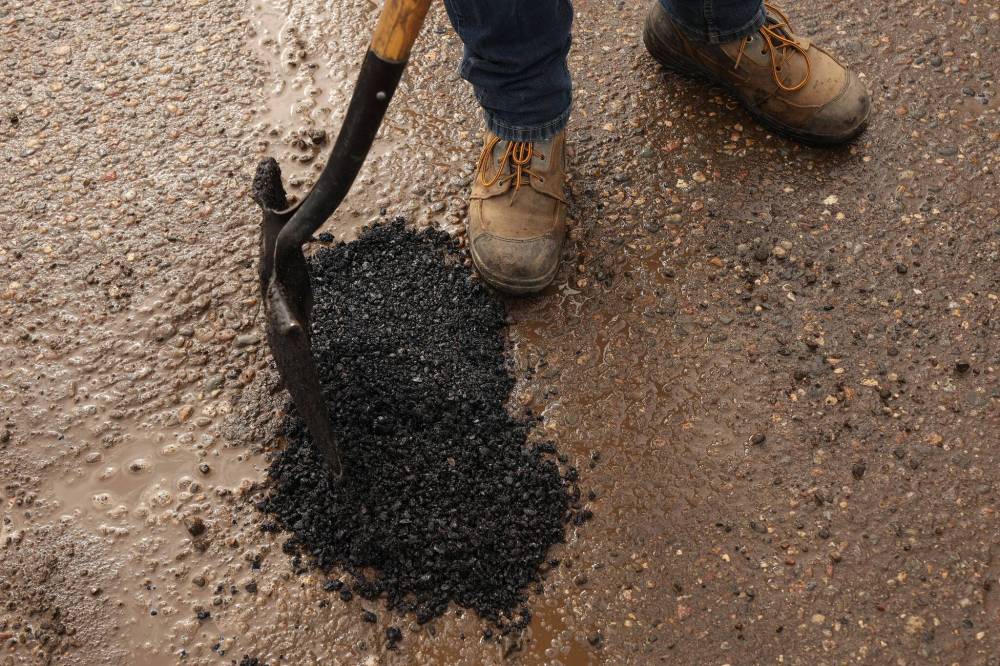
A city worker fills a pothole on Queens Avenue. (Tim Smith/The Brandon Sun)
“It gets a little tedious in the springtime, just because all the moisture and all the water coming into the cold mixture — it doesn’t stay,” Werbowski said.
“So we’re doing the same spots a lot, over and over.”
He said the process isn’t typically difficult, but the mix can chunk up in the cold. Brandon’s high of about 4 C while he was working allowed the process to be “very easy.”
The job would be tiring if he was doing the same thing every day, Werbowski said, but crews are switched out for other tasks, including snow clearing.
Jolliffe said the city received new equipment late last year that will help keep potholes repaired for longer, though it’s only available for the hot mix, which is started when the weather is appropriate, typically in mid-May.
Crews will be able to spray the pothole with a type of oil, put the hot mix in and pack it down with vibratory rollers. The oil has to be heated up to a certain temperature to be effective, he said.
The process of redoing a hole and scraping away the mix that popped out is far less common with the hot mix, he said.
“That issue is eliminated. It sticks in the hole a lot better.”
The new oil works better than the old hot mix because it seals the hole better, not allowing moisture to seep into the asphalt, weakening it over time.
“It’s like a vapour barrier, water barrier — it seals the hole up,” Jolliffe said. “It’s like sticky tack … It helps the asphalt adhere in the hole.”
He said the new equipment “absolutely” makes a difference, both in the longevity of the repair and making sure the pothole won’t get worse.
» alambert@brandonsun.com