
Lawyers for Quebec government tell Supreme Court that Bill 21 is legitimate
Advertisement
Read this article for free:
or
Already have an account? Log in here »
We need your support!
Local journalism needs your support!
As we navigate through unprecedented times, our journalists are working harder than ever to bring you the latest local updates to keep you safe and informed.
Now, more than ever, we need your support.
Starting at $15.99 plus taxes every four weeks you can access your Brandon Sun online and full access to all content as it appears on our website.
Subscribe Nowor call circulation directly at (204) 727-0527.
Your pledge helps to ensure we provide the news that matters most to your community!
To continue reading, please subscribe:
Add Brandon Sun access to your Free Press subscription for only an additional
$1 for the first 4 weeks*
- Enjoy unlimited reading on brandonsun.com
- Read the Brandon Sun E-Edition, our digital replica newspaper
*Your next Free Press subscription payment will increase by $1.00 and you will be charged $20.95 plus GST for four weeks. After four weeks, your payment will increase to $24.95 plus GST every four weeks.
Read unlimited articles for free today:
or
Already have an account? Log in here »
OTTAWA – The Quebec government is urging the Supreme Court of Canada to uphold a controversial secularism law, arguing that the Constitution allows the province to override the Canadian Charter of Rights and Freedoms.
The case revolves around the law, adopted in 2019, that banned some public sector workers from wearing religious symbols on the job, including judges, police officers and teachers.
Quebec pre-emptively used its powers to override the Charter when it adopted the law, and the court challenge could have implications for how other provinces handle similar cases.
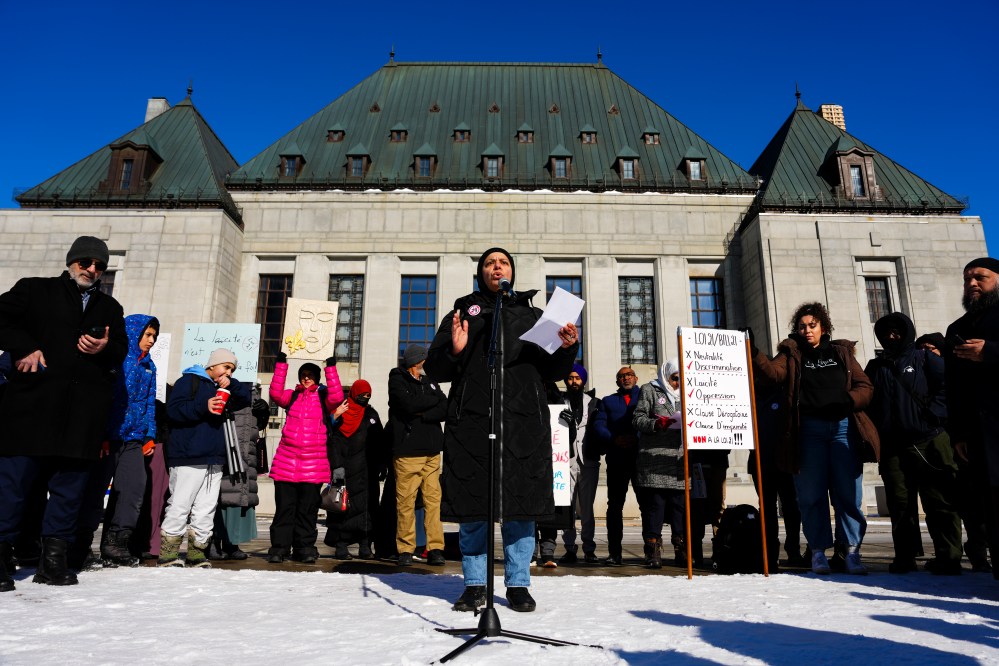
The federal and provincial governments can override the Charter if they invoke what is known as the notwithstanding clause of the Constitution.
Isabelle Brunet, a lawyer representing Quebec in the case, told the court on Tuesday that this means Quebec can use this provision, without needing to justify the content of their legislation, since the notwithstanding clause effectively shields the law from court scrutiny.
Brunet also said the courts should not be used to meddle in a Quebec political debate, saying they should not become “an instrument enabling those who oppose certain legislative measures to evade them.”
During the hearing, Brunet also argued with Justice Nicholas Kasirer over whether the top court could uphold the Quebec law while stating in their ruling that the province was violating a Charter right.
While Brunet argued that making an non-binding declaration in a ruling would be “useless” and an overreach by the court, Kasirer said there was nothing in written law preventing them from doing so.
On Monday, lawyers for the groups challenging Bill 21 told the court that the law goes too far in circumventing Charter rights and is unconstitutional.
Brunet argued that a previous Supreme Court ruling from 1988 confirmed that the Constitution doesn’t place substantive limits on how a government invokes the notwithstanding clause. Those challenging Bill 21 asked the court to revisit that decision.
Brunet and her colleague Samuel Chayer also pushed back against arguments brought forward on Monday by lawyers representing the English Montreal School Board, the main appellant in the case
The appellants’ lawyers argued Bill 21 infringes on Charter rights not covered by the notwithstanding clause, including minority language rights and gender equality. They also argued some of Bill 21’s provisions are under federal jurisdiction.
Chayer stressed only elements related to language itself, and not cultural ones, are covered by the Charter. Chayer added that the gender equality provision of the Charter says rights must be applied equally for men and women. He said Quebec’s secularism bill meets this test.
Following the arguments from Quebec’s Attorney General, lawyers representing pro-secularism parties pleaded their case on the contents of the law. Most arguments focused on the provisions targeting teachers and impacts on Muslim women.
Luc Alarie, for the Mouvement laïque québécois, an advocacy group promoting secularism, invoked parental rights, saying parents can choose to send their children to a school free of religious influence.
Christiane Pelchat, lawyer for women’s group Pour les droits des femmes du Québec argued the head coverings worn by Muslim women are inherently patriarchal and discriminatory. She said Bill 21 is “necessary to ensure gender equality.”
The hearings are expected to last until Thursday.
This report by The Canadian Press was first published March 24, 2026.
— By Erika Morris in Montreal