
Westman vet applauds efforts to improve rural care
Advertisement
Read this article for free:
or
Already have an account? Log in here »
We need your support!
Local journalism needs your support!
As we navigate through unprecedented times, our journalists are working harder than ever to bring you the latest local updates to keep you safe and informed.
Now, more than ever, we need your support.
Starting at $15.99 plus taxes every four weeks you can access your Brandon Sun online and full access to all content as it appears on our website.
Subscribe Nowor call circulation directly at (204) 727-0527.
Your pledge helps to ensure we provide the news that matters most to your community!
To continue reading, please subscribe:
Add Brandon Sun access to your Free Press subscription for only an additional
$1 for the first 4 weeks*
- Enjoy unlimited reading on brandonsun.com
- Read the Brandon Sun E-Edition, our digital replica newspaper
*Your next Free Press subscription payment will increase by $1.00 and you will be charged $20.95 plus GST for four weeks. After four weeks, your payment will increase to $24.95 plus GST every four weeks.
Read unlimited articles for free today:
or
Already have an account? Log in here »
SOURIS — A Westman veterinarian is commending the province for efforts to improve Manitoba’s model of veterinarian care in rural areas.
A few problems with the current subsidized model make it hard to recruit veterinarians, invest in equipment, and create a good work-life balance, said veterinarian Haley Adams, who provides vet care in Souris and Boissevain. Adam’s comments to the Sun came during a meeting where she and other locals gathered in Souris to brainstorm solutions that will be reported to the provincial government.
The agriculture minister for Manitoba, Ron Kostyshyn, has asked for meetings to be held in rural Manitoba discussing the current veterinary care model. He has also asked that the feedback from Manitobans be built into an options report on how to improve the Veterinarian Services District and Veterinarian Services Commission model.
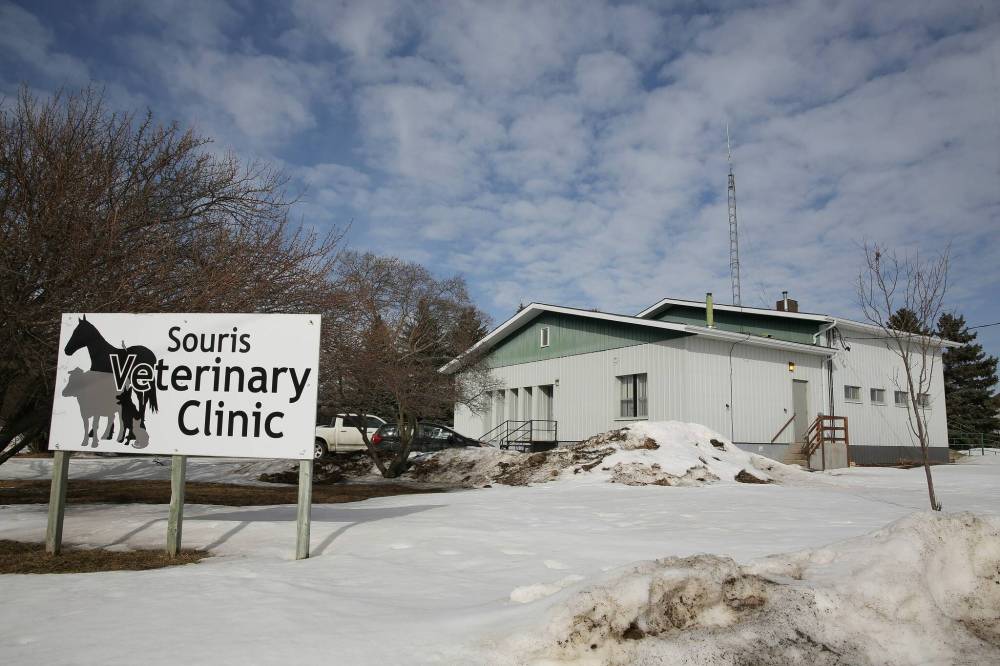
The Souris Veterinary Clinic is one of roughly two dozen clinics in Manitoba operated under a Veterinary Services District model. The model is being reviewed this year as the Minister of Agriculture, Ron Kostyshyn, looks for potential updates to the 50-year-old system. (Connor McDowell/The Brandon Sun)
“Mainly, what I’m taking away from today, is that I am glad that the rural municipalities and the province are acknowledging that something does need to change,” Adams said. “I think this meeting was well timed, in that we really need to look at the structure of this model.”
The Veterinarian Services District model was established in the 1970s. The model subsidizes veterinary clinics in rural Manitoba by having the Province of Manitoba and local municipalities pay costs such as equipment purchases, building repairs, and taxes. The goal is to sweeten the deal so that veterinarians practice in rural Manitoba, where the agriculture sector requires timely care of large animals.
Due to its age, along with persisting shortages of veterinary staff in rural Manitoba, the model is being reviewed for potential updates. Adams was one of roughly three dozen locals to attend the meeting in Souris.
The community raised a few great points of discussion, Adams told the Sun. She said that she liked to hear about possibilities for veterinarians to gain partial ownership of their subsidized practice, receive help recruiting new staff, and consider hubbing their practices in centralized areas.
“I thought those were some really good ideas that were discussed today.”
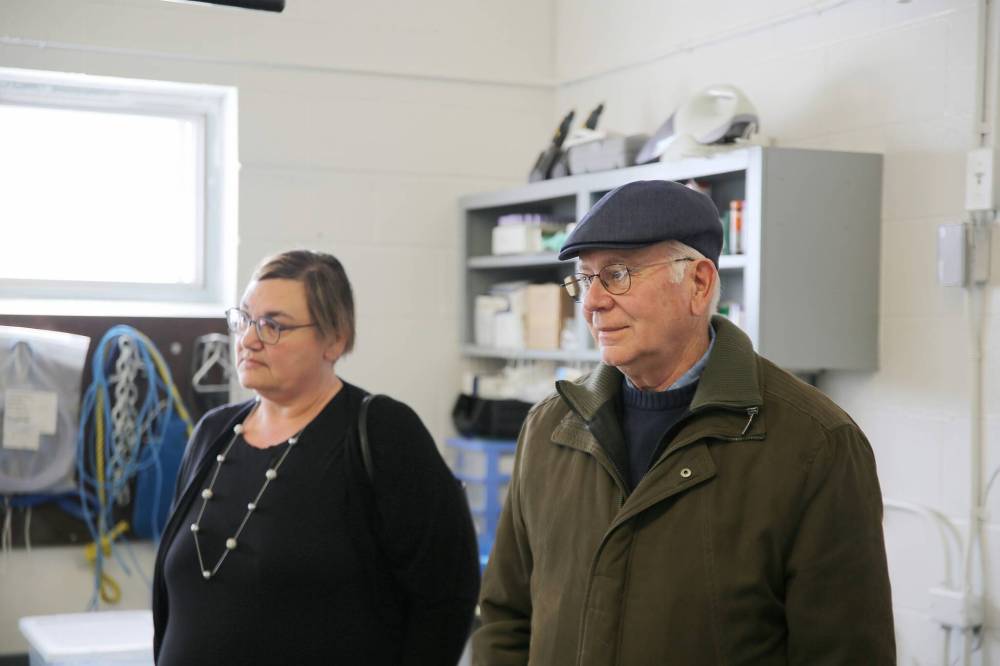
Wayne Lees (right), chairperson of the Veterinarian Services District Working Group, visits the Souris Veterinarian Clinic in mid March. Lees spent the afternoon consulting with roughly three dozen community members about how to potentially update the district service model, which sees this building owned and subsidized by a local board, rather than the practicing veterinarian. (Connor McDowell/The Brandon Sun)
Attendees at the meeting included veterinarians, provincial staff, livestock farmers, producer group representatives and council members. Roughly an hour and a half of open discussion took place with provincial staff taking notes that will be distilled into a report for Kostyshyn this fall.
The meeting in Souris was one of five scheduled in March and April at the behest of Kostyshyn, who created a working group in December to collect feedback.
“We needed to have the task force get out and talk to the rightful people directly involved,” Kostyshyn told the Sun in a recent interview. “The veterinarian services are very key in the rural components, and given where we are in the beef sector, large animal practices, there’s a need for maintaining those numbers in the rural landscape.”
Veterinary care has come up as an ongoing concern at the Association of Manitoba Municipalities, Kathy Valentino, AMM president, told the Sun. She said the association welcomes the review this year.
The AMM has been tasked by communities in Manitoba to lobby the province to relax immigration requirements so that immigrants can more easily practice as veterinarians; to lobby the province so that veterinarians are required to return to Manitoba for a three-year period including large animal practices; to lobby the province to create a veterinarian college within Manitoba; and to lobby the province to increase funding to Veterinarian Service Districts.
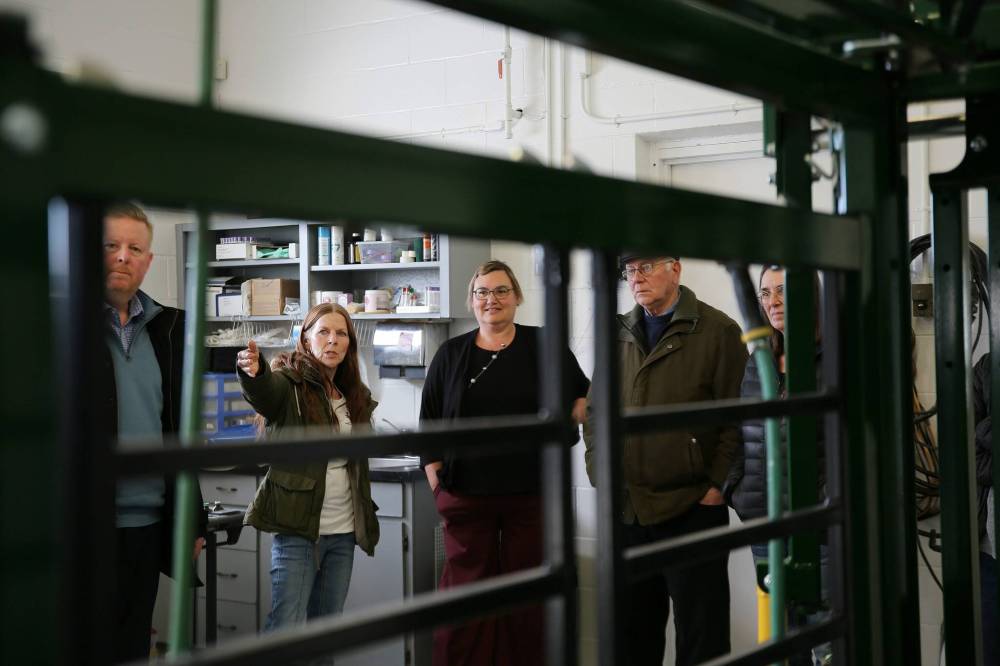
Haley Adams, a veterinarian in Souris and Boissevain, points to large animal equipment in the back of the Souris Veterinary Clinic as she tours the facility. The site was visited in mid March by members of a working group who have been tasked to collect feedback for review and potentially updating the model of veterinary service delivery in rural Manitoba. (Connor McDowell/The Brandon Sun)
According to The Manitoba Veterinary Medical Association, shortages were at a crisis level in 2024. It wrote that there veterinarians and support staff were at troubling vacancy levels.
“The MVMA asserts that the shortage of veterinary professionals is at crisis levels and that immediate action is required.”
At least 68.2 full-time equivalent veterinarian positions and 79.75 full-time equivalent technologist positions were unfilled and were needed to meet demand in the private clinic sector alone at the time.
Shortages are still top of mind this year as the working group consults with rural Manitobans, said working group member and RM of Sifton councillor Scott Phillips in a recent interview with the Sun. He added financial costs are a large concern.
“It comes down to more vets,” Phillips said. “How are we going to get more vets, and how are we going to turn dimes to dollars?”
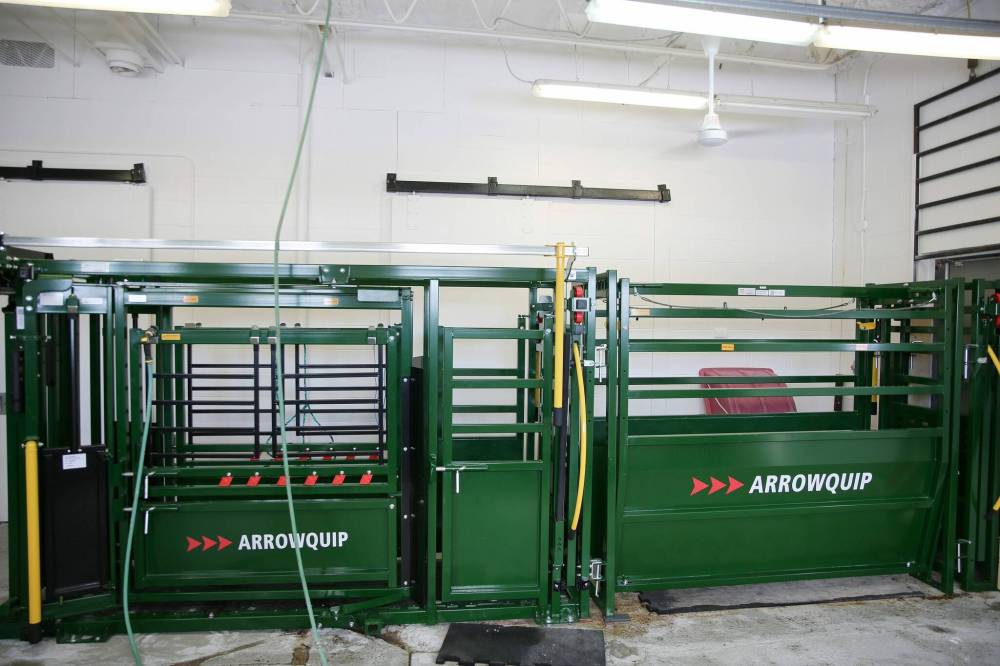
Equipment for managing large animals, such as cattle, in the back of the Souris Veterinary Clinic. A number of rural Manitoban residents need access to large animal veterinary services for assistance with farming. (Connor McDowell/The Brandon Sun)
Awareness is also important, he said.
“We gotta get the youth understanding that there is a demand for large animals, and there is a practice for it.”
Group member Merv Starzyk agreed, saying that many students and recent graduates have no idea the level of support they would receive in the subsidized model should they practice in rural Manitoba.
“When I hit them with the question, ‘Would you consider taking over a clinic?’ They say, ‘Well, no, we couldn’t afford to buy it and all that stuff,” Starzyk said. “You got to tell these students how it works.”
More effort should go into educating young veterinraians that their bills will be subsidized, such as hydro, heat, taxes, and phone lines, he said.
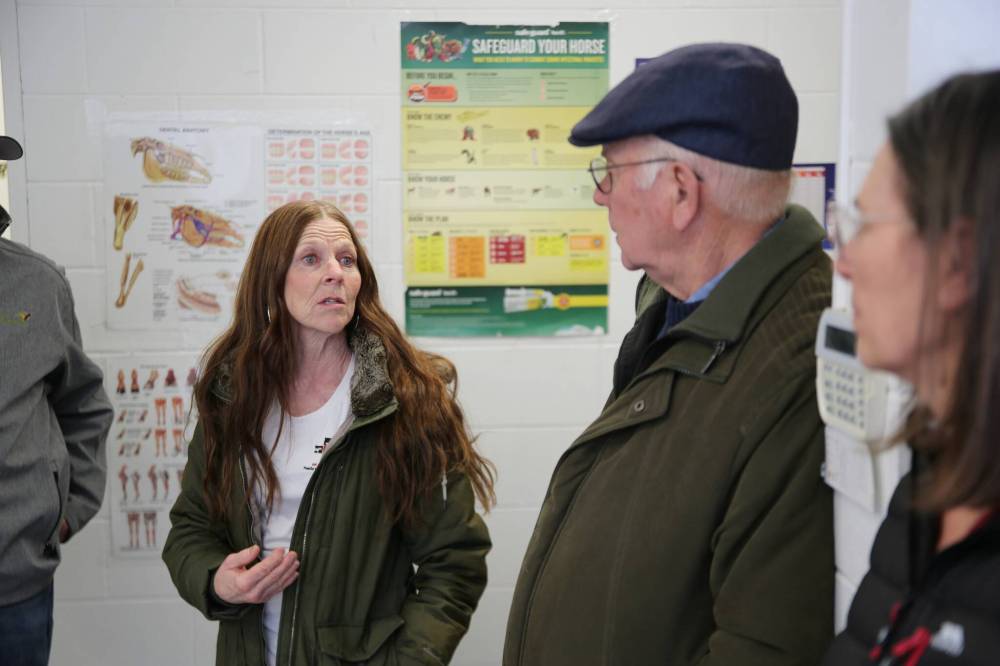
Haley Adams, a veterinarian at the Souris Veterinary Clinic, speaks with a member of the Veterinary Services District Working Group while touring the clinic. Adams said she welcomes the current efforts from the Province of Manitoba to hear from rural Manitobans about how subsidized vet clinics may be changed to operate more effectively. (Connor McDowell/The Brandon Sun)
While the subsidized model has benefits, it also has downsides, Adams said. Practical challenges exist that prevent veterinarians from investing into their clinics, and prevent new recruits from taking interest, she said.
It’s difficult to recruit graduates to a small rural clinic where they may be the only veterinarian, and on-call a large amount of time, she said — graduates are looking for more support out of school.
Because vet clinics are funded by boards in rural communities, she said, the vet needs permission as well as funding to repair equipment, and to purchase new machinery that is needed. This can prevent vets from investing in the clinic — and she believes there could be tweaks to allow partial ownership, or buyout options for vets so that they are incentivized to invest in their clinic.
“It’s not necessarily meeting the needs of today,” Adams said. “A lot of things have changed since all these practices were built.”
Several councillors from Westman told the Sun that the cost of supporting subsidized vet clinics is unsustainable, especially as aging infrastructure prompts the need for repairs. Many rural vet practices were built in Manitoba using a similar blueprint in the 20th century, and many structures are approaching old age today, with repair bills looming on the horizon.
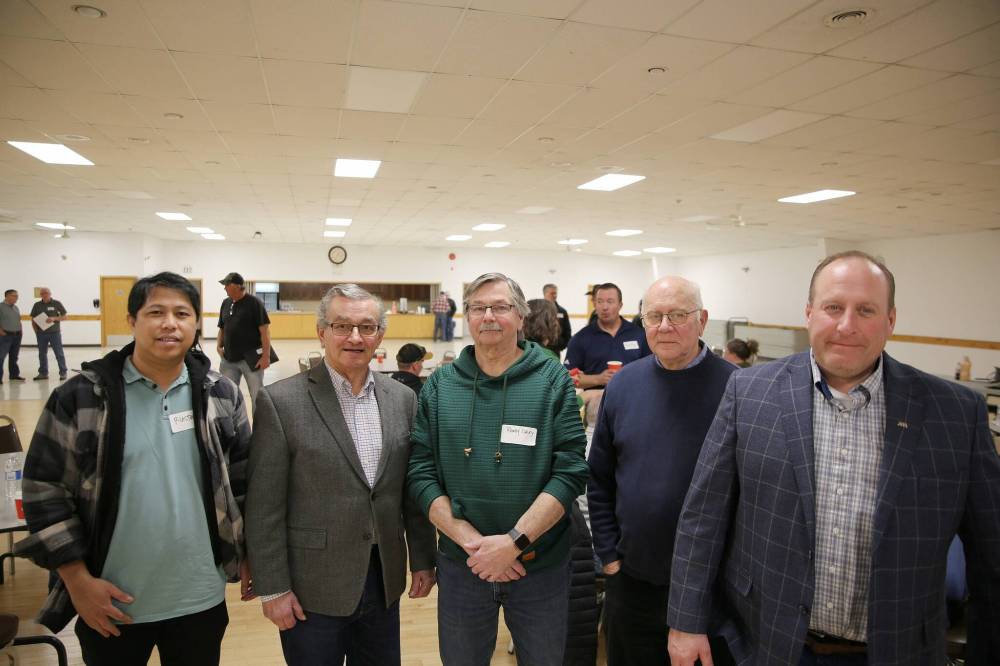
From left, Rustum Orale, Merv Starzyk, Randy Daley, Wayne Lees and Scott Phillips, members assigned to collect feedback about rural veterinary service delivery, are seen at a meeting in Souris in mid march at the Souris Glenwood Memorial Centre. Roughly three dozen people attended, including producers, veterinarians, producer group representatives and council members from Westman. The group is hosting five in-person sessions this year to collect feedback, with three in Westman. (Connor McDowell/The Brandon Sun)
Mike Everett, reeve of the RM of Argyle, said at the Souris meeting that he is not a big fan of the current model. He said his area funds three different clinics, which can be expensive. It might make more sense, he said, to switch to a more custom option, where municipalities help rural veterinarians with the costs of start-up, allowing the vet to build the practice to suit their needs, such as a truck for a mobile veterinarian.
Wayne Lees, chairperson of the working group, said his takeaway from the Souris meeting was that flexibility is needed. A one-size-fits-all model for subsidized clinics seemed to be disapproved of by the room of stakeholders, he said.
The working group’s schedule included a meeting in Fisher Branch, Souris, Dauphin, Morden and Neepawa between March and April.
»cmcdowell@brandonsun.com
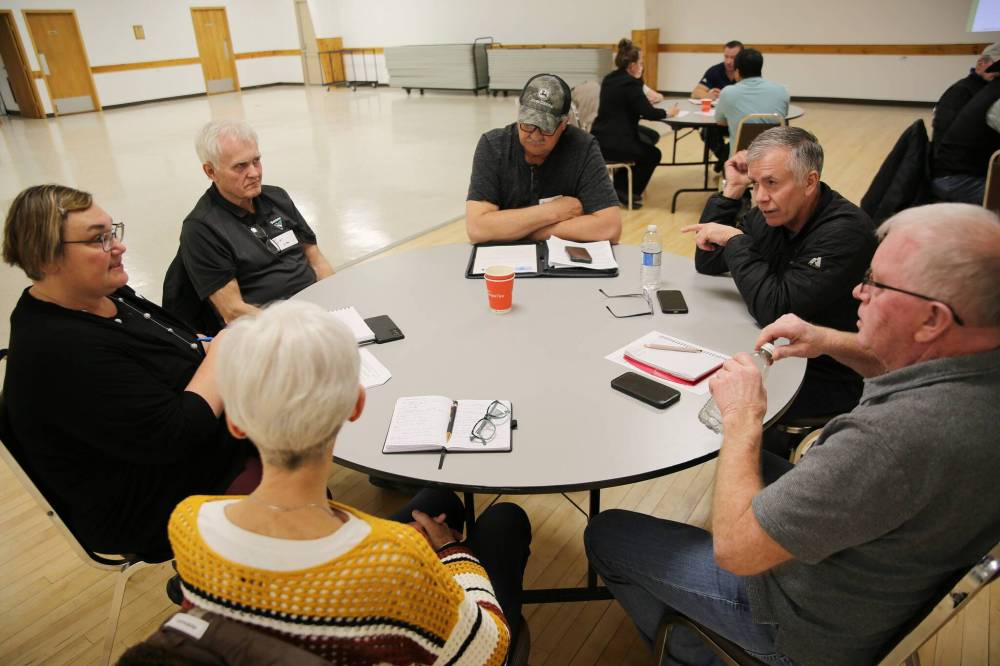
A Province of Manitoba employee consults with a table of stakeholders in the Souris area regarding potential alternative methods of veterinary service delivery. (Connor McDowell/The Brandon Sun)
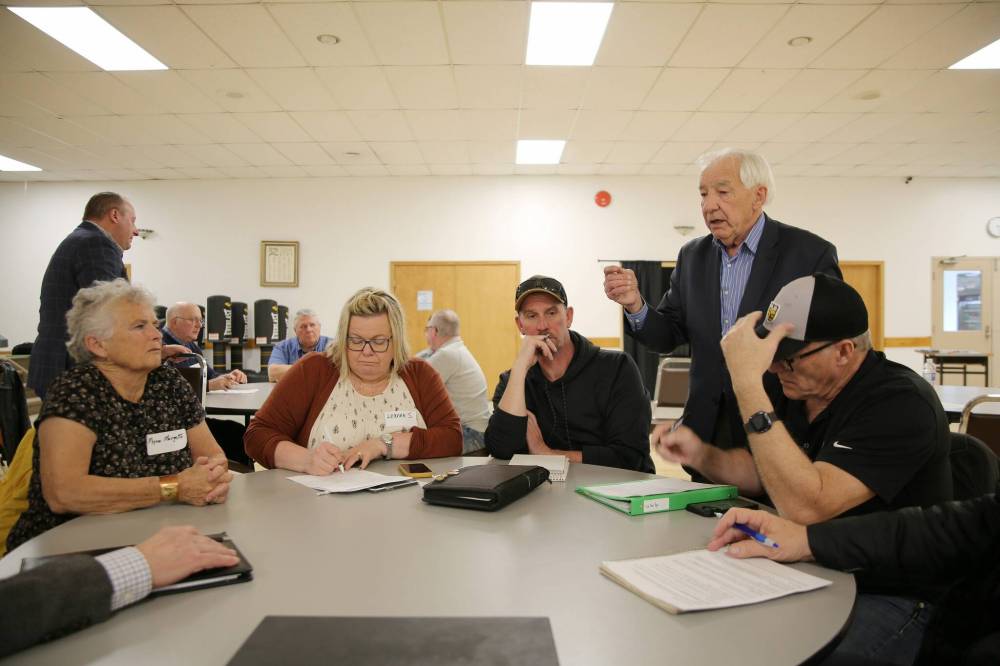
A group provides feedback to a Province of Manitoba employee at a meeting at the Souris Glenwood Memorial Complex. From left, Myna Margetts, Province of Manitoba staffer Leanne Sprung, RM of Argyle Reeve Mike Everett, Manitoba Veterinary Medical Association interim executive director Huge Moran, and Souris-Glenwood councillor Todd Walker. A brainstorming session was held to gather ideas about how to update the current model of delivery for veterinary services in rural Manitoba. (Connor McDowell/The Brandon Sun)