
Bank deputy warns of ongoing upheaval
Advertisement
Read this article for free:
or
Already have an account? Log in here »
We need your support!
Local journalism needs your support!
As we navigate through unprecedented times, our journalists are working harder than ever to bring you the latest local updates to keep you safe and informed.
Now, more than ever, we need your support.
Starting at $15.99 plus taxes every four weeks you can access your Brandon Sun online and full access to all content as it appears on our website.
Subscribe Nowor call circulation directly at (204) 727-0527.
Your pledge helps to ensure we provide the news that matters most to your community!
To continue reading, please subscribe:
Add Brandon Sun access to your Free Press subscription for only an additional
$1 for the first 4 weeks*
- Enjoy unlimited reading on brandonsun.com
- Read the Brandon Sun E-Edition, our digital replica newspaper
*Your next Free Press subscription payment will increase by $1.00 and you will be charged $20.95 plus GST for four weeks. After four weeks, your payment will increase to $24.95 plus GST every four weeks.
Read unlimited articles for free today:
or
Already have an account? Log in here »
Brandon business owners should expect economic uncertainty to continue to shape local and national outlooks, Bank of Canada senior official Carolyn Rogers said.
The central bank’s senior deputy governor told business leaders at the Brandon Chamber of Commerce’s March luncheon Thursday that Canada must prepare for ongoing disruption and adapt to long-term change.
“Canadians have faced a lot of economic upheaval over the past five years, and the next five may not be much calmer,” Rogers said at the Victoria Inn. “Our economy is still facing shocks, and it’s undergoing a series of structural changes that will require us all to adapt.”
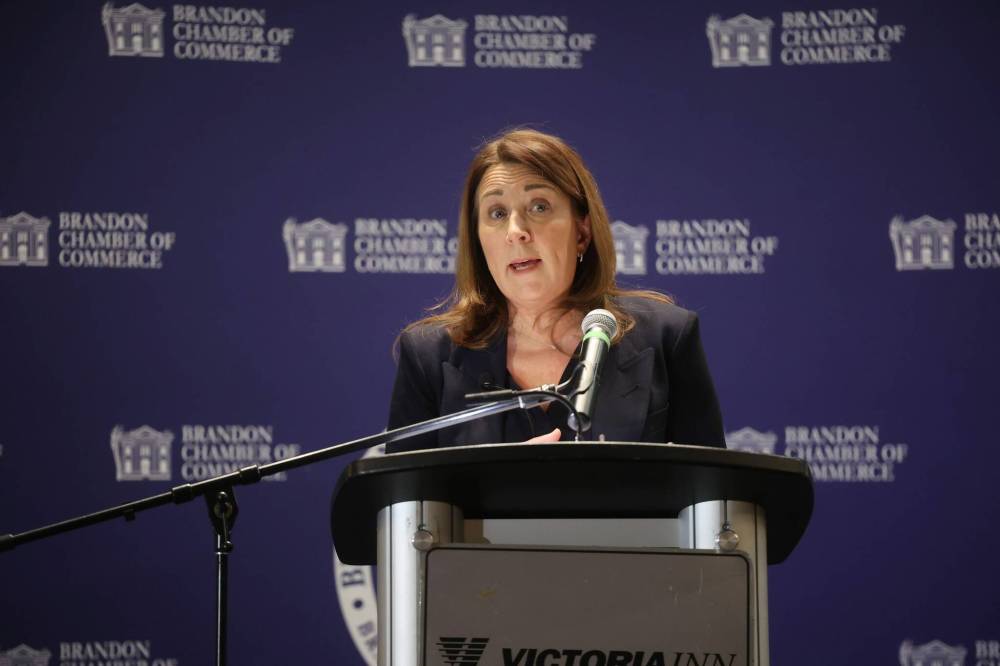
Carolyn Rogers, senior deputy governor of the Bank of Canada, delivers a talk during the Brandon Chamber of Commerce March Economic Outlook Luncheon at the Victoria Inn Grand Salon on Thursday. (Tim Smith/The Brandon Sun)
Rogers said one of the forces causing uncertainty for businesses is a shift in immigration levels, which is expected to have ripple effects across the economy.
“This means relatively fewer workers and consumers in the economy and less potential for the economy to grow,” she said during a discussion session.
“But many businesses, particularly in smaller communities, rely on immigration for workers that are difficult to find locally, and colleges and universities rely on international students to help fund their costs and contain tuition for Canadian students.”
She said “big forces,” including U.S. protectionism, demographic shifts and artificial intelligence, are not temporary shocks but long-term changes that will shape the country’s economy.
The sectors hardest hit by current U.S. policy — autos, steel and aluminum — are concentrated in other parts of the country, Rogers said.
“But local businesses are feeling it, too. Brandon, for example, is home to manufacturers that are important partners in steel supply chains,” she added.
“Fortunately, much of this region’s trade with the United States remains protected by the Canada-United States-Mexico Agreement. That agreement is up for renewal this year. It’s difficult to predict the outcome of that process, or any process that involves U.S. trade policy these days.”
Rogers said such uncertainty is putting a chill on business investment across the country, and that chill has a knock-on effect.
“When businesses aren’t investing, it means fewer jobs and it adds to the long-standing productivity challenge we have in Canada,” she said.
“It’s not all bad news, though. Trade tensions are spurring us to get our own house in order. Canadian businesses are diversifying trading relationships and supply chains, and we see this here in Manitoba. The province has been diversifying markets for some of its top U.S. exports, like farm machinery and pork products.”
The third force, AI, presents both promise and risk, she said.
Rogers said agriculture in Manitoba is a key example of innovation, with AI helping farmers optimize yields and detect disease earlier.
But there is also growing anxiety about the potential for AI to be highly disruptive. People worry that AI could displace workers, drive up the cost of energy, concentrate power into the hands of a few big technology firms and widen inequality, she said.
“There are concerns about the potential for model errors or automated decision-making that results in misinformation or fraud. Both the benefits and the potential risks of AI depend a lot on the breadth and pace of adoption, she said.
Rogers said while the Bank of Canada can respond to cyclical ups and downs through interest rates, it cannot reverse structural changes.
“What we can — and must — do is ensure that Canadians continue to have confidence in low and stable inflation through a period of change,” she said.
She reaffirmed the central bank’s commitment to its two per cent inflation target, calling it a key anchor of stability even during recent economic shocks, including the pandemic and global conflicts.
The bank, she said, is refining how it responds to shocks — using better real-time data, improved supply analysis and scenario planning — to avoid past missteps that underestimated inflation.
Chamber president Jennifer Ludwig said hosting Rogers offered valuable insight for the region’s business community.
“The event gave businesses a clearer understanding of national economic policy and a chance to provide feedback,” she said.
“It was refreshing to hear directly from the senior deputy governor what the shocks are, their effect and how they’re mitigating and managing them. The other thing would be AI and what we need to do or what we should be watching out for as it comes more to fruition.”
Rogers said emerging risks, including geopolitical tensions such as conflict in the Middle East and higher oil prices, could push inflation up in the short term.
The bank recently held its policy rate at 2.25 per cent and is closely monitoring developments, she said.
“Our goal is to be an anchor of stability in uncertain times,” she said.
» aodutola@brandonsun.com
» X: @AbiolaOdutola