
Israel targets nuclear facilities
Advertisement
Read this article for free:
or
Already have an account? Log in here »
We need your support!
Local journalism needs your support!
As we navigate through unprecedented times, our journalists are working harder than ever to bring you the latest local updates to keep you safe and informed.
Now, more than ever, we need your support.
Starting at $15.99 plus taxes every four weeks you can access your Brandon Sun online and full access to all content as it appears on our website.
Subscribe Nowor call circulation directly at (204) 727-0527.
Your pledge helps to ensure we provide the news that matters most to your community!
To continue reading, please subscribe:
Add Brandon Sun access to your Free Press subscription for only an additional
$1 for the first 4 weeks*
*Your next subscription payment will increase by $1.00 and you will be charged $20.00 plus GST for four weeks. After four weeks, your payment will increase to $24.00 plus GST every four weeks.
Read unlimited articles for free today:
or
Already have an account? Log in here »
DUBAI, United Arab Emirates — Iran’s nuclear facilities came under attack Friday, state media reported, just hours after Israel threatened to “escalate and expand” its campaign against Tehran. Israel claimed responsibility for the attacks and Iran quickly threatened to retaliate.
Iran’s Atomic Energy Organization said the Shahid Khondab Heavy Water Complex in Arak and the Ardakan yellowcake production plant in Yazd Province were targeted, IRNA reported. The strikes did not cause any casualties and there was no risk of contamination, it said. The Arak plant has not been operational since Israel attacked it last June.
Yellowcake is a concentrated form of uranium after impurities are removed from the raw ore. Heavy water is used as a moderator in nuclear reactors.
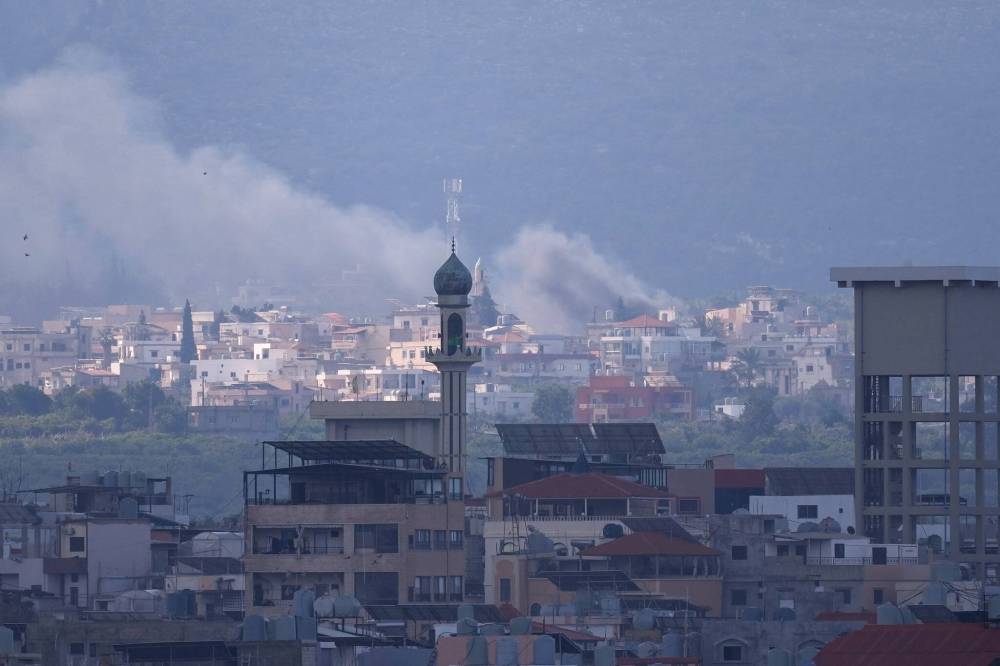
Smoke rises from an Israeli airstrike that hit Qlaileh village, as seen from Tyre city, south Lebanon, on Friday. (The Associated Press)
The Israeli military later hailed its attacks on several Iranian targets, including “missile production capabilities, infrastructure remaining from its nuclear program, and terror regime targets.” It said raw materials are processed for enrichment at the Yazd plant and that the strike was a major blow to Iran’s nuclear program.
The Islamic Revolutionary Guard Corps warned Iran would retaliate for the attacks, IRNA reported. Seyed Majid Moosavi, IRGC’s Aerospace Force commander, posted on X that employees of companies tied to the U.S. and Israel should abandon their workplaces.
“You tested us once before; the world has once again seen that you yourselves started playing with fire and attacking infrastructure,” he said. “This time, the equation will no longer be ‘an eye for an eye,’ just wait.”
U.S. PUSHES FOR DIPLOMACY
Word of the attacks came after U.S. President Donald Trump claimed talks on ending the war were going “very well” and that he had given Tehran more time to open the Strait of Hormuz. Iran maintains it has not engaged in any negotiations.
With the war extending far beyond the Middle East, Trump is under growing pressure to end Iran’s chokehold on the strait, a strategic waterway through which a fifth of the world’s oil is usually shipped.
A Gulf Arab bloc said Thursday that Iran has been exacting tolls from ships to ensure safe passage.
Trump envoy Steve Witkoff said Washington delivered an “action list” to Iran for a possible ceasefire, using Pakistan as an intermediary. It proposes restricting Iran’s nuclear program and reopening the Strait of Hormuz.
Iran rejected the U.S. offer and presented its own five-point proposal that included reparations and recognition of its sovereignty over the vital strait.
Trump has said if Iran doesn’t reopen the strait to all traffic by April 6, he will order the destruction of Iran’s energy plants.
U.S. stocks fell further on Friday, lengthening Wall Street’s longest losing streak in nearly four years, and oil prices rose again. The price for a barrel of Brent crude rose 2.9 per cent to US$104.81, up from roughly US$70 before the war began Feb. 28. Benchmark U.S. crude rose 4.4 per cent to US$98.61 per barrel.
IRAN ATTACKS NEIGHBOURS
Air raid sirens sounded in Israel, and the military said it has been intercepting Iranian missiles on a daily basis. Defence Minister Israel Katz said Iran “will pay heavy, increasing prices for this war crime.”
“Despite the warnings, the firing continues,” Katz said. “And therefore attacks in Iran will escalate and expand to additional targets and areas that assist the regime in building and operating weapons against Israeli citizens.”
Israel’s military said its attacks Friday targeted sites “in the heart of Tehran” where ballistic missiles and other weapons are produced. It said it also hit missile launchers and storage sites in Western Iran.
Smoke rose over Beirut after a pre-dawn strike, and Lebanon’s Health Ministry later reported two people were killed.
Saudi Arabia’s defence ministry, meanwhile, said it shot down missiles and drones targeting the capital, Riyadh.
Kuwait said its Shuwaikh Port in Kuwait City and the Mubarak Al Kabeer Port to the north, which is under construction as part of China’s “Belt and Road” initiative, sustained “material damage” in attacks. It appeared to be one of the first times a Chinese-affiliated project in the Gulf Arab states has come under assault in the war. China has continued to purchase Iranian crude.
U.S. SENDS MORE TROOPS
Diplomats from several countries including Pakistan and Turkey have tried to organize a direct meeting between U.S. and Iranian envoys. Separately, G7 foreign ministers meeting in France adopted a declaration calling for an immediate halt to attacks against populations and infrastructure.
Meanwhile, U.S. ships drew closer to the region carrying some 2,500 Marines, and at least 1,000 paratroopers from the 82nd Airborne — trained to land in hostile territory to secure key positions and airfields — have been ordered to the Middle East.
Nevertheless, Secretary of State Marco Rubio said during the G7 meeting that most U.S. objectives in Iran are “ahead of schedule,” and that “We can achieve them without any ground troops.”
Israel deployed the 162nd Division into southern Lebanon to support efforts to protect its northern border towns from Hezbollah attacks and uproot the militant group, the military said.
The UN’s International Organization for Migration said Friday that 82,000 civilian buildings in Iran, including hospitals and the homes of 180,000 people, are damaged.
“If this war continues, we risk a far wider humanitarian disaster,” Jan Egeland, secretary general of the Norwegian Refugee Council, said in a statement. “Millions could be forced to flee across borders, placing immense pressure on an already overstretched region.”
DEATH TOLL CLIMBS
Eighteen people have died in Israel, while four Israeli soldiers have been killed in Lebanon. Two Israeli soldiers were severely injured in Lebanon on Friday during an “operational accident,” the military said.
Authorities said more than 1,100 people have died in Lebanon and at least 1,900 people have been killed in Iran.
At least 13 American troops have been killed and four people in the occupied West Bank and 20 in Gulf Arab states have also died.
In Iraq, where Iranian-supported militia groups have entered the conflict, 80 members of the security forces have died.
» The Associated Press