
Human rights tribunal approves massive child welfare deal for Ontario First Nations
Advertisement
Read this article for free:
or
Already have an account? Log in here »
We need your support!
Local journalism needs your support!
As we navigate through unprecedented times, our journalists are working harder than ever to bring you the latest local updates to keep you safe and informed.
Now, more than ever, we need your support.
Starting at $15.99 plus taxes every four weeks you can access your Brandon Sun online and full access to all content as it appears on our website.
Subscribe Nowor call circulation directly at (204) 727-0527.
Your pledge helps to ensure we provide the news that matters most to your community!
To continue reading, please subscribe:
Add Brandon Sun access to your Free Press subscription for only an additional
$1 for the first 4 weeks*
- Enjoy unlimited reading on brandonsun.com
- Read the Brandon Sun E-Edition, our digital replica newspaper
*Your next Free Press subscription payment will increase by $1.00 and you will be charged $20.95 plus GST for four weeks. After four weeks, your payment will increase to $24.95 plus GST every four weeks.
Read unlimited articles for free today:
or
Already have an account? Log in here »
OTTAWA – The Canadian Human Rights Tribunal has approved a landmark First Nations child welfare deal between the federal government and First Nations in Ontario, partially ending a decades-long discrimination case.
Monday’s decision comes after chiefs twice voted down a national $47.8 billion deal proposed by the federal government to reform the child welfare system, and a tumultuous two years of political infighting in the country’s most prominent First Nations organization on the way forward.
The tribunal said it chose to issue a “letter decision” ahead of a formal decision to come later, so First Nations in Ontario do not lose a full year of funding under the agreement. It said it reserves the right to make changes to the letter decision after its release.
“In choosing to work with the (Chiefs of Ontario) and the (Nishnawbe Aski Nation), and in recognizing their rightful authority to make decisions for their own children, Canada is taking an important step toward reversing a history marked by racist, paternalistic, colonial, and assimilationist policies embedded in systemic and racially discriminatory structures, including child and family services,” the decision reads.
“First Nations in Ontario are ready, and they have chosen to exercise their right to self-determination by requesting this agreement. They are the ones who represent their children.”
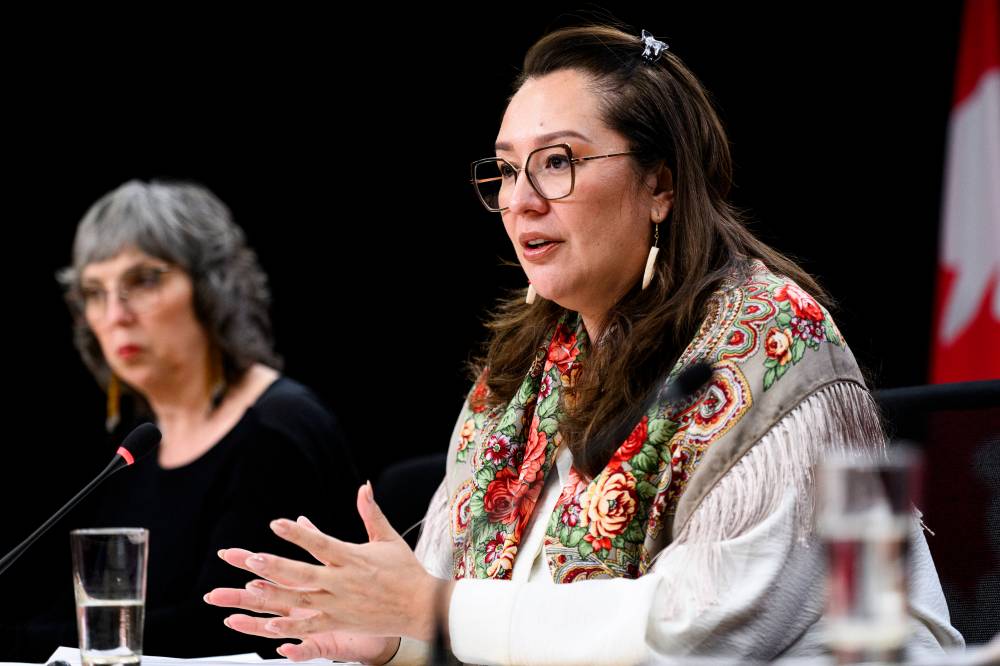
Ontario Regional Chief Abram Benedict said seeing the $8.5 billion deal accepted by the tribunal made the day “extraordinary.”
“But let’s not forget there’s more work to do,” Benedict told a news conference Monday in Toronto.
“This agreement does not end in nine years. It is the beginning of an opportunity for all of us together to continue to forge the way forward and reform this program that has done so much wrong to our people for so very long.”
The decision marks a step toward resolving a dispute that began in 2007, when the Assembly of First Nations and the First Nations Child and Family Caring Society filed a joint human rights complaint about federal child welfare funding.
In a ruling on that complaint in 2016, the Canadian Human Rights Tribunal concluded the federal government had discriminated against First Nations children by underfunding the on-reserve child welfare system. It ordered reforms.
In 2024, chiefs twice voted down the federal government’s offer of $47.8 billion to reform the national child welfare system, saying it didn’t go far enough to eliminate discrimination.
Chiefs in Ontario — whose representatives with Nishnawbe Aski Nation and Chiefs of Ontario took part in the negotiations that led to the $47.8 billion national deal — voted in favour of a separate provincial deal last year that is largely in line with the national deal the chiefs rejected.
Benedict said at the time they couldn’t wait for a national agreement while their children continued to be harmed by the child welfare system.
The tribunal appears to have agreed with that assessment. In its decision, it wrote that it didn’t want to put First Nations in the province at risk of losing the funding by delaying its release.
Indigenous Services Minister Mandy Gull-Masty said Monday the agreement will ensure fewer First Nations children are apprehended by the child welfare system.
“When First Nations lead, outcomes improve,” she said at a news conference in Ottawa.
“Today is an acknowledgment that we are on the right path.”
But that path is not yet in place for First Nations in the rest of the country.
Two competing deals to reform the child welfare system outside of Ontario were presented to the tribunal in December — one from the federal government and one drafted by First Nations leaders outside Ontario.
Gull-Masty said in an interview at the time the government was introducing new components to the deal and allowing regions to decide for themselves how to invest in things like prevention programming or information technology.
The federal child welfare plan proposal offers $35.5 billion in funding to 2033-34, followed by an ongoing commitment of $4.4 billion annually.
Gull-Masty said Monday she is determined to reach a deal with the remaining First Nations but did not commit to a timeline.
“We will take the time that we need to do this work,” she said. “But today, I think is really an acknowledgment that everybody is on the right path in serving these kids.”
Assembly of First Nations National Chief Cindy Woodhouse Nepinak — whose office was the focus of political infighting as chiefs debated how to move forward with Ottawa on reforming the system — called the tribunal’s decision a positive step forward for First Nations in the province.
“We continue to call on Canada to make the same commitment and to work with any region that chooses to pursue a regional path to long-term reform, and to resume the work toward a national agreement. We also hope to see the (Ontario final agreement) funding flow swiftly and without delay,” she wrote in a media statement.
This report by The Canadian Press was first published March 30, 2026.