
Find fairer approach for byelection costs
Advertisement
Read this article for free:
or
Already have an account? Log in here »
We need your support!
Local journalism needs your support!
As we navigate through unprecedented times, our journalists are working harder than ever to bring you the latest local updates to keep you safe and informed.
Now, more than ever, we need your support.
Starting at $15.99 plus taxes every four weeks you can access your Brandon Sun online and full access to all content as it appears on our website.
Subscribe Nowor call circulation directly at (204) 727-0527.
Your pledge helps to ensure we provide the news that matters most to your community!
To continue reading, please subscribe:
Add Brandon Sun access to your Free Press subscription for only an additional
$1 for the first 4 weeks*
*Your next subscription payment will increase by $1.00 and you will be charged $20.00 plus GST for four weeks. After four weeks, your payment will increase to $24.00 plus GST every four weeks.
Read unlimited articles for free today:
or
Already have an account? Log in here »
The final numbers are in, and they aren’t pretty. According to a CTV News report, Canada’s chief electoral officer has revealed that last August’s byelection in the Battle River-Crowfoot riding cost Canadian taxpayers a staggering $2.342 million — more than half a million dollars higher than the average cost of federal byelections in Canada.
For those unfamiliar with the circumstances surrounding last summer’s byelection, it goes back to the federal general election one year ago, in which Conservative Party Leader Pierre Poilievre was defeated in his Carleton riding by Liberal Bruce Fanjoy by more than 4,500 votes. Mere weeks after the election, Conservative MP Damien Kurek announced that he intended to resign his Battle River-Crowfoot seat shortly after being sworn in. Poilievre then announced he would be running for the Tories in the byelection for that seat.
The contest was held on Aug. 18, and Poilievre won with more than 80 per cent of votes cast. That was hardly a surprise, given Battle River-Crowfoot’s reputation as one of the safest Conservative seats in the nation. The byelection was complicated by the fact, however, that more than 200 candidates were listed on the ballot. That was due in large part to efforts by the “Longest Ballot Committee,” which encourages multiple candidates to seek election in ridings as part of its push for electoral reform.
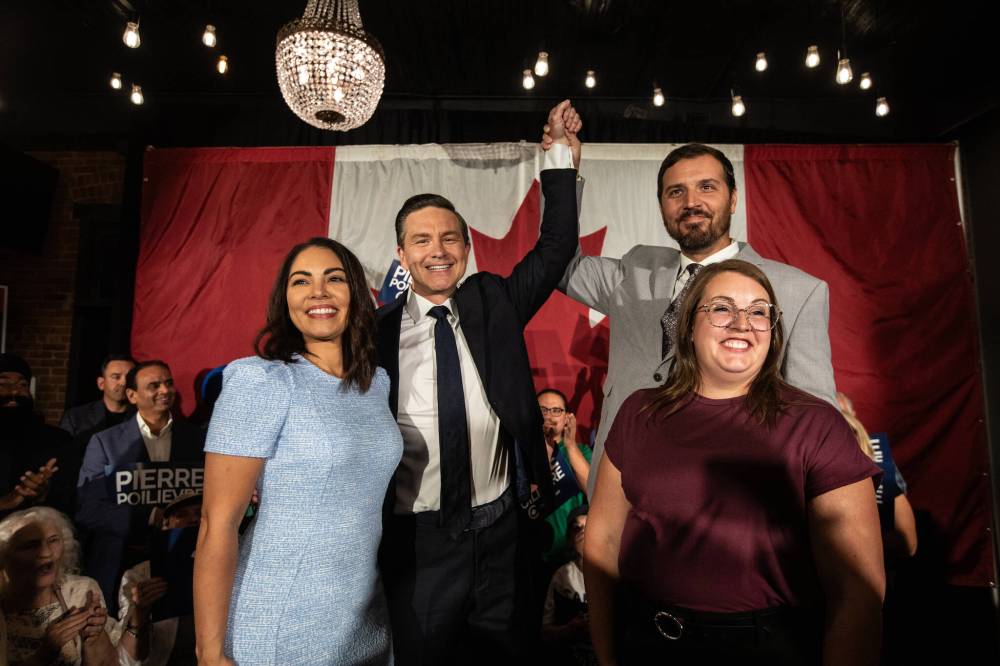
Anaida Poilievre (from left), Conservative Party Leader Pierre Poilievre, Damien Kurek and Danielle Kurek celebrate Pierre Poilievre’s win during the Battle River-Crowfoot byelection in Camrose, Alta. in August. The byelection cost Canadian taxpayers $2.342 million. (The Canadian Press files)
Was it reasonable for Kurek to resign his seat so soon after being elected, in order to bail his leader out of an embarrassing predicament? Was it reasonable for taxpayers to be forced to incur such a large expense solely because Poilievre wanted a second chance at being elected?
Conservative Party communications director Sarah Fischer told CTV that byelections represent just a tiny fraction of total federal spending — as if almost $2.5 million is small potatoes to ordinary Canadians. And, in a display of classic “whataboutism,” she noted that “Byelections are a part of the democratic process … That includes the cost of the byelection currently happening in Scarborough Southwest because the Liberals appointed sitting MP Bill Blair to a patronage appointment overseas.”
That may be true, but the fact that other byelections are currently being held because of resignations by Liberal MPs doesn’t erase the fact that taxpayers are being forced to pick up the cost of byelections caused by MPs’ resignations, again and again.
Democracy Watch co-founder Duff Conacher has considered the situation and proposes that the federal election law be amended in order to force a political party to pay the cost of a byelection when the only reason for that contest is so the party’s leader can have a seat in the House of Commons. He adds that a party should pay a portion of the byelection costs when an MP from that party resigns within the first two years of their term in order to make a career change.
Those ideas are worthy of consideration at first glance, but they do not address situations where the party doesn’t have enough money to pay for the byelection. For example, the New Democratic Party is deeply in debt, and could not afford to pay for a byelection if a member of the caucus stepped down so that new NDP Leader Avi Lewis could seek election. What would happen then? Is it even possible to force a sitting MP to not resign if he or she genuinely wants to?
In addition to those questions, what happens when an opposition leader loses his seat, yet remains in his official residence (with all of its taxpayer-financed perks) until he wins a seat in a byelection held at some point in the future? That happened with Poilievre last summer. Why should taxpayers be stuck with those costs? Should the political party be left with the tab? What happens if they don’t have enough money?
These are complicated issues that require careful consideration. But given the huge cost of byelections, those questions must be finally confronted and resolved. At a time when Canadians are struggling to afford the basics of life, it is unreasonable to force them to also shoulder the cost of byelections caused solely by the ambitions of desperate politicians.
A fairer, more accountable approach is required, and the sooner the better.