
First World War soldier’s remains traced to Manitoba
Roblin farmer served in First World War
Advertisement
Read this article for free:
or
Already have an account? Log in here »
We need your support!
Local journalism needs your support!
As we navigate through unprecedented times, our journalists are working harder than ever to bring you the latest local updates to keep you safe and informed.
Now, more than ever, we need your support.
Starting at $15.99 plus taxes every four weeks you can access your Brandon Sun online and full access to all content as it appears on our website.
Subscribe Nowor call circulation directly at (204) 727-0527.
Your pledge helps to ensure we provide the news that matters most to your community!
To continue reading, please subscribe:
Add Brandon Sun access to your Free Press subscription for only an additional
$1 for the first 4 weeks*
- Enjoy unlimited reading on brandonsun.com
- Read the Brandon Sun E-Edition, our digital replica newspaper
*Your next Free Press subscription payment will increase by $1.00 and you will be charged $20.95 plus GST for four weeks. After four weeks, your payment will increase to $24.95 plus GST every four weeks.
Read unlimited articles for free today:
or
Already have an account? Log in here »
Hey there, time traveller!
This article was published 02/04/2026 (208 days ago), so information in it may no longer be current.
WINNIPEG — More than a century after he was killed by an enemy shell during the First World War in France, the remains of Roblin-area farmer Albert (Bert) Henry Detmold have been identified.
The 33-year-old private, who served with the 107th Overseas Battalion, was killed while digging a trench on the first day of the Battle of Hill 70 on Aug. 15, 1917.
Despite the efforts of the surviving members of the unit to find the dead and wounded, in the midst of enemy attacks that involved mustard gas, Detmold’s remains could not be found.
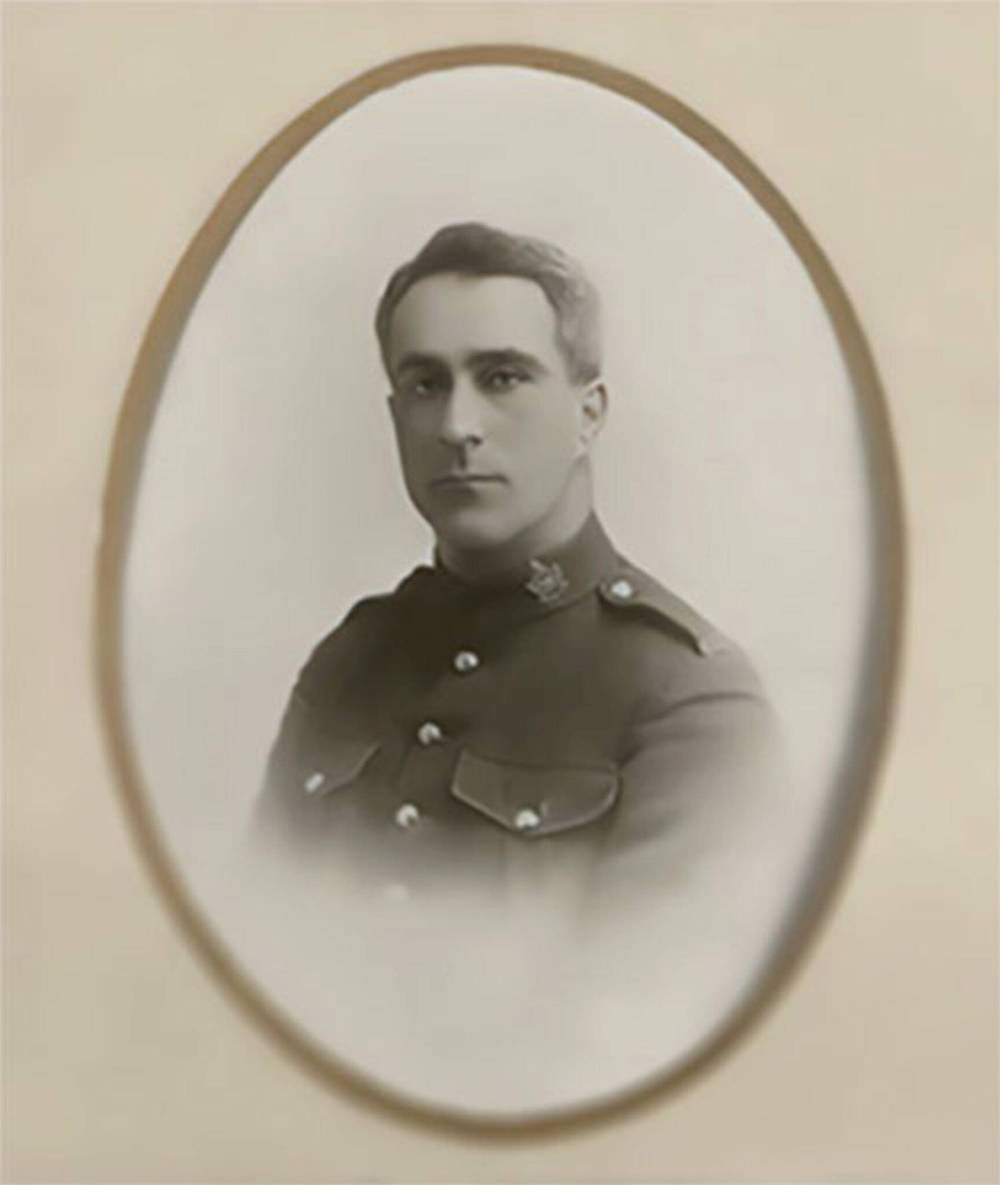
Private Albert Henry Detmold from Roblin, Man. (Supplied)
It wasn’t until August 2020 that a construction crew, doing excavation of a site intended for a new hospital, discovered his remains.
In December 2025, the remains were identified by the Department of National Defence’s casualty identification review board.
Detmold will be formally buried under a marked gravestone at a cemetery in France with other members of his battalion.
Alexandra McKinnon, a historian with the casualty identification program, said Detmold’s relatives on his brothers’ side, didn’t know about his existence, let alone that he had been missing in action during the war.
“It was complete news to them,” McKinnon said on Tuesday.
“The next of kin is always the oldest closest living relative so, as you might imagine, it is frequently someone who is quite elderly… I think it was a bit overwhelming.
“We’re calling about your great uncle — we found him.”
Sarah Lockyer, a forensic anthropologist with the identification program, said she confirmed Detmold’s identity through DNA analysis.
“It’s a good day when this happens,” Lockyer said. “At Hill 70, we have 1,300 Canadians who are still missing. That’s a huge number for one specific battle.”
But Lockyer said it helped to find there was a collar badge for the 107th Battalion with the remains.
“There were only 11 from the 107th Battalion who are missing so that helped to narrow it down from 1,300 to 11.”
Lockyer said she was glad to be able to identify Detmold.
“As a forensic anthropologist, the whole point of my field is to return the names and faces and identities to unknown individuals,” she said. “When we are able to do that, it is quite a special day.
“There are 45 others right now who are waiting for the same thing, but to be honest, some of them we may not be able to identify so they will have to be buried as unknowns.”
Detmold was born in Hamburg, Germany on July 9, 1884, the third of four children. He had two brothers and one sister when he died.
The family moved to England and he went to school at Alleyn’s School in London before leaving in 1898 and heading to Canada with his older brother, Fred, in Feb. 1902.
McKinnon said Detmold submitted a homestead application for a quarter section of land near Shell River, just north of Roblin, on March 16, 1905. Roblin is about 400 kilometres northwest of Winnipeg.
“We know he was fairly active as a farmer,” she said. “He became the secretary of the Silverwood branch of the Manitoba Grain Growers Association; he pops up in the Grain Growers Guide.”
McKinnon said some time after Fred moved to Australia — he later served with the Australian Imperial Force in the war — Detmold left Manitoba to visit him for a year before returning to his farm.
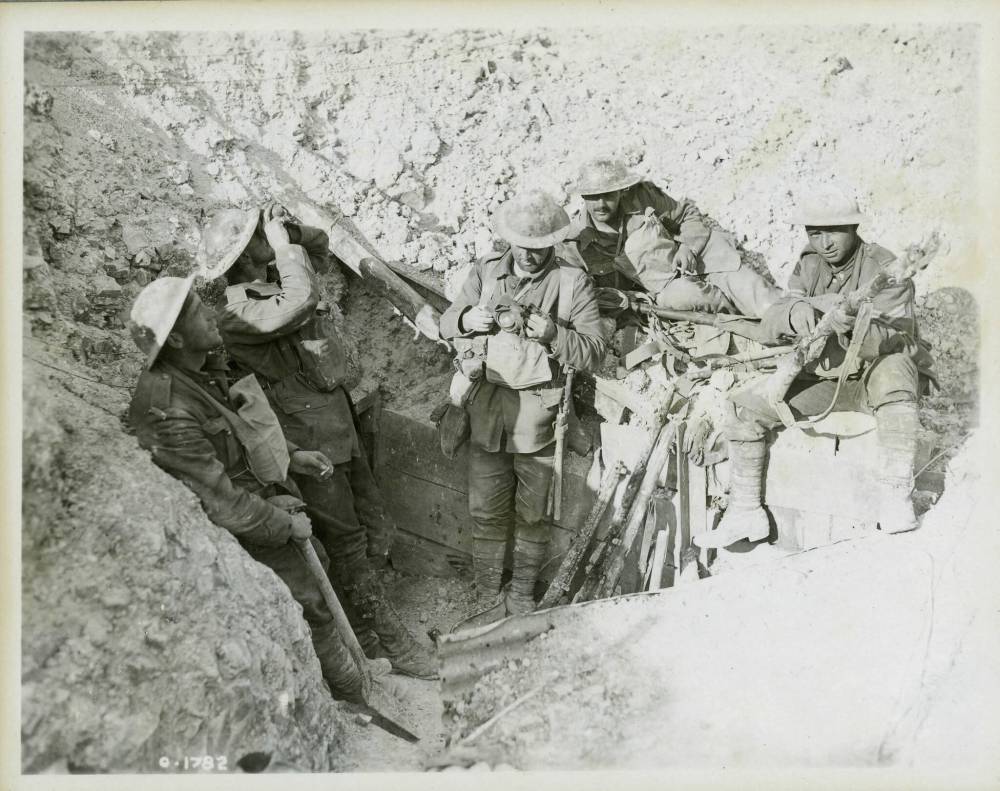
Canadian soldiers take a break in a captured German trench at Hill 70 on the outskirts of Lens in the Nord-Paw-de-Calais region of France between Aug. 15-25, 1917. Canadian forces lost more than 9,000 soldiers at Hill 70 during the First World War, but killed or wounded an estimated 25,000 Germans. (Photo courtesy the Canadian War Museum archives)
Detmold was farming when the war broke out. He enlisted on Valentine’s Day, 1916 in Winnipeg and by February 1917, he was on the Western Front.
Detmold’s unit helped prepare for the attack on Vimy Ridge by burying communication cables, clearing roads and keeping light railways running.
Then in August, Detmold and his battalion were working to extend communication lines across no man’s land when the unit diary says they came under “heavy hostile shellfire.”
By the time Hill 70 was captured 10 days later, more than 1,800 Canadians died, including Detmold and 27 other members of his battalion.
McKinnon said while Detmold was in England he dated a cousin on his dad’s side, Violet Detmold, and they were engaged to be married.
“We know Violet never married. She died in 1970.”
McKinnon said all three surviving siblings of Detmold later ended up in Canada and the oldest closest relative lives in British Columbia.
While Detmold’s name is listed on the side of the community’s cenotaph, along with 18 others who made the “supreme sacrifice,” Jim Poyser, a member of the Roblin branch of the Royal Canadian Legion, said Detmold’s information on a separate framed commemoration plaque needs to be updated.
Poyser said the document lists all the local residents who served with units from the Riel Rebellion to peacekeeping missions.
“On that plaque, anyone killed in action, there is a cross beside their name,” he said.
“(Detmold’s) doesn’t have that because nobody knew that he had been killed in action. He was missing. Now we will need to update that.”
Teresa Iacobelli, the Canadian War Museum’s First World War historian, said identifying fallen soldiers is important to the Canadian Armed Forces.
“They still attempt to get a name to every single Canadian military fatality,” she said.
“There is a personal aspect to, for the families who are involved. Even over 100 years later, to be contacted about a deceased family member, who went unidentified for so many years, or had no known grave site, to learn they have been found and identified and will be buried with a proper headstone, is so meaningful.”
» kevin.rollason@freepress.mb.ca