
Hands-on workshop teaches locals about tanning hides
Advertisement
Read this article for free:
or
Already have an account? Log in here »
We need your support!
Local journalism needs your support!
As we navigate through unprecedented times, our journalists are working harder than ever to bring you the latest local updates to keep you safe and informed.
Now, more than ever, we need your support.
Starting at $15.99 plus taxes every four weeks you can access your Brandon Sun online and full access to all content as it appears on our website.
Subscribe Nowor call circulation directly at (204) 727-0527.
Your pledge helps to ensure we provide the news that matters most to your community!
To continue reading, please subscribe:
Add Brandon Sun access to your Free Press subscription for only an additional
$1 for the first 4 weeks*
- Enjoy unlimited reading on brandonsun.com
- Read the Brandon Sun E-Edition, our digital replica newspaper
*Your next Free Press subscription payment will increase by $1.00 and you will be charged $20.95 plus GST for four weeks. After four weeks, your payment will increase to $24.95 plus GST every four weeks.
Read unlimited articles for free today:
or
Already have an account? Log in here »
RM OF CORNWALLIS — A Brandon resident said she was thrilled to participate in late March in a one-week hide camp hosted outside of Brandon because it gave her a chance to reconnect with her roots.
The resident, Rashel Quill, attended a workshop put on by Seven Teachings Art Collective over spring break in the RM of Cornwallis. Quill was one of a few young women who learned how to flesh hides, scrape fur and prepare hides for conversion into various tools and products using methods shared by her ancestors.
“My people have been suppressed for so long, to learn about it again is going to keep us alive,” Quill told the Sun while holding the leg bone of a moose. “It’s just nice to be here.”
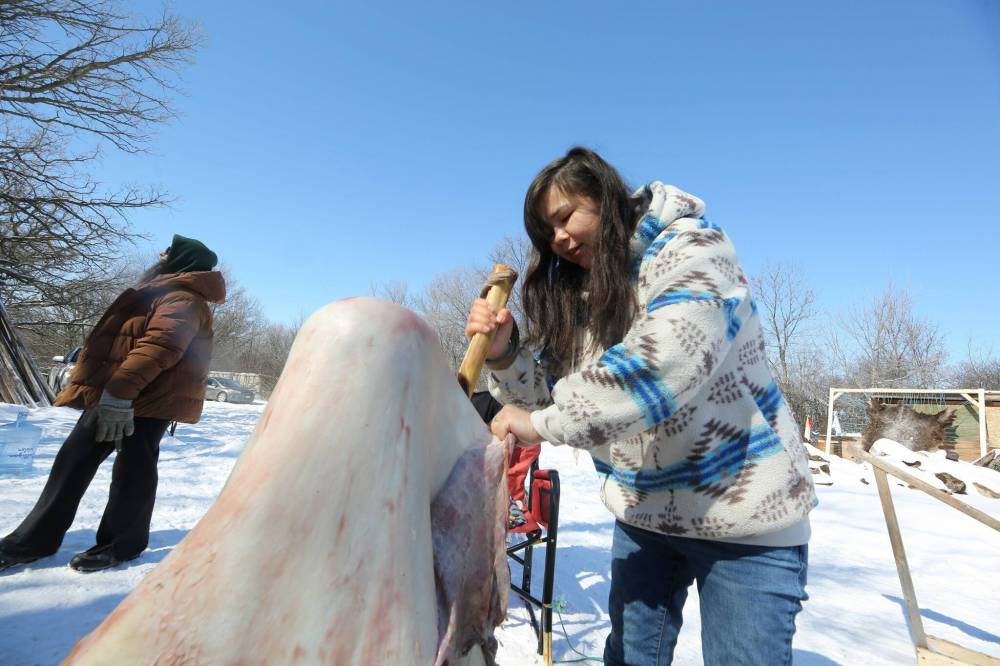
Rashel Quill, a Brandon resident, learns how to peel a flesh layer from a moose hide. She is using a scraping bone tool, made from the leg of a moose. (Connor McDowell/The Brandon Sun)
In the wooded space, under a warm spring sun on a bluebird day, Quill was being taught how to use the carved bone to “flesh” a moose hide. She wore designs that reflected her Indigenous heritage, while striking and tearing away a sinewy layer of tissue to prepare the hide for processing into products like moccasins. A bonfire roasted nearby, singing the nose of a moose, considered a delicacy to many First Nations people. The tongue of the moose was boiling over the same fire.
The workshop featured four moose hides, a deer hide, an elk hide and an otter hide so students could learn with hands-on work, Grace Masse, the workshop leader, told the Sun.
Masse is a Cree woman, and current Selkirk resident, who attended BU for a four-year honours degree in native studies, and the University of Saskatchewan for a master’s degree in Indigenous land-based education.
She said about 10 pairs fo moccasins could be made from one moose hide, and taught students various steps in the process to tan the animal hides. It’s crucial these skills are known, she said, because of the cultural importance, but also because it’s important to maximize resources left behind by slain animals.
“It’s more respectful to the animals,” Masse said. “It’s so important. Especially as a hunter, I see a lot of waste left; I see a lot of hides left.
“I just think it’s important for the hunters to save the hides and use it.”
Masse spent five days at a snowy, forested area outside of Brandon where hides were stretched on frames, meals were served in a sacred lodge and bonfires were used to cook meat. She was putting on the workshop with support from Jessie Jannuska and Nichol Marsch, the co-founders of the art collective that organized the event.
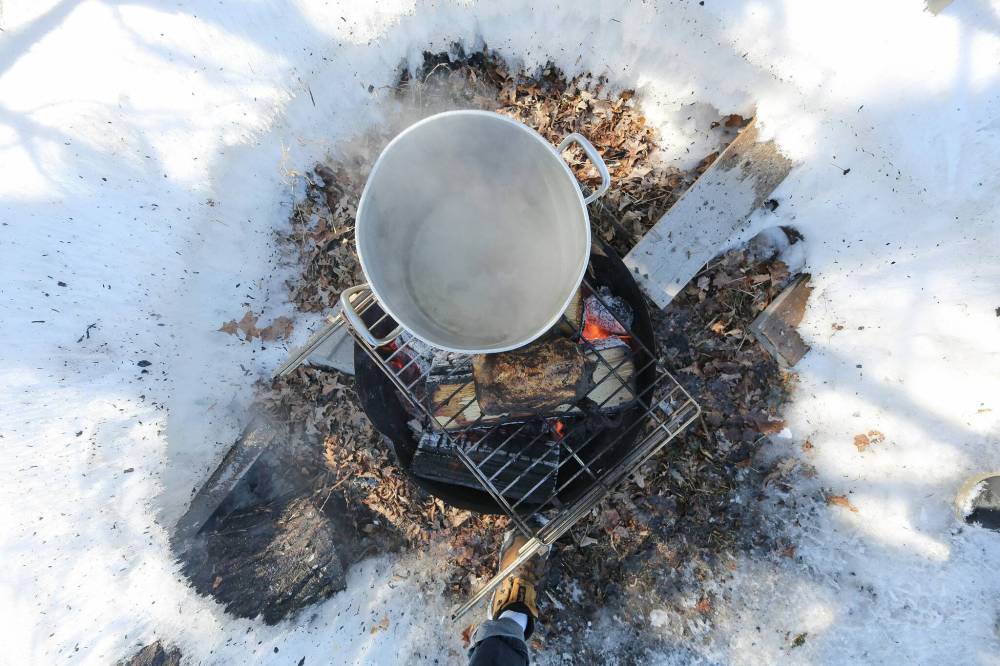
A moose tongue boils in a pot, and beside it on the wood fire is a moose nose. The parts were cooked for food during a hide camp near Brandon. (Connor McDowell/The Brandon Sun)
In an interview with the Sun, Jannuska said the group chose the event to provide people an experience she and Marsch missed when they were young.
“Me and Nicole weren’t raised in our culture. We learned it later,” Jannuska said. “(The goal is ) just to share knowledge, create community, and create free opportunities.”
The organizers secured grant funding through the Manitoba Arts Council and the Canada Council for the Arts. They said that it was crucial the event was free because they have seen how access is important for well-being.
“I was raised really poor and I didn’t have any art opportunities,” Jannuska said. “If I had found these opportunities, I would have been happier earlier.
“It being free is really important to us.”
The event was advertised online and through local organizations like the Brandon Friendship Centre, which attracted Quill. The young woman said she learned of the event through the centre, and made the trip independently, because she wants to learn about her culture.
Dezarae Bodnar, another young woman attendee, who lives in Ste. Rose, told the Sun she came for similar reasons. When the Sun visited in late March, she said she was happy to practise skills that connected her with her ancestry.
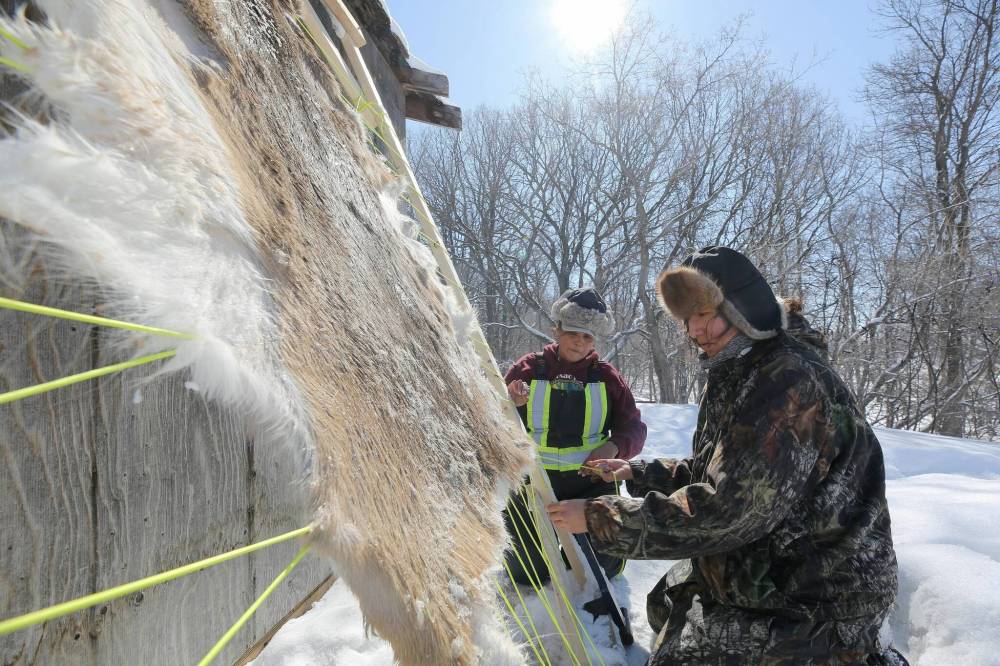
Grace Masse (left) helps a workshop attendee lace a hide to a frame in late March. Once laced, the hide is scraped of its fur. (Connor McDowell/The Brandon Sun)
Jannuska said that the event has returned for three years now thanks to engagement and local interest. The workshop was scheduled for five days during spring break to allow for people to get time off work, and for travelling, she said.
“It’s a lot of word of mouth and it seems a lot of people want to come back the next year,” Jannuska told the Sun. “(We’re) just trying to put opportunities together for folks to learn.”
» cmcdowell@brandonsun.com