
Alberta’s access restrictions threaten privacy, democratic role of libraries: critics
Advertisement
Read this article for free:
or
Already have an account? Log in here »
We need your support!
Local journalism needs your support!
As we navigate through unprecedented times, our journalists are working harder than ever to bring you the latest local updates to keep you safe and informed.
Now, more than ever, we need your support.
Starting at $15.99 plus taxes every four weeks you can access your Brandon Sun online and full access to all content as it appears on our website.
Subscribe Nowor call circulation directly at (204) 727-0527.
Your pledge helps to ensure we provide the news that matters most to your community!
To continue reading, please subscribe:
Add Brandon Sun access to your Free Press subscription for only an additional
$1 for the first 4 weeks*
- Enjoy unlimited reading on brandonsun.com
- Read the Brandon Sun E-Edition, our digital replica newspaper
*Your next Free Press subscription payment will increase by $1.00 and you will be charged $20.95 plus GST for four weeks. After four weeks, your payment will increase to $24.95 plus GST every four weeks.
Read unlimited articles for free today:
or
Already have an account? Log in here »
EDMONTON – Critics of Alberta’s proposed rule changes to public libraries say the true danger lies in giving the province power to dictate access and potentially snoop on which books people are checking out.
James Turk, director of the Centre for Free Expression at Toronto Metropolitan University, says the government’s stated reason for the bill – to keep kids from accessing graphic sexual material – is a red herring.
“Nobody’s advocating that children should have access to inappropriate materials, least of all libraries,” Turk said in an interview. “This is a non-existent problem that the province is using as a ploy to bring radical overreach in terms of controlling libraries.”
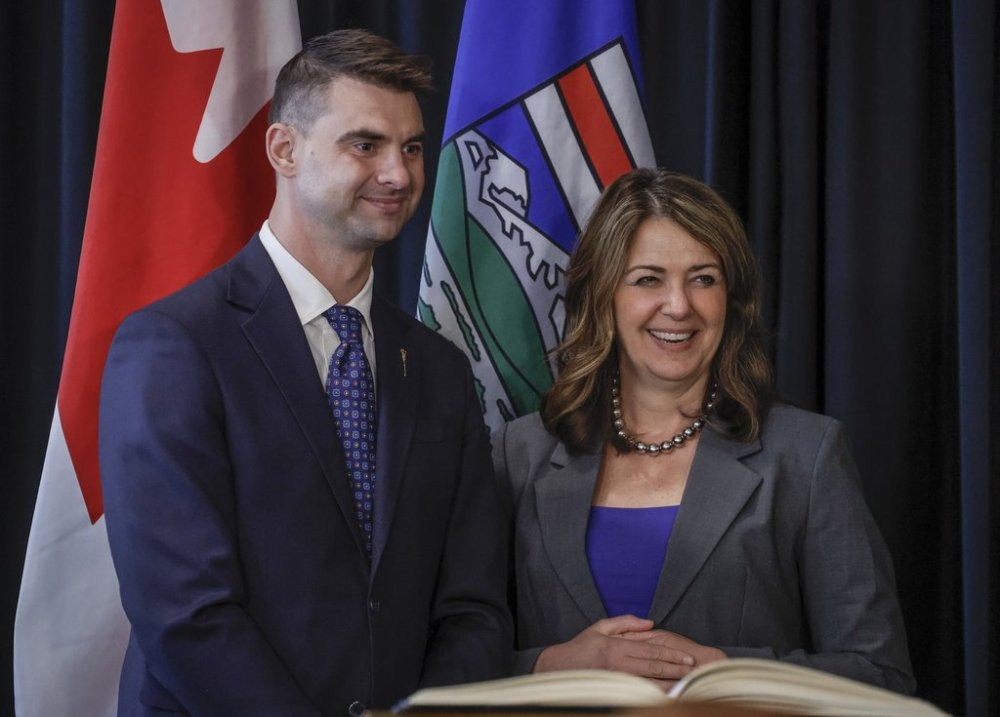
Municipal Affairs Minister Dan Williams proposed the legislation last week. He promises to ensure children ages 15 and under won’t be able to access visual depictions of sex. Regulations expected later this spring could include having such material controlled by library staff or put in separate areas.
“We will require that they are put behind a counter in a place that children cannot find them while wandering these libraries,” Williams said after tabling the bill, holding up copies of graphic sex images to prove his point.
“When a family walks into a public library, they should feel confident that appropriate safeguards are in place.”
Turk, however, said the bill doesn’t specify anything about explicit material — sexual or otherwise — and gives the municipal affairs minister authority to restrict any topic or subject.
The wording of the bill proposes giving an inspector appointed by the ministry the broad power to look at “any matter relating to the management, administration or operation of a public library” and to access records they deem relevant. The minister would then have the authority to make any order he “considers appropriate.”
Turk calls that an unprecedented intrusion into libraries, which are supposed to be governed by local boards to serve diverse communities.
“That’s a real concern in a democratic society,” he said.
The Coalition of Alberta Public Libraries says the changes would affect 324 public points across the province serving 99 per cent of Albertans.
Speaking on behalf of the organization, Pilar Martinez, CEO of the Edmonton Public Library, and Ron Sheppard, director of the Parkland Regional Library system, questioned what would happen when authorities are ordered to check out what someone is checking out.
Martinez said Edmonton libraries have self-checkout stations, which many patrons prefer because they’d rather keep their borrowing habits private.
In small rural libraries and even in the province’s capital, Martinez said branches don’t have space behind counters to squirrel away restricted material the way Williams envisions.
She said the books displayed by Williams are already catalogued and held in the adult section.
Turk questioned whether it would even be legal, under privacy law, for the ministry to demand a patron’s borrowing records.
And then there’s the internet.
Public libraries subscribe to third-party digital platforms that provide access to users ebooks, audiobooks, movies and music.
The coalition said it’s not yet clear how those digital platforms would be handled under the changes. It’s also not clear what internet restrictions might be put in place for those who sit down and log onto a public computer.
Jack Alarie, Williams’ press secretary, said in a statement the government has no interest in inspecting the private borrowing records of Albertans.
“The minister has been clear and consistent on the intent of this legislation. Those suggesting otherwise are choosing to misrepresent his remarks rather than engage with them in good faith,” he said.
Earlier this week, Alarie said in a statement that the government remains committed to working with libraries on developing the regulations.
“However, it remains the policy of the government of Alberta that children under the age of 16 should not be able to stumble upon explicit, graphic sexual and pornographic content in any public library.”
Opposition NDP Leader Naheed Nenshi was blunt when assessing the bill last week. “This is fascist behaviour,” he said.
Martinez and Sheppard say they want the United Conservative Party government to pause the changes, so people who run libraries can help it address serious concerns ranging from practicalities — like finding space for restricted materials and age-verification training for staff — to broader privacy issues.
There’s also the awkward factor, with someone who may want the materials having to walk up to a counter to ask.
The coalition says no extra funding has been offered by the province to deal with the operational requirements of the proposed rules.
Martinez and Sheppard said they wonder whether the bill opens the door for other topics or other belief systems to be censored.
“Today it’s sexually graphic images. What could it be tomorrow?” asked Martinez. “There is quite the range of topics that people find offensive.”
Martinez said it’s a slippery slope, because books and material that may offend folks on one side of the political spectrum remain available on the shelves.
Sheppard pointed to a few titles in circulation, including one which purports to debunk reports of unmarked graves and missing children at residential schools, and another that claims to help readers “inoculate” their children against the “trans craze.”
“What about people who feel that some of these materials are offensive? Do we have to put them behind a different set of curtains?” asked Sheppard.
The library heads said the bottom line is about who decides what goes in public libraries.
Sheppard said libraries — from their collections to their programming — are governed by local boards specifically to keep politics and politicians at arm’s length.
“With this legislation, the minister would have more authority over a public library service point than the municipality that actually appoints the board and funds the board,” he said.
This report by The Canadian Press was first published April 10, 2026.