
‘Furry face to greet them:’ How facility dogs help victims navigate the court system
Advertisement
Read this article for free:
or
Already have an account? Log in here »
We need your support!
Local journalism needs your support!
As we navigate through unprecedented times, our journalists are working harder than ever to bring you the latest local updates to keep you safe and informed.
Now, more than ever, we need your support.
Starting at $15.99 plus taxes every four weeks you can access your Brandon Sun online and full access to all content as it appears on our website.
Subscribe Nowor call circulation directly at (204) 727-0527.
Your pledge helps to ensure we provide the news that matters most to your community!
To continue reading, please subscribe:
Add Brandon Sun access to your Free Press subscription for only an additional
$1 for the first 4 weeks*
- Enjoy unlimited reading on brandonsun.com
- Read the Brandon Sun E-Edition, our digital replica newspaper
*Your next Free Press subscription payment will increase by $1.00 and you will be charged $20.95 plus GST for four weeks. After four weeks, your payment will increase to $24.95 plus GST every four weeks.
Read unlimited articles for free today:
or
Already have an account? Log in here »
WINNIPEG – Tucked in a quiet corner on the fourth floor of Winnipeg’s law courts building is a spacious room filled with vibrant toys, children’s books and leather couches.
It’s a stark contrast to the cold marble and ornate, wooden fixtures that make up the rest of the building.
It’s where four-legged Glossy spends a lot of her working days comforting children going through the judicial system.
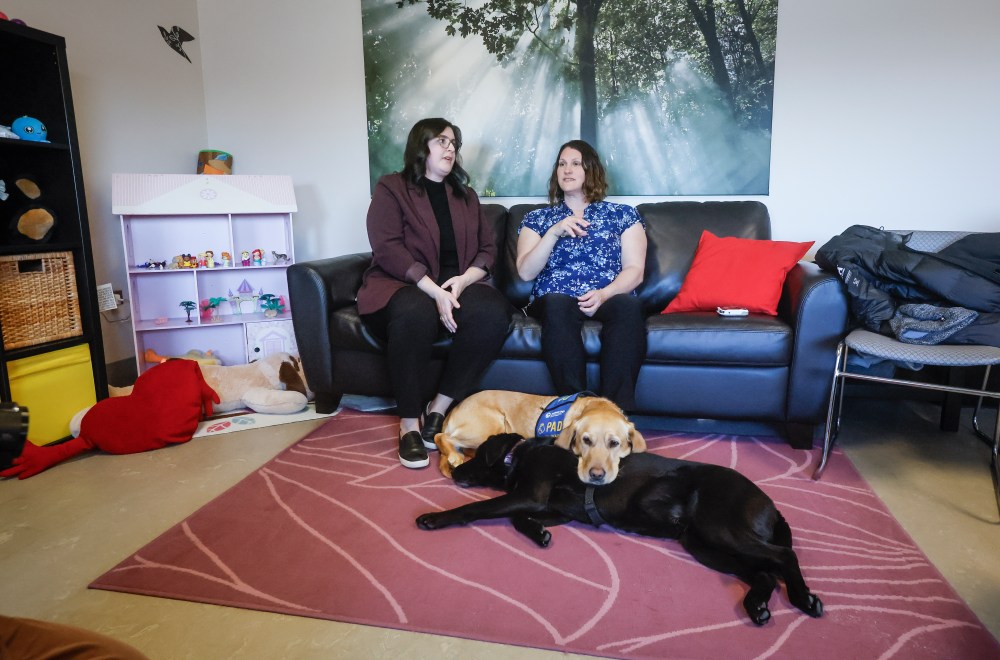
The five-year-old Labrador retriever with milk chocolate-coloured eyes and a shiny black coat to match her name, is one of two accredited facility dogs that support victims of crime or their families by lending a sympathetic paw.
“It’s something that helps make them feel comfortable to come in and talk about some of the worst things that have probably ever happened, knowing that there’s going to be a little furry face to greet them,” said Carla Deeley, a victim services worker and Glossy’s handler.
Glossy has been with the Manitoba Justice Victim Services team since July 2023. The province welcomed its first facility dog, Milan, in 2016. She retired in 2021.
The dogs were bred, raised and trained by the British Columbia-based Pacific Assistance Dogs Society. The non-profit trains facility dogs to work with police, in the justice system or with teachers, as well as service dogs to provide support for people with mobility issues or post-traumatic stress disorder.
Research has shown that assistance dogs can help reduce stress, anxiety and aggression and assist people who have trouble communicating, particularly children and those with disabilities.
Deeley says she sees it every day: Glossy in a witness box helping a child testify or giving snuggles to create a safe space for someone to open up.
“I had a young person who had selective mutism. So it took a couple meetings ,but eventually they started talking. I don’t know if it would have been possible without (Glossy),” she said.
As Glossy’s handler, Deeley spends most of her waking moments with the pup.
The duo primarily work with children who have to testify in court, but they have been brought in to help with other cases.
Glossy often made rounds at the 2024 trial of serial killer Jeremy Skibicki, who was found guilty of first-degree murder in the deaths of four Indigenous women: Rebecca Contois, Morgan Harris, Marcedes Myran and Ashlee Shingoose.
During the day, Glossy gives courthouse tours to families to help ease their worries, meets with victims and sits with witnesses in trials.
At night, she goes home with Deeley, where the working dog’s low energy and friendly demeanour mesh with Deeley’s pet dog.
It’s been a learning process for all, said Misty Bousquet, executive director of victim services team.
Judges, defence lawyers, prosecutors and court clerks had to learn to share their space, said Bousquet, and some didn’t understand the role of a facility dog.
“Those bumps have been really smoothed out, and the court system has really looked forward to seeing the dogs,” she said. “They bring something that’s so special, it is really hard to explain what it is.”
The department is seeing more and more requests for the dogs, which prompted the province to seek out a second dog to specifically work with victims’ families.
Bagel, a three-year-old mixed yellow Labrador and golden retriever, was brought in last summer.
She was recently in the court gallery for the trial of Jamie Felix, who was found guilty of second-degree murder in the shooting deaths of five people at a Winnipeg rooming house.
The canine comforted some of the victims’ families as they heard details of the violent killings.
“There’s a few times that I didn’t have Bagel in the courtroom. And the first thing I get (from family members) was, ‘Where’s Bagel?'” said Deanna Shaw, the dog’s handler and a victim services worker.
It’s not just families and victims who rely on the dogs. Glossy and Bagel depend on each other, too.
“They’re definitely besties, for sure,” said Shaw.
Bagel — also called Wiggles for her high energy — sometimes looks for guidance from Glossy.
When they’re off the clock, they sometimes meet up at the dog park to romp around.
When it comes time for retirement, Deeley and Shaw said they hope to make the dogs permanent family members.
“Truly an honour to have them and be able to be their handlers,” said Shaw. “Most people don’t have this opportunity, so I’m very thankful.”
This report by The Canadian Press was first published April 11, 2026.