
Parkland at ‘elevated risk’ of overland flooding
Advertisement
Read this article for free:
or
Already have an account? Log in here »
We need your support!
Local journalism needs your support!
As we navigate through unprecedented times, our journalists are working harder than ever to bring you the latest local updates to keep you safe and informed.
Now, more than ever, we need your support.
Starting at $15.99 plus taxes every four weeks you can access your Brandon Sun online and full access to all content as it appears on our website.
Subscribe Nowor call circulation directly at (204) 727-0527.
Your pledge helps to ensure we provide the news that matters most to your community!
To continue reading, please subscribe:
Add Brandon Sun access to your Free Press subscription for only an additional
$1 for the first 4 weeks*
- Enjoy unlimited reading on brandonsun.com
- Read the Brandon Sun E-Edition, our digital replica newspaper
*Your next Free Press subscription payment will increase by $1.00 and you will be charged $20.95 plus GST for four weeks. After four weeks, your payment will increase to $24.95 plus GST every four weeks.
Read unlimited articles for free today:
or
Already have an account? Log in here »
The reeve of one Parkland municipality said he is concerned about the likelihood of serious overland flooding.
The province on Saturday said there is an “elevated risk” of overland flooding in the Parkland region because of temperatures rising above 10 C in the coming days.
“This year, we’re pretty worried about how quickly it melts,” Municipality of Swan Valley West Reeve Bill Gade said on Monday.
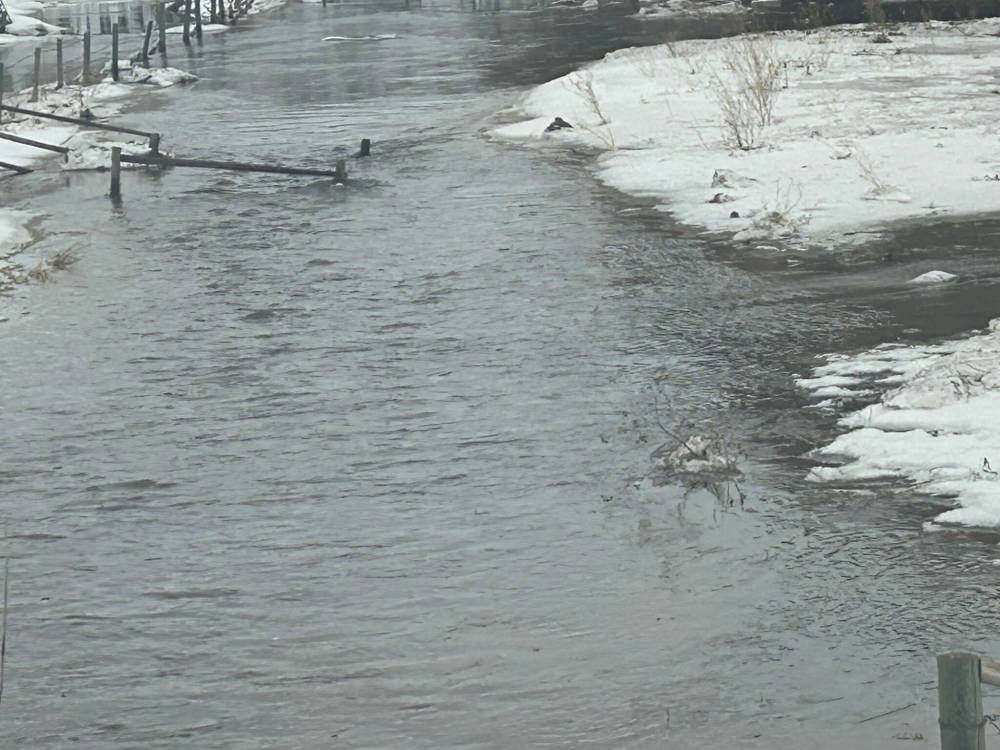
Water flows by a drain running through the RM of Dauphin on Monday. (Submitted)
“We’re expecting we’re going to see a fair amount of overland flooding.”
He said with heavy snowfall last week and more precipitation in the forecast this week, that roads could be washed out in the municipality.
Gade said there was less snow last year and the municipality still saw some roads affected by the melt.
Aside from roads, the flooding would likely hit farmland before it would impact homes, he said, adding that wet farmland for a day or two isn’t a big deal, but it could pose an issue the longer it stays.
“But the biggest issue for us is the infrastructure of the roads. It gets very expensive very quickly if we start washing roads out,” Gade said.
Gade said the damage to roads can vary, with some cases seeing only a loss of gravel on the surface that can be replaced.
“But other times, you know, we lose the culverts that are there, we lose the entire road, we’re spending weeks rebuilding roads and that’s kind of the way the year is starting to look right now.”
If it is a bad year for flooding, officials in the municipality keep their “fingers crossed” in hopes that the province allows it to claim disaster assistance, though that’s not a goal every year, he said.
“We always try to rebuild in a way that won’t see the damage again the next time,” Gade said.
“Sometimes that is impossible. Things get out of hand in a spring melt, but we certainly try very hard to make it so we don’t see the same problem in the same spot year after year after year.”
He said drainage work over the past decades has increased the flow and speed of running water.
In the meantime, to prepare, the municipality is getting ready by clearing culverts and doing work on ditches.
“It’s getting scary up here, because the longer it doesn’t melt, the faster it usually does, all at once,” he said.
Other municipal leaders in the region were less concerned about flooding, despite the province’s spring flood outlook.
Municipality of Minitonas-Bowsman Reeve Larry Mychalchuk said everything depends on how fast the snow melts.
If it’s a slow melt with cool evenings, there won’t be much difference this year compared to other years.
“We’re kind of prepared for it or whatever,” Mychalchuk said. “We clean out some problem areas prior to and clearing out pipes and such — stuff like that to minimize any problems that will arise.
“It’s nothing to get too excited about.”
Mychalchuk said clearing out waterways, which the municipality does every year, helps keep water from backing up and crossing roads.
“We are happy with the extra snow or whatever, because we can certainly use the moisture, so long as it’s a slow melt and it can soak into the ground,” he added.
A meteorologist with Environment and Climate Change Canada said the Swan River area saw about 25 to 30 centimetres of snow last week and could see 15 to 20 cm later this week.
The Dauphin area saw upwards of 30 cm last week and could see 10 to 20 cm later this week.
The estimations for later this week could change, said warning preparedness meteorologist Danielle Desjardins.
“If there is already a flood watch ongoing, any additional snow on top of what is already there, that’s just that much more moisture and precipitation to melt,” Desjardins said.
“Ideally, we would want a slow melt so that the ground has time to absorb the moisture, and we don’t have all the precipitation melting at once.”
If the snow did melt faster, it would “exacerbate the situation,” she said.
Temperatures for the rest of the week should be below average, Desjardins said, calling it a “good thing.”
The region should return closer to normal temperatures early next week, with near or slightly below normal temperatures for the rest of the month, models show.
“That’s the average of a longer period of time, so you are going to get days that are above and below normal in between there,” she added.
In the Rural Municipality of Dauphin, an official says he isn’t “overly concerned” about flooding.
Chief administrative officer Grady Stephenson said the municipality is also working on ditches to get water moving, but last week’s snowfall filled things back in.
“We can expect the water over some of the roads, and at this point we do have a couple of low-level crossings that have water running over them,” Stephenson said. “So we’ve done a couple of road closures, but nothing too significant so far.
“But you know, we’re always ready for that, and expect a little bit of it every year.”
He said residents should be mindful of water levels and take their own precautions so things don’t go sideways on them.
“We try to keep things moving on our end as much as possible. We can’t get everywhere where we’re only a smaller crew, and we can’t do everything at the same time,” he added.
Stephenson said it had been a fair spring up until last week’s snowfall.
“The outlook is still fairly positive right now, but we’re always making sure we’re prepared for the worst if we need to be.”
The province’s advisory also included an “increased flood risk” in the Interlake region because of significantly above-normal snowpack, a delayed melt and an increased likelihood of rapid runoff combined with spring precipitation.
In Peguis First Nation, people are bracing for flooding and are placing sandbags around some buildings.
The First Nation has been advised that it could see similar flooding to 2022, when the community had a large evacuation.
Elsewhere in the province, there is a moderate flood risk, including along portions of the Assiniboine, Souris and Saskatchewan rivers. Low risks are expected for tributaries of the Assiniboine, the advisory adds.
The mayor of the Municipality of Russell Binscarth and the reeve of the Rural Municipality of Riding Mountain West didn’t respond to requests for comment on Monday.
» alambert@brandonsun.com, with files from The Canadian Press