
Wheat Kings answer five questions
Advertisement
Read this article for free:
or
Already have an account? Log in here »
We need your support!
Local journalism needs your support!
As we navigate through unprecedented times, our journalists are working harder than ever to bring you the latest local updates to keep you safe and informed.
Now, more than ever, we need your support.
Starting at $15.99 plus taxes every four weeks you can access your Brandon Sun online and full access to all content as it appears on our website.
Subscribe Nowor call circulation directly at (204) 727-0527.
Your pledge helps to ensure we provide the news that matters most to your community!
To continue reading, please subscribe:
Add Brandon Sun access to your Free Press subscription for only an additional
$1 for the first 4 weeks*
*Your next subscription payment will increase by $1.00 and you will be charged $20.00 plus GST for four weeks. After four weeks, your payment will increase to $24.00 plus GST every four weeks.
Read unlimited articles for free today:
or
Already have an account? Log in here »
In the days before the 2025-26 Western Hockey League season began, five questions were posed about this year’s edition of the Brandon Wheat Kings.
The Wheat Kings won 40 games for the first time since 2017-18, but were swept in the Eastern Conference quarterfinals by a less talented Calgary Hitmen squad that played a better team game and defended their net like their lives depended on it.
Wheat Kings head coach and general manager Marty Murray said his club was able to bounce back from a terrible start and a raft of injuries in a season of ups and downs.
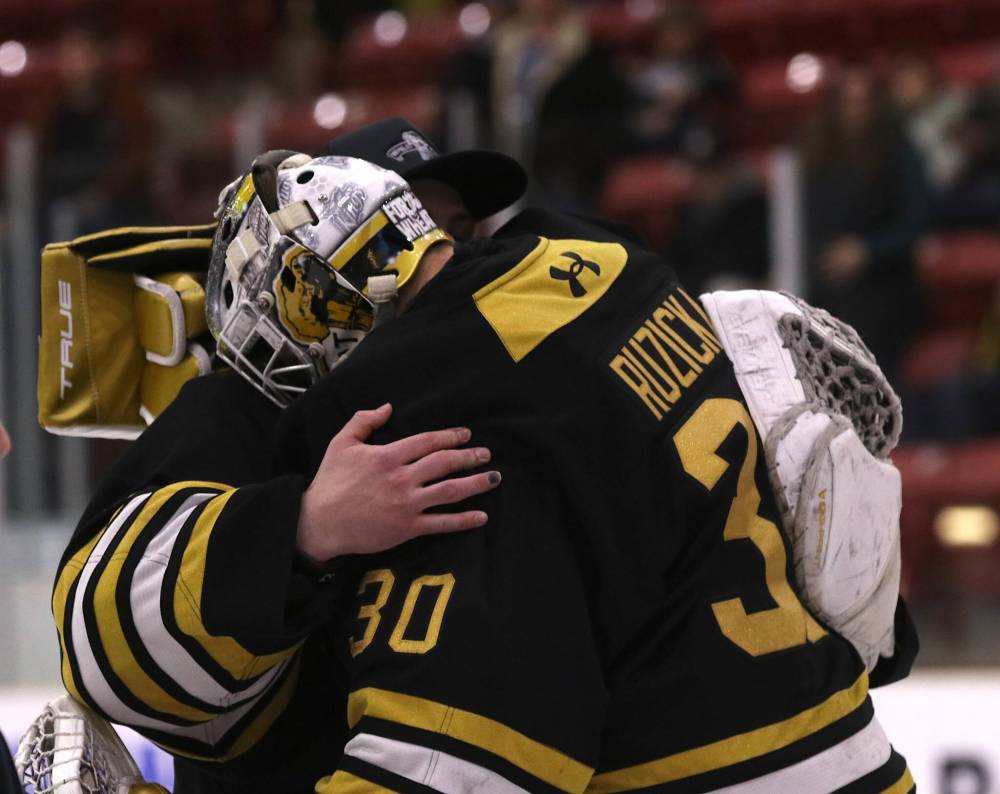
Brandon Wheat Kings netminder Filip Ruzicka (30) is comforted by his goalie partner Jayden Kraus (33) after Game 4 of their Western Hockey League quarterfinal series at Virden’s Tundra Oil and Gas Place on April 2. The two proved to be a strong goaltending duo for Brandon. (Perry Bergson/The Brandon Sun)
“The start was really frustrating,” Murray said. “We were 0-4-1 in our first five games and I think everything that could go wrong did go wrong. We just weren’t clicking. The schedule, with three really good teams in a row coming out of the Moose Jaw weekend wasn’t great timing. We found ourselves behind the 8-ball early and had to some soul searching.
“I thought guys came out of it and performed real well. Our December, we were 11-1 and really putting a stamp on the season that we can compete with anybody. A lot was dictated by injury. We had quite a few injuries and played a number of weeks without a full lineup and that’s hard to do.”
Part of the blessing and the curse of the injury bug was the fact that players got plugged into unfamiliar roles and some thrived, but at the end of the season, the club had been worn down and couldn’t elevate against the Hitmen.
“You could see some guys take some strides,” Murray said. “I use Prabh Bhathal or Nigel (Boehm) as an example. They get more opportunity and it’s fun to see them develop and expand their game. To lose (Easton Odut) and (Carter Klippenstein) through the season wasn’t ideal but I thought we showed a lot of character. Winning 40 games with the adversity we faced is something they can be proud of.
“Obviously the playoffs were disappointing with four one-goal games. We didn’t score at the right time or kind of dried up a little bit offensively and losing those two in overtime in Calgary, Games 1 and 2, really stung, and you throw in an illness bug going into Game 3 and it’s a lot to overcome. “Our guys battled hard but ultimately it’s disappointing wrapping up the season after round one.”
With five of their top seven scorers moving on, Brandon will need continued growth from their youngsters and immediate contributions from a talented group of rookie prospects to thrive next season.
When the five questions were originally asked in September before the season started, Murray and 10 returning veterans were asked to weigh in. Now Murray and The Brandon Sun look back at the season that just ended.
QUESTION 1
Who will step up down the middle to replace Roger McQueen and Matteo Michels?
August wasn’t a great month for Marty Murray as he lost the players he had slotted in to centre his top two lines when McQueen and Michels made late decisions to head to the NCAA.
It’s not unusual for WHL forwards to have played at least some centre before they arrived in major junior and were shifted to the wing, but Murray and his staff face a bit of a conundrum until the problem works itself out.
The leading candidates to step up appear to Jaxon Jacobson and winger Carter Klippenstein, with a handful of other possibilities as well.
What’s the solution, and how effective will it be?
• ANSWER: Jacobson centred the top line, with Klippenstein and Nick Johnson shifting back into the middle and American rookie Jimmy Egan also pitching in.
Jacobson was terrific at the dot, winning 55.4 per cent of his team-leading 1,123 draws, followed by Klippenstein (51.9 per cent), Johnson (49.8 per cent) and Egan (46.5 per cent). Brady Turko (48.3 per cent) and Prabh Bhathal (53.8 per cent) also both took more than 170 draws each.
“I think it was by committee,” Murray said. “Nick and Carter stepped in and did a good job of playing a positions they hadn’t played probably since youth hockey. Jaxon overall did a real good job of coming in and being a first-line centre as a young 17-year-old. That’s not always easy.”

Brandon Wheat Kings forward Joby Baumuller (17) scored his 36th goal against the Tri-City Americans during Western Hockey League action at Toyota Center on Jan. 30 and went on to snipe 40 times in a breakout season. (John Keller/Tri-City Americans)
“Jimmy Egan had a pretty solid season all the way around. I felt it was a Bandaid year with guys in and out and injuries. We even used Turko towards the end of the year. It was always a question mark but I think we did a pretty good job of masking the lack of depth we had this year and the guys did a pretty good job.”
The Wheat Kings should have more depth next season, with Jacobson, Egan, Turko and Bhathal returning and rookie Levi Ellingsen likely coming into the lineup.
“I think we’ll have more potential solutions there than we had this year,” Murray said.
QUESTION 2
Can the defensive corps take the next step with the loss of captain Quinn Mantei and overager Luke Shipley?
Teams regularly graduate their top pairing, but the Wheat Kings were hoping their captain would return for his overage season. Instead, he opted to go to school and the Wheat Kings found themselves moving forward without their best defensive and offensive blue-liners.
The trade for overager Grayson Burzynski and the addition of 19-year-old Czech defender Adam Hlinsky certainly helped, but they will need more from last year’s rookie trio of Gio Pantelas, Nigel Boehm and Dylan Ronald to make another big step this season.
Can this unit carry the load?
• ANSWER: An honest appraisal suggests they could, sometimes, but it’s impossible to ignore how often the Wheat Kings got outshot by a wide margin.
“There were ups and downs,” Murray said. “Just breaking pucks out and seeing plays and playing under pressure is something that good D corps, when they face that kind of pressure, they can get themselves out of trouble. For us, it was a bit of a challenge breaking pucks out consistently. There were times when we did but it’s an area that our D as a whole has to be better at. What we talked about all year was that the strength of our team was our forward depth, and getting the puck in their hands was critical.
“That’s an area we need to take a step in.”
One thing that hurt was losing 19-year-old veteran Merrek Arpin for the entire season in a pre-season game.
In addition, Hlinsky played just two games before he was injured and eventually went home, and was replaced by a waiver pickup in Russian blue-liner Daniil Skvortsov. That at least gave Brandon access to seven defencemen again.
“They knew we had to bring somebody in,” Murray said. “It helped bringing in a competitive side. For quite some time with Hlinsky unable to play, by default those were our six guys, and when you do that, even if things aren’t going great, you get complacent. ‘I know I’m not going to be taken out of the lineup.’
“When we brought Skvortsov in, it just brought in a little bit of a healthy competition and guys had to play well to make sure they were in the lineup.”
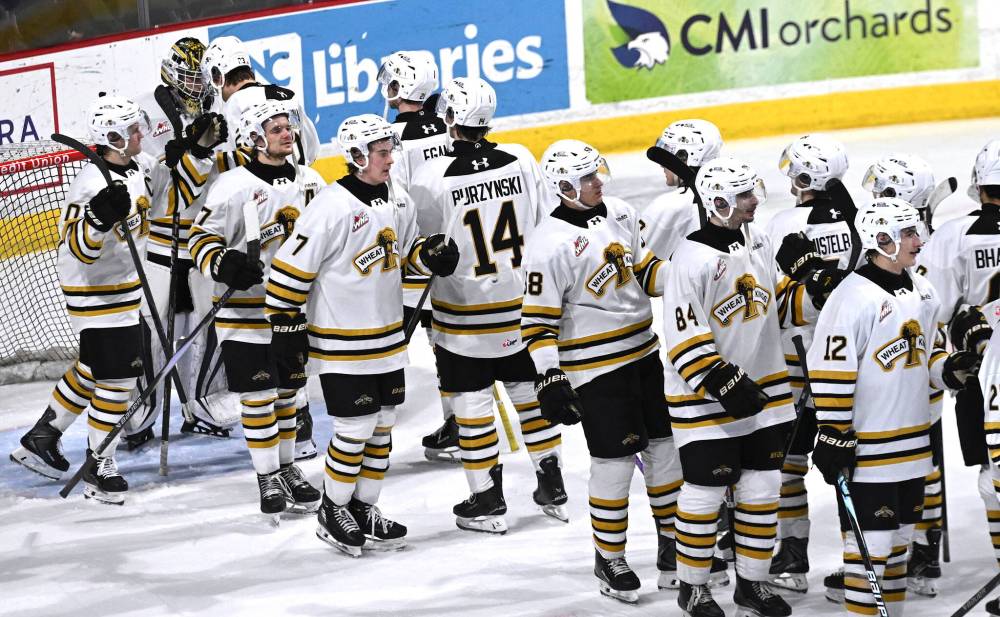
The Brandon Wheat Kings celebrate their 6-3 victory over the Wenatchee Wild 6-3 during Western Hockey League action at Town Toyota Center on Jan. 28. The team had 40 such celebrations in the regular season but none in the playoffs. (Russ Alman/Wenatchee Wild)
As the unit battled with injuries, it took time to find its footing. The team’s early defensive struggles were just that — nobody on the team was great early on — and the problems can’t entirely be pinned on the blue-liners.
“We grew a little bit as the season wore on as a D corps but I just want to get to that level where we’re hard to play against, we’re stingy and at the end of the day, you look at the results on the scoreboard,” Murray said. “I’m a guy who wants to win every facet of the game, scoring chances, shots on goals, things like that and there were nights where our goaltending did a great job but we relied too much on them.
“Our D and our whole team in general have to really dive into being really responsible all over the ice. It’s funny, the better you are at it, the less time you have to spend there.”
The linchpin of the unit was Pantelas, who took on a major role at 17 in much the same way Braden Schneider did as an alternate captain during the 2018-19 season. While he didn’t post the offensive numbers Burzynski did, he faced the other team’s best players night after night and showed terrific defensive growth.
It came with Pantelas in his National Hockey League draft year, something Murray thinks is on the mind of any eligible player to some extent.
“For Gio, it’s understanding that less is more,” Murray said. “When he tries to do too much, it backfires on him, but Gio has to find that line of being the number-one guy along with Burzynski maybe. What is it for Gio? For me, it’s defending well, defending hard and maybe the offence is kind of a bonus. It’s not what you are as a player, but overall, he handled it pretty well especially in the last part of the year when he played some of his best hockey.
“When you’re playing that much and playing that role, you’re playing against the other team’s top line and for a young 17-year-old defenceman he did a pretty good job.”
The Wheat Kings have an incredible influx of defensive prospects coming in next season, with 17-year-olds Ethan Young and Easten Turko, 16-year-old first rounder Cruz Jim and potentially 17-year-old Finnish blue-liner Samu Alalauri all looking for spots.
With Burzynski and Lavoie both moving on — and the overager Ronald, 19-year-old Skvortsov, 18-year-olds Pantelas, Boehm and Allard all coming back — something has to give with either the veterans or the talented newcomers.
QUESTION 3
Which players will take giant steps in production?
The question for Brandon isn’t if anyone will step in production, but rather who will make the most significant leaps forward. If Jacobson has a gifted trigger man like Mistelbacher riding his wing, he could pile up the points. Joby Baumuller, Jordan Gavin, Carter Klippenstein, Caleb Hadland, Brady Turko, Nick Johnson, Gio Pantelas and Easton Odut may also see significant increases.
So who steps up?
• ANSWER: Joby Baumuller, raise your hand please.
The third-year forward was sensational, jumping from 18 goals to 40 as he emerged as a dangerous scoring threat. The other major improvement came from Jacobson, who jumped from 44 points to 85 and was leading the WHL in assists when he was injured on Nov. 21 and missed three weeks.
“Since I’ve been here, it’s the first time we’re had anybody over 80 points and anybody over 40 goals,” Murray said. “It’s nice to have that when you’re standing on the bench knowing you have guys who can produce points.”

Brandon Wheat Kings forward Jaxon Jacobson smiles as his team celebrates its 5-4 victory over the Lethbridge Hurricanes during Western Hockey League action at VisitLethbridge.com Arena on Jan. 21. Jacobson had an outstanding season offensively and also helped solve a major problem up the middle for the Wheat Kings. (Erica Perreaux/Lethbridge Hurricanes)
The other jump came from Johnson, who set career highs with 22 goals, 31 assists, 53 points and a plus-minus of +34 as he moved into the middle.
But that didn’t mean everyone made big jumps in productivity. Klippenstein, Odut and Hadland all had injury problems, with the first two missing extensive time.
“When our team was doing well and having success, it was everybody,” Murray said. “We had a lot of guys who maybe we thought could have produced more and that’s hockey. In playoffs, the strength of our team was scoring by committee and having the ability to have whatever line win a game night in and night out for us, and you could see we had a lot of guys who came up dry, unfortunately at a big time of the year.
“It’s a team thing and the responsibility is on everybody, but we had guys who were capable of producing more and I think they would say the same thing.
“It’s not like they didn’t bring anything to the table but at the same time, guys who have had success, whether it be in past seasons or small doses, that’s usually the difference with moving on in the playoffs.”
QUESTION 4
Can Brandon’s new goaltending tandem carry the mail?
The Wheat Kings find themselves in a rare position in net as they kick off another season.
With the graduation of Carson Bjarnason and the trade of backup Ethan Eskit that brought in former Victoria Royals starter Jayden Kraus, Brandon will have two new netminders to start a season for the first time since 2018-19 when they traded Dylan Myskiw and Jiri Patera and Ethan Kruger took over.The last time they had a completely new tandem to start camp was in 2010-11 when Jacob DeSerres and Andrew Hayes were replaced by Liam Liston and Corbin Boes.
The candidates to back him up are former Edmonton Oil Kings netminder Hudson Perry, who is 18, and a pair of 17-year-olds, prospect Dylan McFadyen and Czech netminder Filip Ruzicka, whose transfer has been appealed by his former club and is caught up at the IIHF. As a result, no one is certain when he’ll arrive.
What’s the forecast for the new-look duo?
• ANSWER: McFadyen struggled at camp and was reassigned, and with Ruzicka’s arrival delayed, Perry earned the backup job.
It was Kraus who paid early on as the team struggled to defend, and he took all season to rebuild his numbers. He was simply sensational at times as he boosted the .833 save percentage he had a month into the season into a more recognizable .895.
Then, late in the campaign, he suffered an upper-body injury at practice and made just one appearance in the final month. By then, Ruzicka had put his stamp on the starting job and appeared in all four playoff games.
“We felt really comfortable starting either Jayden or Filip on any given night in the second half of the year,” Murray said. “They both gave us a chance to win. I think there was a switch in general with our team too. For whatever reason, I don’t think we played as well in front of Jayden at the start of the year, and I think that got balanced out in the second half when we knew what we were going to get from our guys, regardless of who was playing, which was nice.
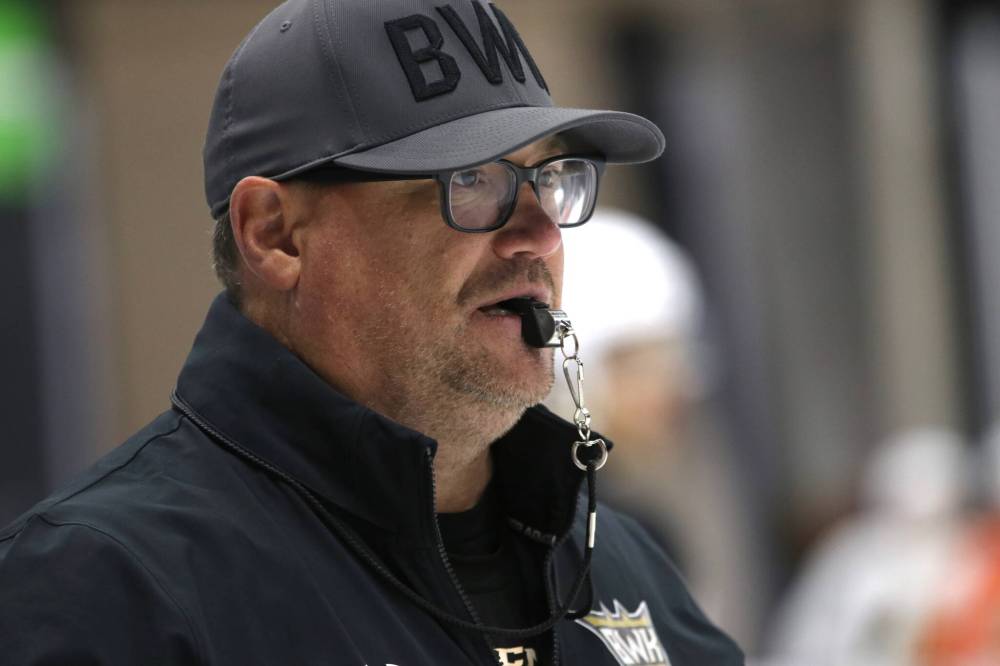
Brandon Wheat Kings head coach and general manager Marty Murray said his team showed a lot of character as they faced repeated adversity during the season but still won 40 games. (Perry Bergson/The Brandon Sun)
“We all know how important goaltending is and we all know how important it is to have two guys you can count on. We had that in the second half.”
The six-foot-seven Czech goalie was transcendent at his best, effortlessly covering a lot of net. He played himself into almost certainly being a National Hockey League draft pick.
With the benefit of a season’s experience and a real love for his teammates and his time in Brandon, he could be one of the top goalies in the WHL next season.
But in a revealing look at the team’s bad luck, both had the flu or food poisoning for Games 3 and 4 of the playoffs, with Ruzicka throwing up on the bus on the way home after making 48 saves in a 3-1 loss in Virden in Game 3.
“In the playoffs we gave Filip all four games,” Murray said. “There was a lot of conversation about ‘Even though it’s not Filip’s fault, do we try to change the mojo up here a little bit and give Jayden a start. We thought Ruzicka played so well and his numbers were sparkling and Jayden was one of the guys who came down with the flu bug coming off the broken finger, so it made more sense to continue with Filip, who also got sick as the series went on.
“They both made it difficult, and that’s a good problem to have, who to give the net to at the critical times.”
The thing that Murray enjoyed most about his duo was that they put the team first. While that sometimes didn’t look great for their numbers, victories were what they wanted.
“What I really liked about both goalies was when you’re a goalie, you probably want to win 2-1 and stop 29 out of 30 or whatever,” Murray said. “Where I tip my cap to them was there were nights when maybe we win 5-4 and they were OK, they weren’t great and maybe there was a defensive breakdown, but they were both just happy with the win. You could tell, and that speaks volumes about the kids and the type of people they are.”
QUESTION 5
Can the special teams be special again?
Depending on what nights you saw the Wheat Kings last season, you could be forgiven for thinking their two special teams units were the best — or worst — in the WHL.
The power play struggled to score in big moments last year and despite some inspired stretches, fell to 15th in the league at 22.8 per cent. The penalty killing was a revelation, leading the league for a stretch before some late struggles dropped them to ninth at 78.3. Combined, that puts them at 101.1 per cent, down from the combined total of 105 per cent that is traditionally seen as the sign of effective special teams.
With McQueen, Mantei, Shipley and overagers Nolan Flamand and Marcus Nguyen gone, the power-play units will feature a new look, but it seems to have the pieces in place for success.
On the PK, can Brandon finish in the top five for the third time in the last 20 years? A big part of that will also be limiting penalties in a kinder, gentler era of the game.
• ANSWER: Combined the two units were at 98.8 per cent, well below the 105 threshold and down from a year earlier.
One of the great mysteries of this season is what happened to the power play. In mid-November, Brandon’s once mighty power play was first in the league at 38.3 per cent, but it fell off precipitously and finished the season in 11th place at 23.6 per cent.
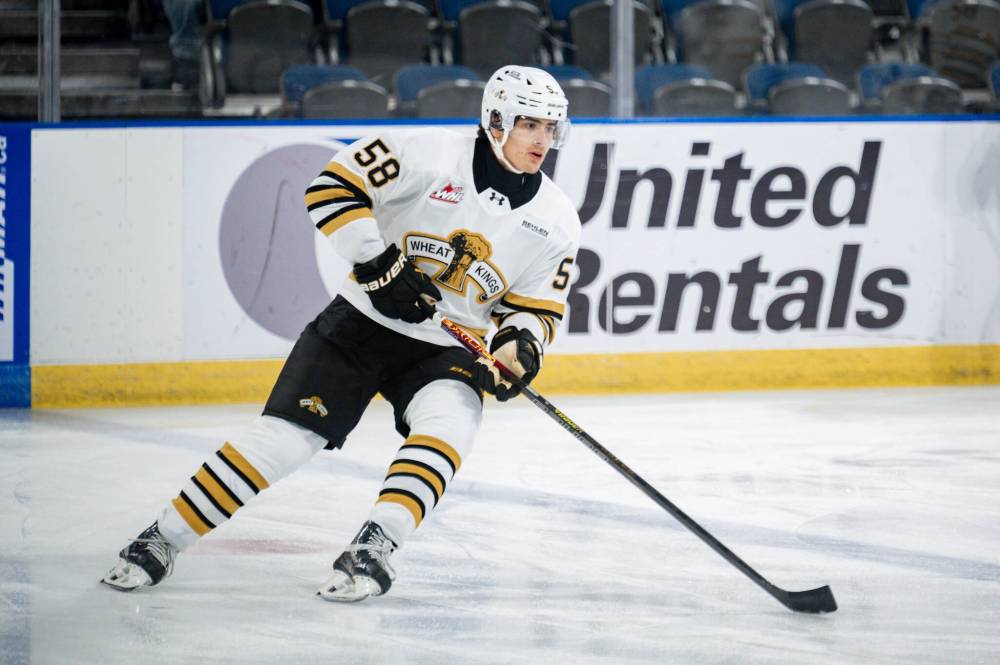
Brandon Wheat Kings defenceman Daniil Skvortsov (58) makes his debut against the Lethbridge Hurricanes at VisitLethbridge.com Arena during the home team’s wild 8-7 Western Hockey League victory on Nov. 7. His arrival came at an important time for Brandon. (Erica Perreaux/Lethbridge Hurricanes)
“We got a little flat I thought down the stretch with our power play,” Murray said. “At the start of the year, we looked like we were going to score every time. It’s such a momentum thing and such a confidence thing. We definitely got flatter as the season went on.”
While they were capable of jaw-dropping brilliance at times, they were also sometimes deliberate, slow and overly confident of soft passes into danger zones that led to odd-man rushes or easy clears.
“You have to take what’s given to you,” Murray said. “Just like five on five, you don’t have to make something happen right now. It might be 10 seconds from now. Guys wanted to get the power play going and wanted to have it be a factor in the game, but it’s understanding the time and the place. “Sometimes stretching them out and finding that seam, where if you’re forcing pucks with passes that aren’t necessarily there, it’s usually on a stick and down the ice. If you’re four or five breakouts per penalty kill, guess what you’re spending most of your time doing?
“Forcing passes and recovering pucks, whether it be after shots or off faceoffs, those were areas that hurt us.”
All those failures to execute were also reflected in the fact Brandon was tied for 12th in the league with seven shorthanded goals against. And in the playoffs, the power play could have decided the four one-goal games but instead went 1-for-10.
“When it’s crunch time, special teams are so big,” Murray said. “We played Calgary in the first round and they had one of the top power plays in the league and they took the fewest penalties in the league. We knew we couldn’t take penalties and in saying that, we knew they weren’t going to take too many, so any time there was a special-teams situation, you have to make it count.
“There were times down the stretch of the season and especially in the playoffs where you need your special teams to come up with a goal, whether it be in overtime. Look at Calgary, they’re down 2-1 in the third period and get a power play and score on it. That to me is where you need those special teams to come through.”
On the other side of the penalty box, Brandon took 877 penalty minutes, an average of 12.9. The Wheat Kings finished 14th on the kill in the 23-team league at 75.2 per cent, allowing 63 power-play goals on 254 chances.
They were also tied for worst in the league with just two shorthanded goals, 11 fewer than the league-leading Medicine Hat Tigers.
“The PK struggled at the start of the year and I think got better as the season wore on,” Murray said. “Part of it is just paying the price. We talked a lot about goaltending, and your best penalty killer is usually your goaltending, so if the goaltending is playing well, that often helps your PK.
“Just having good sticks and being in shot lanes and eating a lot of pucks, and in the second half of the year, it was significantly noticeable that we blocked a lot more shots and those are the things that are difference makers.”
» pbergson@brandonsun.com