
Austin grain elevator bites the dust
Advertisement
Read this article for free:
or
Already have an account? Log in here »
We need your support!
Local journalism needs your support!
As we navigate through unprecedented times, our journalists are working harder than ever to bring you the latest local updates to keep you safe and informed.
Now, more than ever, we need your support.
Starting at $15.99 plus taxes every four weeks you can access your Brandon Sun online and full access to all content as it appears on our website.
Subscribe Nowor call circulation directly at (204) 727-0527.
Your pledge helps to ensure we provide the news that matters most to your community!
To continue reading, please subscribe:
Add Brandon Sun access to your Free Press subscription for only an additional
$1 for the first 4 weeks*
- Enjoy unlimited reading on brandonsun.com
- Read the Brandon Sun E-Edition, our digital replica newspaper
*Your next Free Press subscription payment will increase by $1.00 and you will be charged $20.95 plus GST for four weeks. After four weeks, your payment will increase to $24.95 plus GST every four weeks.
Read unlimited articles for free today:
or
Already have an account? Log in here »
AUSTIN — Community members in Austin watched in awe as a grain elevator built in 1951 crashed to the ground during a planned demolition led by the Pine Creek Hutterite Colony late Wednesday morning.
John and Nellie Reimer — who stood among a large crowd of people behind a barricade on Second Avenue — said they felt mixed emotions as an excavator gutted the elevator before knocking it over, creating a massive cloud of dust.
“I guess it’s sad in a way to see it go, but it’s rotten and it’s not safe anymore,” said Nellie, 77, who has lived in Austin with her husband since 2011.

The grain elevator in Austin, built in 1951, comes crashing down on Wednesday during demolition by members of Pine Creek Hutterite Colony. (Photos by Tim Smith/The Brandon Sun)
John, 81, said it was “almost sad” to watch the demolition, but he knew it was only a matter of time before it could have collapsed anyway.
He pointed to his house about a block from the grain elevator.
“At the kitchen window, I could sit there at the table and look out and see the elevator, but it’s gone now,” he said.
The Hutterite colony took ownership of the 75-year-old grain elevator from the agriculture company Viterra in 2003 and used it to weigh and clean grain, said Michael Maendel, the colony’s full-time minister.
“The demolition — it’s unfortunate we had to do it,” he said. “It got all rotten and everybody was complaining, and stuff was flying off in a big wind.”

A crowd gathers to watch as the grain elevator in Austin is torn down on Wednesday.
The grain elevator hasn’t been used commercially in the last few years, he said.
The Municipality of North Norfolk notified the public of the upcoming demolition last week, explaining that the structure was “deemed unfit for occupancy” and that Second Avenue would be closed from 11:30 a.m. to 4:30 p.m.
Maendel said his crew was able to start the demolition before 11 a.m. because a train heading west to Saskatchewan passed by ahead of schedule. This brought a wave of relief to workers, who no longer had to worry about a time-crunch to remove rubble if the building partially fell on the tracks, he said.
Cleaning up the debris won’t happen with magic, Maendel said, especially as farmers are preparing for seeding season to begin. The rubble will be fenced off for at least a week.
Any salvable materials will be recycled, and the rest will be taken to the landfill, he said, adding that the grain cleaner and scale will be relocated to another elevator for commercial use.
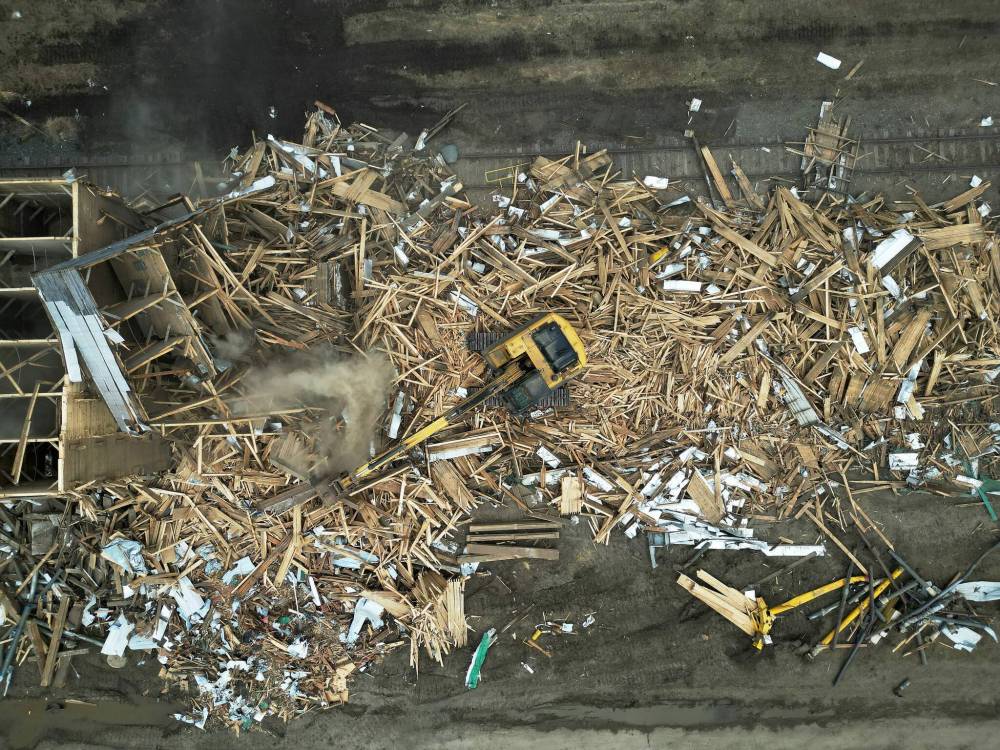
An aerial view of Wednesday’s demolition.
“We used to clean grain in here a lot for ourselves and we’re going to miss that part,” Maendel said.
“It was really great because back in the day, when you were using tandems, you could haul grain in there and have a semi hauling to the elevator. So, the whole system was really rotating before anybody really had B-trains.”
John Reimer said he still remembers what it was like as a truck driver in the ’70s hauling grain, flaxseed and canola from the Austin elevator to places such as Altona in southern Manitoba and Minneapolis.
“You would drive in from the far end onto the scale. Scale your truck to your empty weight, and they’d fill it up till your proper weight, scale it, put on your tarp and head for Minneapolis,” he said.
Netha Hildebrand, 55, who’s lived on a farm a few miles outside of Austin for 34 years, said she and her husband used the elevator to weigh their grain.

Members of Pine Creek Hutterite Colony collect the lettering from the grain elevator in Austin on Wednesday, while tearing down the elevator. The colony bought the elevator from Viterra in 2003.
“It’s very sad to watch it come down,” she said. “Now it’s gone, you know, I won’t see that every day anymore.”
Grain elevators are widely viewed as a symbol of the Prairies, but they are becoming too small for modern agriculture and often require a lot of maintenance, said Gordon Goldsborough, the acting executive director of the Manitoba Historical Society.
The Austin structure was primarily made of wood and was covered in metal cladding that was meant to protect against all kinds of weather.
“All it takes is a few windstorms that tear off some of those protective metal panels on the outside, and then water starts to creep in, and that’s when they start to deteriorate,” Goldsborough said, adding that there were many gaping holes along the siding.
Most towns across southern Manitoba were developed near railways, so farmers using horse-drawn wagons wouldn’t have a long distance to haul their grain to the local elevator, he said.
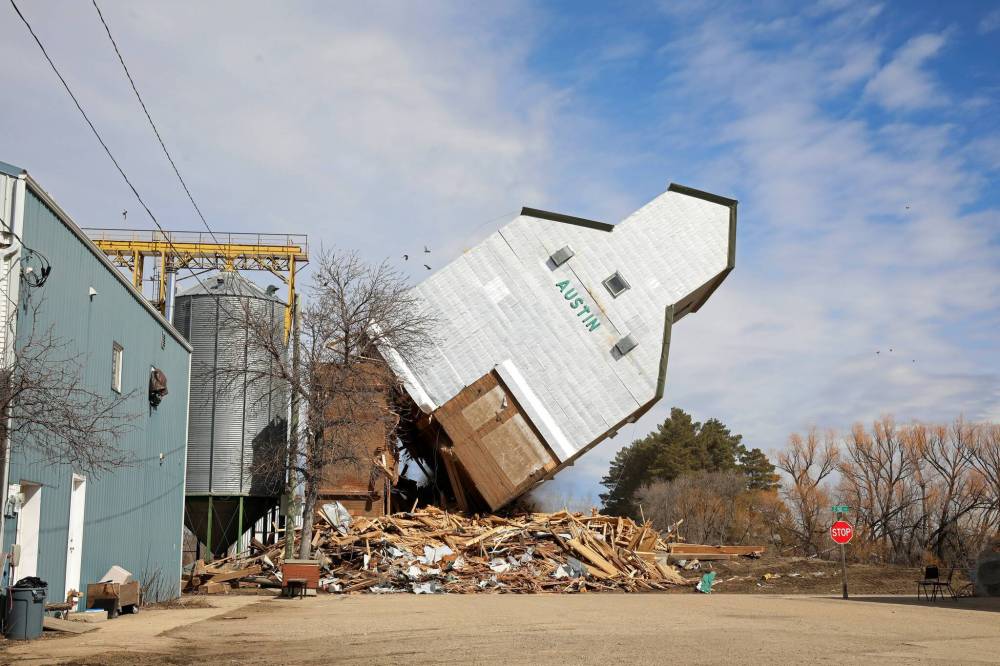
The grain elevator in Austin comes tumbling down on Wednesday.
“These elevators are the hearts of Prairie communities,” Goldsborough said.
“It’s always sad because the number of them dwindles year by year, and I anticipate probably within the next couple of decades, they’ll almost all be gone.”
At one point, Manitoba had more than 700 grain elevators, but after Wednesday’s demolition, only 113 remain with more than half left vacant and no longer in use, he said.
“That’s never a good recipe for survival,” because then nobody’s maintaining them, they start to deteriorate and become a liability in the community, Goldsborough said.
Wednesday’s demolition leaves Austin with only the 1901 Western Canada Flour Mills grain elevator that’s on display at the Manitoba Agricultural Museum, located just south of town on Highway 34. The historical society decribes it as the oldest surviving grain elevator in Manitoba. It was designated as municipally significant by the Municipality of North Norfolk in 2013.

Letters are removed from the site after Wednesday’s demolition.
» tadamski@brandonsun.com