
Fair-trade artisan rugs are family affairs
Advertisement
Read this article for free:
or
Already have an account? Log in here »
We need your support!
Local journalism needs your support!
As we navigate through unprecedented times, our journalists are working harder than ever to bring you the latest local updates to keep you safe and informed.
Now, more than ever, we need your support.
Starting at $15.99 plus taxes every four weeks you can access your Brandon Sun online and full access to all content as it appears on our website.
Subscribe Nowor call circulation directly at (204) 727-0527.
Your pledge helps to ensure we provide the news that matters most to your community!
To continue reading, please subscribe:
Add Brandon Sun access to your Free Press subscription for only an additional
$1 for the first 4 weeks*
- Enjoy unlimited reading on brandonsun.com
- Read the Brandon Sun E-Edition, our digital replica newspaper
*Your next Free Press subscription payment will increase by $1.00 and you will be charged $20.95 plus GST for four weeks. After four weeks, your payment will increase to $24.95 plus GST every four weeks.
Read unlimited articles for free today:
or
Already have an account? Log in here »
Ten Thousand Villages Brandon is kicking off its annual event on Saturday promoting the sale of more than 250 hand-knotted fair-trade rugs made by artisans in Pakistan.
The opening reception for the event begins at 10:30 a.m. in the store at 829 Rosser Ave. and will feature a presentation by Yousaf Chaman, the director of Bunyaad, a fair-trade company based in Lahore, Pakistan.
Chaman, who grew up in the capital of Punjab, told the Sun he plans to share artisan stories and tips on how to care for the Tribal, Bokhara and Persian rugs and runners that range from classic to contemporary designs and vary in size and texture.
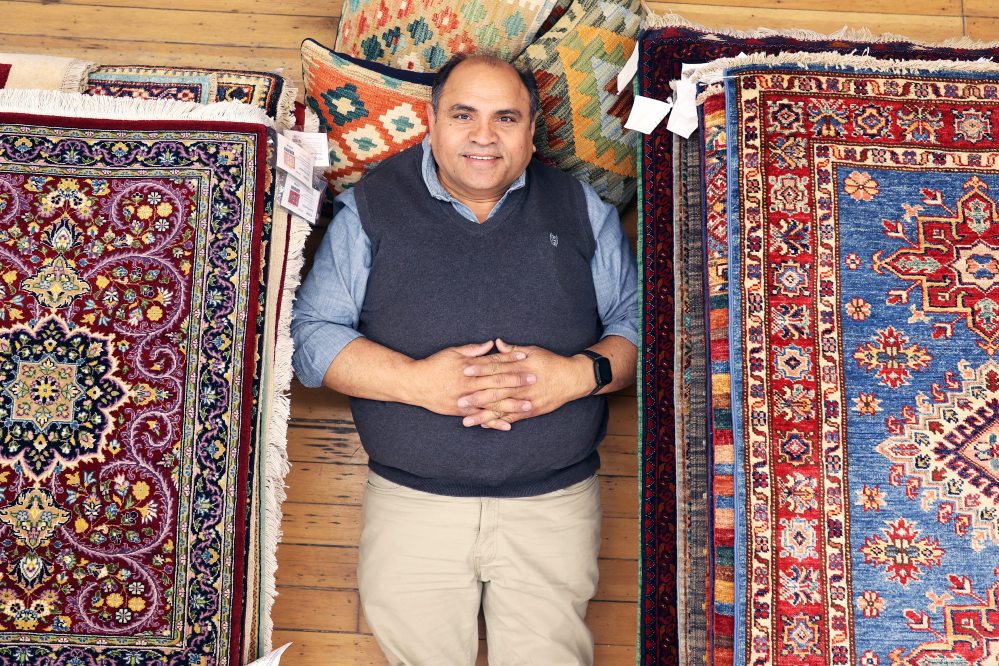
Bunyaad, which means “foundation” in Urdu, aims to preserve the rich cultural heritage of traditional rug-making while increasing employment opportunities for people in Pakistan.
“The goal of the fair wage is that the artisan has three meals a day, education for their children and a good living condition. That means if there’s floods, if there’s earthquakes or anything, their houses are designed to handle those things so they can sustain life in the villages,” he said.
Chaman’s father was one of the rug-makers who started the company by helping 10 families in the 1960s. The initiative has now grown to support more than 850 families across roughly 125 villages.
“That’s why there’s a wide variety of rugs that you see, from sizes to colours and prices as well, because some artisans do more handspun wool … and then some artisans do more intricate like Persian-style rugs,” Chaman said.
The rugs are made from wool, cotton and silk and have natural dyes that include onion skins, walnut shells, flowers and peels from different foods, as well as synthetic and commercially produced dyes, he said.
The price is set by the artisans and varies based on the knot count, materials and the labour, including spinning the wool, designing and washing it, Chaman said.
It can take one to two years to complete a high-quality rug that is meant to last forever as the dyes are designed to handle sunlight, he said.
Chaman travels to Pakistan about twice each year and is in frequent contact with the artisans to let them know when their rug has sold.
“It gives them great joy to see where their rug ends up. Historically, that never was the case because a rug was sold and nobody knew exactly where it ends up in the world,” he said.
Chaman said he recently met an artist who studied to become a teacher and then moved to a village with 20 to 30 families to teach the children and continue her family tradition of rug-making.
“The goal is to keep the tradition alive in the villages where the rugs have been made for centuries,” he said.
Chaman said his first memory dates back to when he was four years old, watching his uncle and father make rugs together on a loom.
“For me to grow up in that environment, knowing the rugs inside out — both in terms of knot count, the quality and how they decide what size they’re going to make — it really means a lot to me because it’s part of the livelihood, it’s part of the culture and it’s very authentic,” he said.
His uncle would promise to let Chaman and his cousin tie four to five knots once they had completed their homework in the evening.
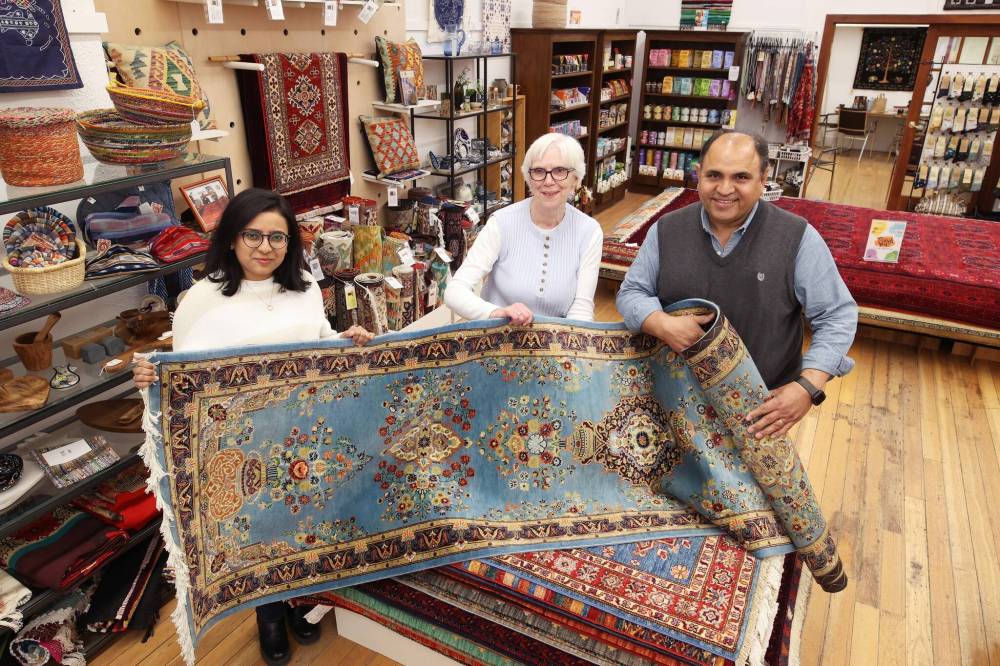
Ten Thousand Villages Brandon store manager Bhoomi Pokar, board chair Linda Dryden Friesen and Yousaf Chaman, director for the Bunyaad program, hold up one of the hand-woven Pakistani rugs for sale at the Rosser Avenue store on Thursday. The store will kick off its annual fair-trade rug event on Saturday. (Tim Smith/The Brandon Sun)
“I’m pretty sure that he took those knots out because the knots have to be precise, but he taught us how to tie the knots,” Chaman said.
Children may learn how rugs get made, but they don’t typically start making or designing their own until adulthood because the knots have to be precise.
Poorly made rugs reflect badly on the entire village, Chaman said.
Bhoomi Pokar, the manager of Ten Thousand Villages Brandon, said the store received all the rugs on Wednesday.
The rug collection will be available at the store until May 6 before they are transferred to a different location in Canada, she said.
“It’s a good collaboration to support everybody and … people can explore the hand-knotted rugs and the traditional rug-making process as well.”
Pokar said this is the fourth year Brandon has partnered with Bunyaad for the rug sale event.
Whether people decide to purchase a rug that costs up to $14,000 or not, she encourages them to admire the craftsmanship.
“It’s kind of a small art gallery where you go and experience these beautiful hand-knotted rugs, and the hard work behind each rug and the story is just inspiring,” Pokar said.
The event will also feature music from pianist Holly Walker and refreshments will be served.
» tadamski@brandonsun.com