
B.C. ‘chemical fingerprint’ scheme to track illicit drugs is likened to DNA tests
Advertisement
Read this article for free:
or
Already have an account? Log in here »
We need your support!
Local journalism needs your support!
As we navigate through unprecedented times, our journalists are working harder than ever to bring you the latest local updates to keep you safe and informed.
Now, more than ever, we need your support.
Starting at $15.99 plus taxes every four weeks you can access your Brandon Sun online and full access to all content as it appears on our website.
Subscribe Nowor call circulation directly at (204) 727-0527.
Your pledge helps to ensure we provide the news that matters most to your community!
To continue reading, please subscribe:
Add Brandon Sun access to your Free Press subscription for only an additional
$1 for the first 4 weeks*
- Enjoy unlimited reading on brandonsun.com
- Read the Brandon Sun E-Edition, our digital replica newspaper
*Your next Free Press subscription payment will increase by $1.00 and you will be charged $20.95 plus GST for four weeks. After four weeks, your payment will increase to $24.95 plus GST every four weeks.
Read unlimited articles for free today:
or
Already have an account? Log in here »
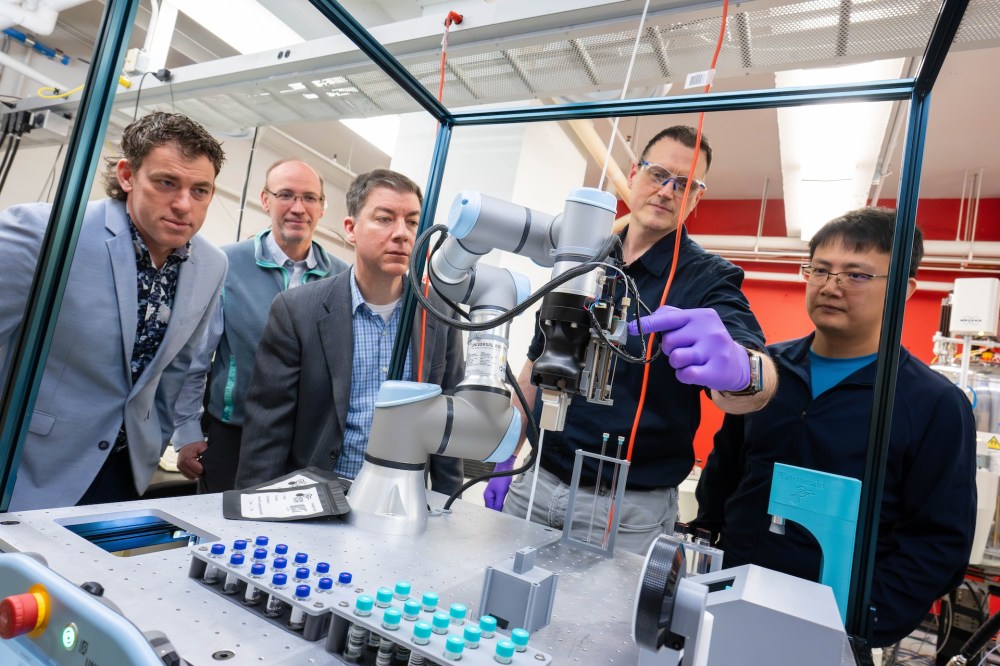
VANCOUVER – Tucked in the basement of the chemistry building at the University of British Columbia, an arm-sized robot carries out the repetitive task of collecting and weighing colourful vials as machinery whirrs in the background.
It’s part of a unique blend of robotics, chemistry and artificial intelligence aimed at helping police and health officials trace the path of batches of illicit drugs.
Police hope the “chemical fingerprinting” program is a game-changer in B.C.’s battle against toxic illicit drugs, with one senior officer likening it to DNA testing.
The provincially funded program will use technology developed at UBC by Aidos Innovations that looks at the chemical makeup of drugs and calculates their method of production, which police say could help them learn how drugs move over time.
Aidos Innovations will use artificial intelligence to generate what the provincial government says will be “actionable insights” for police, while also helping to target public health alerts when toxic additives are detected.
Victoria’s Chief Constable Fiona Wilson said the technology had “potential to be the most significant advancement in drug intelligence and public health” in her almost three decades of policing.
“I actually compare it to the advent of DNA, when it first emerged,” she told a news conference at UBC to announce the program.
Dr. Matthew Roberts, managing director of Aidos Innovations, said the two-year pilot program, which has already received its first samples from police, doesn’t just identify drugs.
“It allows us to look backwards to understood how they were produced in the first place,” he said.
The technology allows investigators to anticipate how drugs move over time, he added.
The robotic instruments developed on campus will test seized drugs for impurities.
“Then, using AI, we can actually back calculate the method of production,” he said. “So, this goes well beyond typical drug-checking sort of technology by using those two layers together.”
Roberts said the technology is different from regular drug testing because it looks at a broad spectrum of chemicals instead of a specific substance, which allows AI to calculate the “recipe” that makes up drugs in particular batches.
Jason Hein, a UBC chemistry professor whose lab is home to the program’s robotic equipment, said it utilizes the same technology used in the manufacturing of pharmaceuticals.
The lab receives drug samples from police partners, and its robot picks, weighs and dissolves the vials into measurable components.
Then the samples go into a machine that acts like an “MRI for molecules” and allows analysis at the molecular level.
The last step is an AI analysis, which puts the pieces together on a real-time dashboard that helps track drugs’ origins.
Wilson said analysis results will be available through a dashboard to investigators and others.
But the program, which the province is funding with $300,000 per year, won’t be used in prosecutions, and nor will drugs obtained in prosecuted cases be tested.
“It is intended to improve our understanding of the illicit drug supply, support front-line responders and public health actions.”
The pilot is “proof of concept,” and its use could be broadened in time, Wilson said.
“Our hope is that the results of the pilot project will be such, that with further engagement with Crown and the coroners service and other partners that eventually, we will be able to use the information gleaned from the analysis and the dashboard for criminal prosecution. We are not there yet.”
But police “do hope to get there one day,” she added.
Friday’s announcement comes just three days after B.C. marked the 10th anniversary of the declaration of a public health emergency around illicit toxic drugs that have since killed more than 18,000 people since.
B.C. Public Safety Minister Nina Krieger said the testing program was a “bold” step in responding to the toxic drug crisis.
Health Minister Josie Osborne said one of the greatest challenges of this crisis has been the unpredictability of the toxic drug supply.
“The track-and-trace technology helps us better understand where the greatest harms are coming from, and these kinds of insights into the illicit drug supply can be used to inform responses in conjunction with community drug checking,” she said.
— With files from Wolfgang Depner in Victoria
This report by The Canadian Press was first published April 17, 2026.