
Is all that spending necessary?
Advertisement
Read this article for free:
or
Already have an account? Log in here »
We need your support!
Local journalism needs your support!
As we navigate through unprecedented times, our journalists are working harder than ever to bring you the latest local updates to keep you safe and informed.
Now, more than ever, we need your support.
Starting at $15.99 plus taxes every four weeks you can access your Brandon Sun online and full access to all content as it appears on our website.
Subscribe Nowor call circulation directly at (204) 727-0527.
Your pledge helps to ensure we provide the news that matters most to your community!
To continue reading, please subscribe:
Add Brandon Sun access to your Free Press subscription for only an additional
$1 for the first 4 weeks*
- Enjoy unlimited reading on brandonsun.com
- Read the Brandon Sun E-Edition, our digital replica newspaper
*Your next Free Press subscription payment will increase by $1.00 and you will be charged $20.95 plus GST for four weeks. After four weeks, your payment will increase to $24.95 plus GST every four weeks.
Read unlimited articles for free today:
or
Already have an account? Log in here »
On Monday night, Brandon City Council unanimously approved a new transit master plan that will almost completely revamp the city’s existing public transit network. As reported in Wednesday’s Sun, the plan will be implemented in three phases over several years. Once all of the elements are in place, it will create seven completely new bus routes, move from one to three transit hubs, increase evening bus services and extend Sunday operating hours.
The first phase, which could be implemented as early as this fall, would see the existing routes 4 and 5 replaced by two new routes. One of those routes, which will be known as Route 3, will be a one-way loop on the North Hill, serving the Corral Centre, commercial properties along the Trans-Canada Highway, Assiniboine College’s North Hill campus and First Street North.
The new Route 7, on the other hand, will start at the downtown bus exchange, turn west on Pacific Avenue to 18th Street and then head north. It will serve Stickney Avenue and continue north on 18th to Braecrest Drive, then travel south on First Street North on its way back to the downtown exchange.
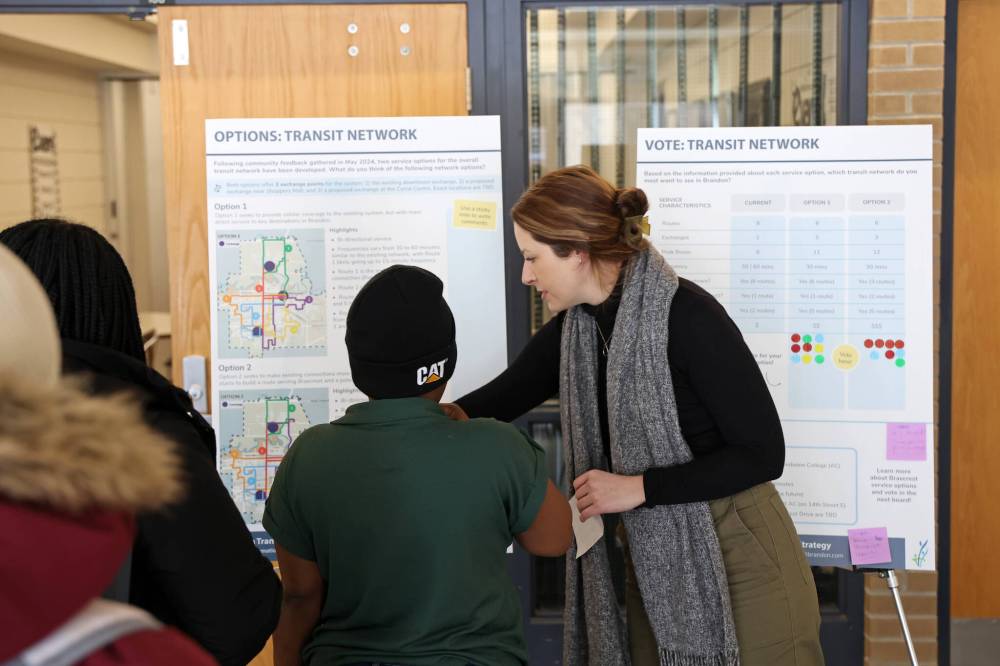
Lainy Stevenson (right), senior transportation planner with Watt Consulting Group, speaks with students at Brandon University last year during public engagement on behalf of the City of Brandon regarding proposed options for the future of Brandon Transit. Deveryn Ross wonders whether it was worth it for the city to bring in an out-of-province consulting firm “for a plan that basically tweaks” the existing transit plan. (Tim Smith/The Brandon Sun files)
Given that the two routes somewhat overlap, it makes sense that they would be rolled out at the same time. What makes less sense, however, is the fact that the city reportedly paid an out-of-province consulting company more than $180,000 to come up with a transit plan that the city admits (in the report from administration for last Monday’s meeting) “closely resembles the current system.”
Did taxpayers really need to spend all that money — the total annual salaries for up to three city staff, or the total amount of property taxes collected from 90 average homes in the city — for a plan that basically tweaks the existing transit plan? Could these changes not have been designed by city staff following consultations with the public?
Think about it. The addition of an express route that would travel 18th Street between the Corral Centre and Shoppers Mall will be a welcome addition, but Brandonites have been calling for such a route for more than a decade, along with east-west express routes on Richmond and Victoria avenues. Similarly, the possibility of a bus exchange being located within the Corral Centre property, as opposed to a bus bench on 18th Street North, is a solution that transit users have wanted since the mall opened two decades ago.
In other words, there is nothing in the new transit plan that Brandonites weren’t already talking about and/or requesting years ago. Given that reality, can it really be said that high-priced consultants were absolutely needed in order to get the job done? Can it really be said that Brandon taxpayers got their money’s worth?
Sadly, this is not a one-time problem. Over the past several years, city hall has increasingly relied upon consultants to do work, at a very high cost, that likely could have been done by our highly skilled and well-compensated city employees. For example, we paid an accounting firm more than $100,000 to tell us something that many of us already knew — that years of too-low tax increases by previous city councils meant that the city wasn’t taking in enough revenues to cover its future spending obligations.
That’s information that was easily available in the city’s treasury department, and readily apparent to those of us who follow the city’s finances. Beyond that, the city also paid accountants tens of thousands of dollars to consult with the public regarding the idea of a new outdoor pool and consider its feasibility. That report sat on the shelf for years, ignored. In other cases, the city has hired well-paid facilitators to host public consultations, yet used city staff to host others.
Those are just three of many examples. Altogether, the city’s consulting contracts can quickly add up to hundreds of thousands of dollars annually, for advice from people who in many cases don’t possess any specialized expertise regarding the issues they are being asked to provide advice on.
All of this spending has been draining tax dollars from more important priorities for years and/or driving larger-than-necessary tax increases — and it’s a problem that’s happening in governments all over the world. For example, spending by the federal government increased from $8.3 billion in 2015-16 to a knee-buckling $19.5 billion just 10 years later.
Why is this happening? A number of reports say it is largely due to a combination of “hollowed-out” departments that result in a shortage of expertise among government staff, the need for specialized skills and/or knowledge that government employees do not usually possess, and the desire for political cover. To make matters even worse, a recent report by the Canadian Centre for Policy Alternatives claims that many large consulting firms are relying upon artificial intelligence software to write their reports in order to maximize profits. Whether doing so improves the quality of the work done and advice provided is a less-important matter, it seems.
Given the impact that the growing use of consultants is having on the city budget, growing questions over whether all that spending is really necessary, and growing concerns that we aren’t getting our money’s worth for all that spending, it is surprising that our city councillors have not be more vocal about the issue. With the next local election just six months away, however, perhaps that will change.