
Supreme Court of Canada to hear Churchill portrait thief’s sentence appeal
Advertisement
Read this article for free:
or
Already have an account? Log in here »
We need your support!
Local journalism needs your support!
As we navigate through unprecedented times, our journalists are working harder than ever to bring you the latest local updates to keep you safe and informed.
Now, more than ever, we need your support.
Starting at $15.99 plus taxes every four weeks you can access your Brandon Sun online and full access to all content as it appears on our website.
Subscribe Nowor call circulation directly at (204) 727-0527.
Your pledge helps to ensure we provide the news that matters most to your community!
To continue reading, please subscribe:
Add Brandon Sun access to your Free Press subscription for only an additional
$1 for the first 4 weeks*
- Enjoy unlimited reading on brandonsun.com
- Read the Brandon Sun E-Edition, our digital replica newspaper
*Your next Free Press subscription payment will increase by $1.00 and you will be charged $20.95 plus GST for four weeks. After four weeks, your payment will increase to $24.95 plus GST every four weeks.
Read unlimited articles for free today:
or
Already have an account? Log in here »
OTTAWA – The man who stole the “Roaring Lion” portrait of Winston Churchill from the Château Laurier in Ottawa will have a chance to appeal his sentence in the Supreme Court of Canada.
The top court, following its usual practice, gave no reasons Thursday for agreeing to hear Jeffrey Wood’s case, and no date for a hearing has been set.
The famous image of Churchill was snapped by photographer Yousuf Karsh during the British prime minister’s wartime visit to the Canadian Parliament in December 1941.
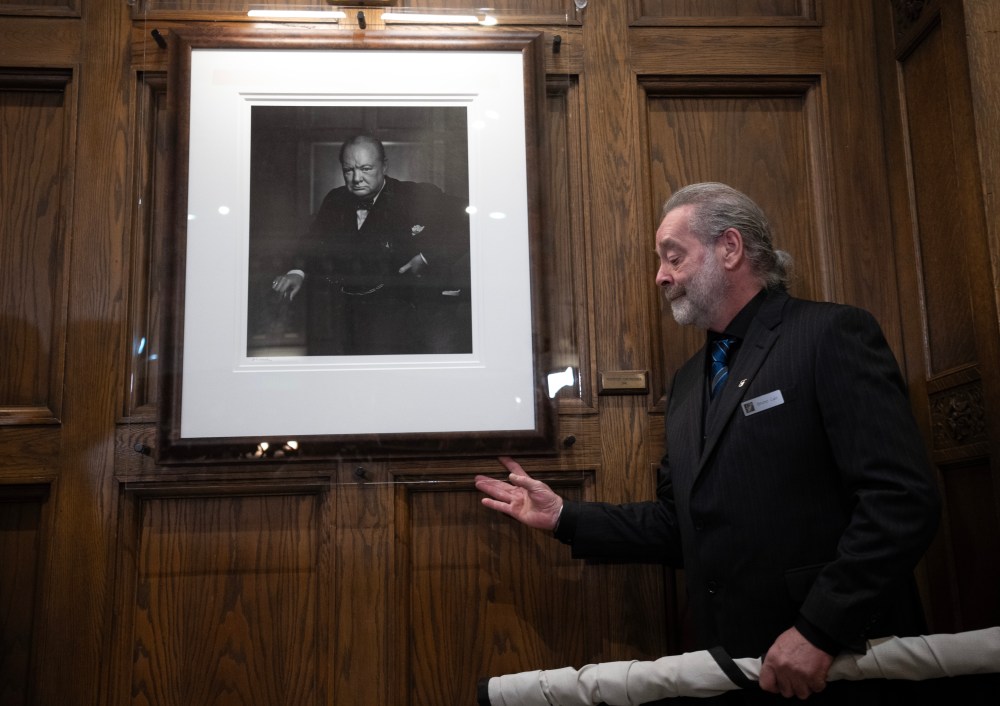
The print displayed at the Château Laurier was personally developed, framed and signed by Karsh, who gave it to the hotel — where he had long kept a studio — as a gift.
Wood stole the portrait sometime between Christmas Day 2021 and Jan. 6, 2022, replaced it with a cheap copy and sold the original through a London auction house.
The print was returned to public display at the Ottawa hotel with help from authorities in the United Kingdom and Italy.
Wood was sentenced in May 2025 to two years less a day in jail after pleading guilty to theft over $5,000, forgery and possession of stolen property over $5,000 for the purpose of trafficking.
A majority of the Ontario Court of Appeal dismissed his sentence appeal last October.
Two members of the three-judge panel said the sentence of two years less a day “was not demonstrably unfit.”
The majority agreed with the sentencing judge’s finding that the theft and forgery was an affront to the venerable hotel, to the reputation of Karsh and to everyone who was deceived by the forgery.
The Court of Appeal found no error by the sentencing judge in referencing domestic and international case law dealing with thefts of items of cultural and historic significance.
“As the sentencing judge pointed out, there were limited Canadian precedents dealing with such thefts, making it appropriate to consider the manner in which courts in other jurisdictions have approached such crimes,” the majority said in the ruling.
The Court of Appeal also said the sentencing judge properly weighed mitigating factors, including Wood’s guilty plea, his expression of remorse to the court and the fact he had no previous criminal record.
While the sentencing judge did not expressly refer to the possibility of imposing a conditional sentence — one served in the community under conditions such as house arrest — he considered and rejected alternatives other than jail for Wood, the Court of Appeal added.
In their written request to the Supreme Court for a hearing, Wood’s lawyers said the sentencing judge provided no analysis of how sentencing in other countries “compares, if at all, to our own.”
“Effectively, the sentencing judge interpreted foreign case law and used it to establish and at least influence the sentencing regime in this case, when those decisions ought not to have been given any weight,” Wood’s lawyers wrote.
They also argued the sentencing judge did not consider the availability of a conditional sentence — an error that affected the sentence imposed on Wood.
In its submission to the Supreme Court, the Crown said Wood’s application should be dismissed and that he was trying to relitigate the arguments rejected by the majority of the Court of Appeal.
“The sentencing judge was right not to simply try to situate the applicant’s offences within the same range as commonplace property crimes in Canada,” the Crown’s submission said. “Doing so would fail to recognize the portrait’s intangible value and the public harm inflicted by stealing, trafficking, and forging a culturally significant piece of public art.”
The Crown also said that although the sentencing judge did not expressly refer to the possibility of imposing a conditional sentence, he recognized that he must consider options other than incarceration.
This report by The Canadian Press was first published April 30, 2026.