
Poilievre: Carney should state what ‘leverage’ Canada has in trade talks
Advertisement
Read this article for free:
or
Already have an account? Log in here »
We need your support!
Local journalism needs your support!
As we navigate through unprecedented times, our journalists are working harder than ever to bring you the latest local updates to keep you safe and informed.
Now, more than ever, we need your support.
Starting at $15.99 plus taxes every four weeks you can access your Brandon Sun online and full access to all content as it appears on our website.
Subscribe Nowor call circulation directly at (204) 727-0527.
Your pledge helps to ensure we provide the news that matters most to your community!
To continue reading, please subscribe:
Add Brandon Sun access to your Free Press subscription for only an additional
$1 for the first 4 weeks*
- Enjoy unlimited reading on brandonsun.com
- Read the Brandon Sun E-Edition, our digital replica newspaper
*Your next Free Press subscription payment will increase by $1.00 and you will be charged $20.95 plus GST for four weeks. After four weeks, your payment will increase to $24.95 plus GST every four weeks.
Read unlimited articles for free today:
or
Already have an account? Log in here »
TORONTO – Prime Minister Mark Carney should spell out to Canadians what leverage the country has over the United States in coming trade negotiations, Conservative Leader Pierre Poilievre asserted on Sunday.
That comes after Carney rejected characterizing energy and critical minerals as “leverage” in talks to renew the Canada-United States-Mexico Agreement, also known as CUSMA.
Poilievre said Carney should explain how he intends to secure an end to sectoral tariffs and a renewal of the free-trade pact.
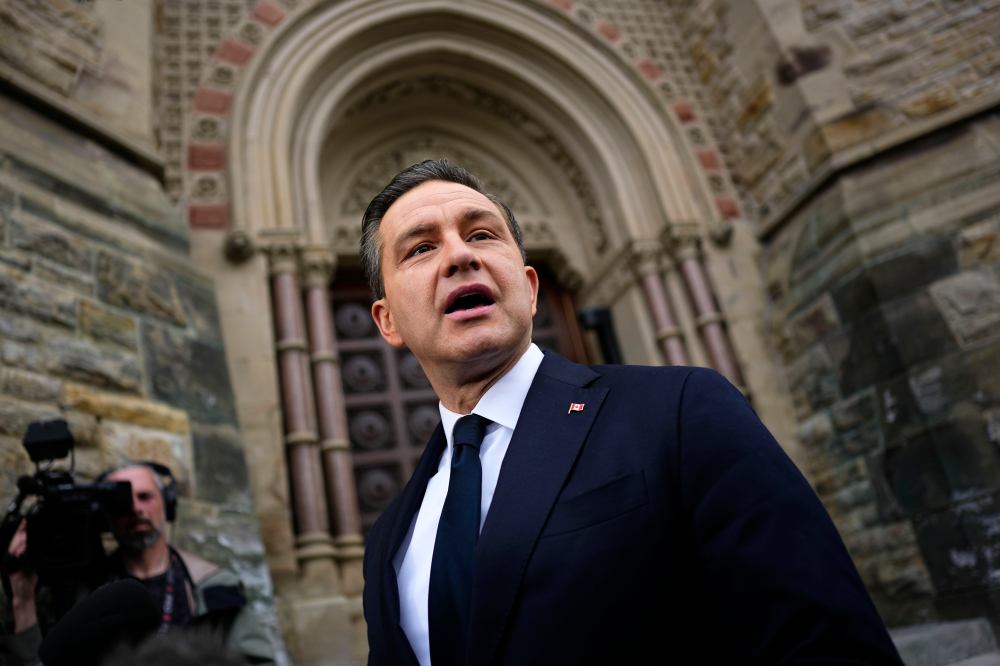
“If energy and minerals are not going to be leveraged for Canada in these negotiations, what leverage does Mr. Carney claim to have?” Poilievre said while speaking with reporters at a press conference in Toronto.
“He can’t tell us what leverage we have, what demands he’s making, what tariffs he wants to get removed, and when and if he will even get a deal at all.”
Carney said in an interview with The Canadian Press on Friday that he simply views these sectors as future trade opportunities with the United States — or with other trading partners.
“Reclassifying that as leverage, I’m not sure that’s the way I look at that. I look it as trade,” Carney said. “It’s looking at, is it in our mutual interest to trade more? Where is it? And if it’s not there, we have other options.”
The prime minister said Canada is not about to halt any such trade with the U.S., but suggested further integration in those sectors remains up in the air amid the ongoing trade war.
“Should we be further integrating our energy markets with the United States at a time they view that as, quote, ‘leverage’?” Carney said.
United States Trade Representative Jamieson Greer cautioned a group of Canadian politicians in Washington on Wednesday that Ottawa shouldn’t try to use energy as leverage in the trade talks.
Sources who attended that meeting told The Canadian Press Greer said greater collaboration on energy shouldn’t come with the condition of U.S. concessions. Greer also said the Trump administration is not looking to disrupt the energy relationship between the two countries.
Natural Resources Minister Tim Hodgson said about a week ago that Canada’s energy and natural resources are “Canada’s strongest cards” in renegotiating the trade deal.
Poilievre said his strategy would be to “build up a massive strategic reserve of our energy and our minerals and use that as leverage to get tariff-free access to the United States economy.”
Negotiations between Canada and White House to remove American tariffs against Canada’s steel, aluminum, automotive and forestry sectors froze last fall.
Talks stalled after Trump became angered by an Ontario advertising campaign that quoted former president Ronald Reagan criticizing tariffs.
The continental trade pact is meantime approaching a mandatory review, which is scheduled to start by this summer.
Greer has said the United States is unlikely to rubber-stamp the deal in July, suggesting longer negotiations are in store.
Last week, when Carney’s Canada-U.S. economic advisory council met for the first time, the federal government made clear it has no intentions of making any concessions before a broader negotiation on CUSMA renewal.
Carney said last month that America’s sectoral tariffs remain Canada’s greatest trade “irritant” to resolve.
The prime minister said in the Friday interview there normally would have been a broader discussion about a series of “technical” trade issues in the coming review.
He pointed to greater regulatory harmonization on “all aspects digital,” such as combating online harms, as one example.
“That’s not really on the table now,” Carney said.
The prime minister said Ottawa does desire greater integration and co-operation with the United States when it’s “absolutely recognized that it’s in both countries’ interests.”
But Canada must now be “careful, to a degree” on further integration in energy and other markets, as tariffs that violate the spirit of the agreement dig into key economic sectors.
“There’s a question about whether that alignment is still there,” Carney said. “Can we really rely, ultimately, on what’s written in the agreement, what’s in a dispute settlement mechanism? That’s a very different environment than was there previously.”
This report by The Canadian Press was first published May 3, 2026.
— With files from Kyle Duggan in Ottawa, Kathryn Mannie in Toronto and Kelly Geraldine Malone in Washington.