
Arbour an inspired choice for governor general’s role
Advertisement
Read this article for free:
or
Already have an account? Log in here »
We need your support!
Local journalism needs your support!
As we navigate through unprecedented times, our journalists are working harder than ever to bring you the latest local updates to keep you safe and informed.
Now, more than ever, we need your support.
Starting at $15.99 plus taxes every four weeks you can access your Brandon Sun online and full access to all content as it appears on our website.
Subscribe Nowor call circulation directly at (204) 727-0527.
Your pledge helps to ensure we provide the news that matters most to your community!
To continue reading, please subscribe:
Add Brandon Sun access to your Free Press subscription for only an additional
$1 for the first 4 weeks*
- Enjoy unlimited reading on brandonsun.com
- Read the Brandon Sun E-Edition, our digital replica newspaper
*Your next Free Press subscription payment will increase by $1.00 and you will be charged $20.95 plus GST for four weeks. After four weeks, your payment will increase to $24.95 plus GST every four weeks.
Read unlimited articles for free today:
or
Already have an account? Log in here »
“Louise Arbour is outspoken and courageous. She is a woman of facts: she speaks only when she has something to say, and when she speaks, it matters.”
— Louise Otis, McGill University law professor
“The comments that Louise Arbour has made in respect of the state of Israel and the people of Israel are, in fact, a disgrace and I stand by those words.”
— Then Harper-era Treasury Board president, and Manitoba MP Vic Toews, 2008
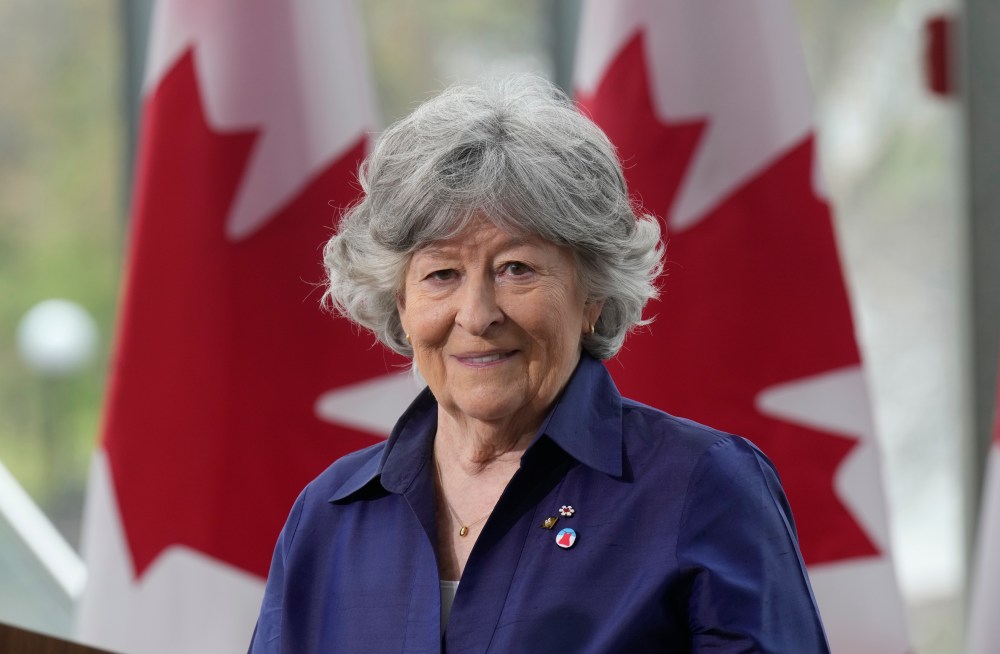
It didn’t take long for Canada’s far-right pundits to cart out the “elitist” and “activist” rhetoric when Prime Minister Mark Carney announced his choice of retired Supreme Court justice Louise Arbour to the role of Canada’s next governor general on Tuesday.
Arbour, who was hailed by Carney as a defender of human rights, has a long and storied career with high-ranking positions in Canadian law and international human rights. Among her many roles over the years, Arbour was chief prosecutor for the International Criminal Tribunals for the former Yugoslavia and for Rwanda in the Hague. She was appointed by former prime minister Jean Chretien to the Supreme Court of Canada, where she served until 2004.
She then served as the UN High Commissioner of Human Rights until 2008. Most recently, she led an independent review into sexual harassment and misconduct in the Canadian Armed Forces. Her report, delivered in 2022, called for sweeping changes to the military’s culture and it’s institutions.
Within hours of her appointment, a far-right columnist with the Toronto Sun had already dismissed Arbour as a “left-wing activist” who “fits the stereotype of a Laurentian Elite liberal,” and whose partisan appointment by Carney has “undermined the role of the Governor General.”
Such criticism from Canadian conservatives is not surprising, given the fact that the phrase “judicial activist” isn’t really an unfair description of Arbour.
She has been relentless in her pursuit of human rights reform both in Canada, and in her criticism of world powers such as Russia, China, the United States and Israel. She has actively prosecuted sexual assault as a crime against humanity, and has earned the unofficial title of being an “agent of change.”
It was in fact her condemnation of the Israel Defense Forces for what she called a “disproportionate use of force” against Palestinians — even as she dually criticized rocket attacks by Palestinian militants — that drew the ire of Vic Toews in 2008 in the House of Commons.
Truth be told, she is not the last representative of the United Nations to call out the Israeli government and the IDF for their treatment of Palestinians in Gaza — the UN-backed International Criminal Court has outstanding warrants issued for Israeli Prime Minister Benjamin Netanyahu and former defence minister Yoav Gallant for alleged war crimes.
It is interesting, then, that she now takes up a position in which she will rarely — if ever — be called upon to make any kind of official decision. The post of governor general, after all, mostly involves granting royal assent to legislation, opening Parliament and other minor duties as the King’s representative in Canada.
It’s only in rare scenarios where the governor general can exercise so-called “residual” or reserve powers, such as dismissing a prime minister who refuses to resign after losing a confidence vote, or the dissolving of Parliament.
More likely the prime minister is considering the possibility of future constitutional crises with separatists and U.S. interference a growing concern in Alberta, the return of separatist sentiments in Quebec, and upcoming discussions over the limits of provincial use of the Notwithstanding Clause under the Canadian Charter of Rights and Freedoms.
Arbour brings a deep understanding of Canada’s constitutional order, and has a reputation for accountability and fairness. And in her comments on Tuesday, she called Canada a wonderful country that has not only been shaped by its “diversity of people, of perspectives and experiences,” but also by a “common respect for strong public institutions and for the rule of law.”
If anything, Arbour will be a governor general who will seek to strengthen Canada’s institutions, not tear them asunder or undermine their foundations. At a time when the world seems all the more destabilized, keeping Canada’s governments and its political future grounded in law should be one of our main priorities.
For Carney, having Arbour as a constitutional resource with which to consult during such tumult is an inspired choice. Though she comes across publicly as humble and thoughtful, Arbour may well deserve the title of one of Canada’s “elite” — she has certainly earned it, given her experience and education.
But when it comes to constitutional questions, we don’t need the populist.
We need the expert.
» Matt Goerzen, editor