
Waterlogged municipality puts bounty on beavers
Advertisement
Read this article for free:
or
Already have an account? Log in here »
We need your support!
Local journalism needs your support!
As we navigate through unprecedented times, our journalists are working harder than ever to bring you the latest local updates to keep you safe and informed.
Now, more than ever, we need your support.
Starting at $15.99 plus taxes every four weeks you can access your Brandon Sun online and full access to all content as it appears on our website.
Subscribe Nowor call circulation directly at (204) 727-0527.
Your pledge helps to ensure we provide the news that matters most to your community!
To continue reading, please subscribe:
Add Brandon Sun access to your Free Press subscription for only an additional
$1 for the first 4 weeks*
- Enjoy unlimited reading on brandonsun.com
- Read the Brandon Sun E-Edition, our digital replica newspaper
*Your next Free Press subscription payment will increase by $1.00 and you will be charged $20.95 plus GST for four weeks. After four weeks, your payment will increase to $24.95 plus GST every four weeks.
Read unlimited articles for free today:
or
Already have an account? Log in here »
GLENBORO — The Municipality of Glenboro-South Cypress is trapping beavers as the most recent effort to fix water backup that has flooded farmland, basements and roads in the area for years.
The municipality put out a request for trappers in March, and brought on three trappers, Coun. Dale Fisher told the Sun. Trapping will continue until the middle of May, removing beavers from a crucial channel to the Souris River.
Water needs to flow through — and out — of the community faster, Fisher told the Sun during a recent interview. Glenboro receives a large amount of water that is finding its way to the Souris and eventually the Assiniboine River, but Glenboro has been unable to pass that water quickly enough, he said. That has historically led the local water table to rise, causing expensive problems.
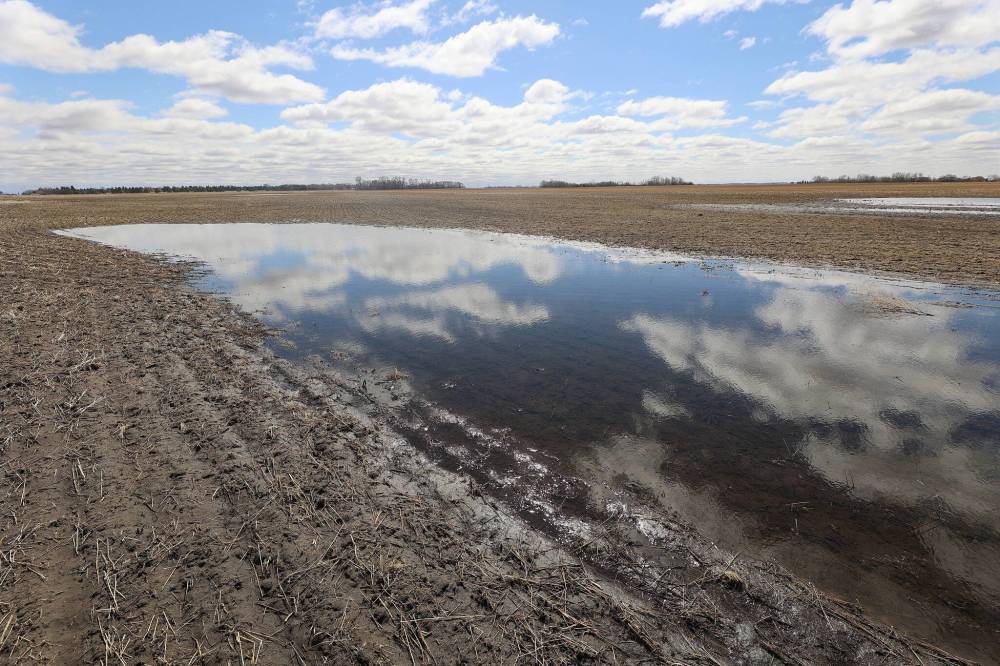
Farmland is covered with water in Glenboro. The issue has improved in recent years, thanks to efforts to free up the flow of water through the area, including the removal of beavers that build dams. (Connor McDowell/The Brandon Sun)
“This is prime agricultural land and it’s been going backwards and continuing to get worse every year,” Fisher said. “There’s been some pissed-off people.”
Beavers are the most recent factor to be addressed in the years-long effort that has improved water flow. The beaver’s damming is preventing water from passing at the right speed, Fisher explained.
“That’s why we have to get rid of them, because all the way through here, it’s trickling,” Fisher said while standing at a creek in the area. “It has to get through in a timely manner. It has to flow. Because if it’s not, it’s going back the opposite way and then rising the water table, which is a problem in Glenboro.”
Many homes in the area are on sand point wells, a technology that drives a pipe into the ground and allows water to come up from the water table to provide water for the home. When water builds up in the area, residents have constant flooding in their basements, which they then have to pump out into their yards. Agricultural land is also impacted, reducing productivity in the area.
It is the second year the beaver trapping program has run as a way to counter this. The municipality offers a bounty per beaver caught — having at least 18 already caught this year, on top of 48 beavers caught last year.
Other efforts included excavation to destroy large blockages at culverts, created by the beavers, Fisher told the Sun. He had an excavator brought in to remove a dam of mud and sticks that beavers had installed in front of a 10-foot-wide culvert.
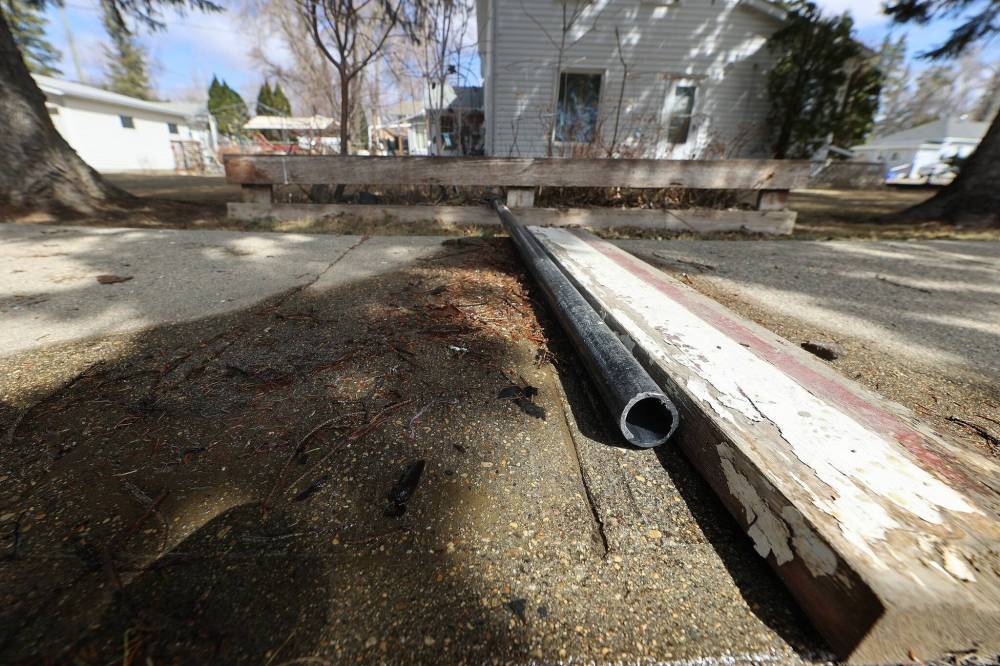
A 40-foot pipe is erected to pump water from the basement of a home in Glenboro. Due to a high water table, basements commonly flood in the municipality and, in the spring, many houses pump water to remedy the situation. One way to reduce basement flooding is to trap beavers, which trap water in the area through the building of dams in the local watershed, Municipality of Glenboro-South Cypress Coun. Dale Fisher said. (Connor McDowell/The Brandon Sun)
Destruction of dams has been useful, but ultimately the beavers themselves have to be removed because they continously, out of their nature, create dams, Fisher said.
“You can take it out, and three days later they’ll have it rebuilt. I’ll tell you, they are not scared of work.”
The municipality has also replaced culverts to increase the flow of water, he said. Results have been immediately noticable, Fisher said, gesturing to all the land around him in Glenboro.
“Before, all this land would be underwater,” he said of acres of farmland in the countryside. “If we didn’t have that opening cleaned out, this would have been completely underwater.”
Fisher said he has been frustrated by the Province of Manitoba for making it difficult to clear the waterway and increase flows. He said the government has been dragging its heels, citing legislation written around water rights and environmental concerns.
Minister of Environment and Climate Change Mike Moyes said that he has asked a staff person in the water stewardship department to reach out to Glenboro-South Cypress and open the door for communication. In a recent interview with the Sun, he said the government is happy to work with the municipality on potential projects, but he is not aware of any current proposals at this time.
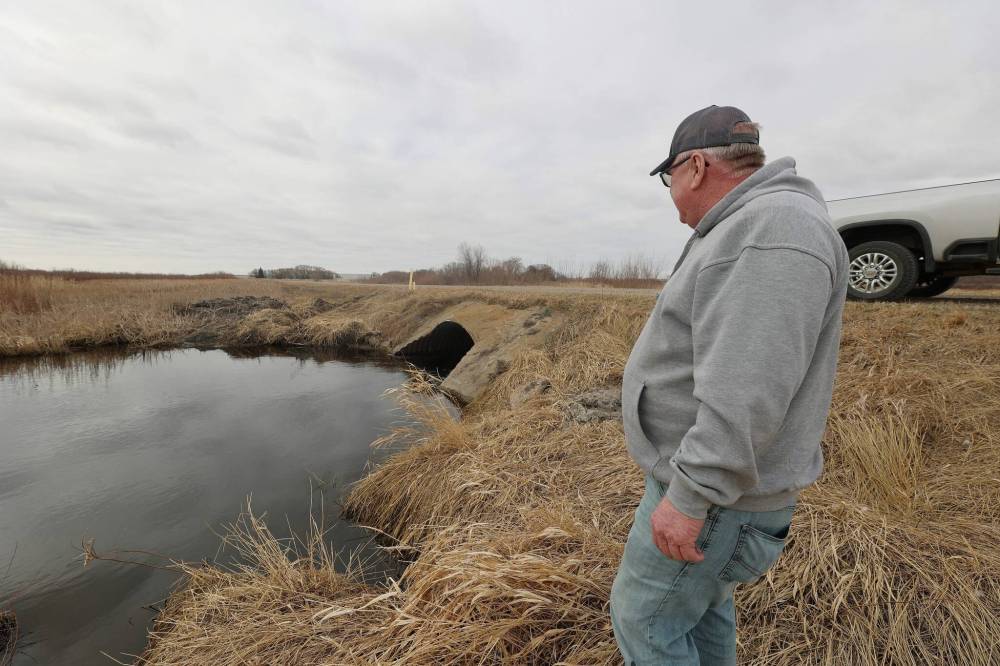
Fisher looks on at a culvert that was blocked heavily in recent years due to beaver damming. A pile of mud and sticks, seen across the water, was removed using an excavator. Increasing the water flow in the area reduces the height of the water table, which can sometimes rise so high that it floods acres of farmland, Fisher said. The buildup of water in Glenboro also leads to basement flooding and overland flooding. (Connor McDowell/The Brandon Sun)
“If they do have a proposal, then we can work with them towards seeing a solution, so hopefully that in the future, there’s not these issues being faced,” Moyes said.
“Our department is always open to hearing from folks, and happy to do that in this case,” Moyes said. “If they have questions, our folks can ensure that they’re getting the best information.”
Fisher said previous proposals have been bogged down and stymied. He cited a case last year, when two large potato growers in the region, Under the Hill Farms, and Swansfleet Alliance, proposed to install infrastructure to divert water away from Glenboro and into an existing reservoir.
Fisher and another councillor told the Sun that the potato growers abandoned the proposal after getting bogged down by red tape from the Province of Manitoba. Potato growers have been impacted by a higher water table that damages their crop, and in some cases leads them to be unable to sell their product, Fisher said.
Beaver trapper Tyler Rolfe told the Sun in a recent interview he trapped for about three weeks this spring, catching 18 beavers. He said he had caught the beavers mostly around a low-lying concrete bridge and a wooden bridge along the main channel that passes water through Glenboro.
Rolfe stopped trapping in late April because he said he found that the population had been lowered quite a bit so that he was finding empty traps.
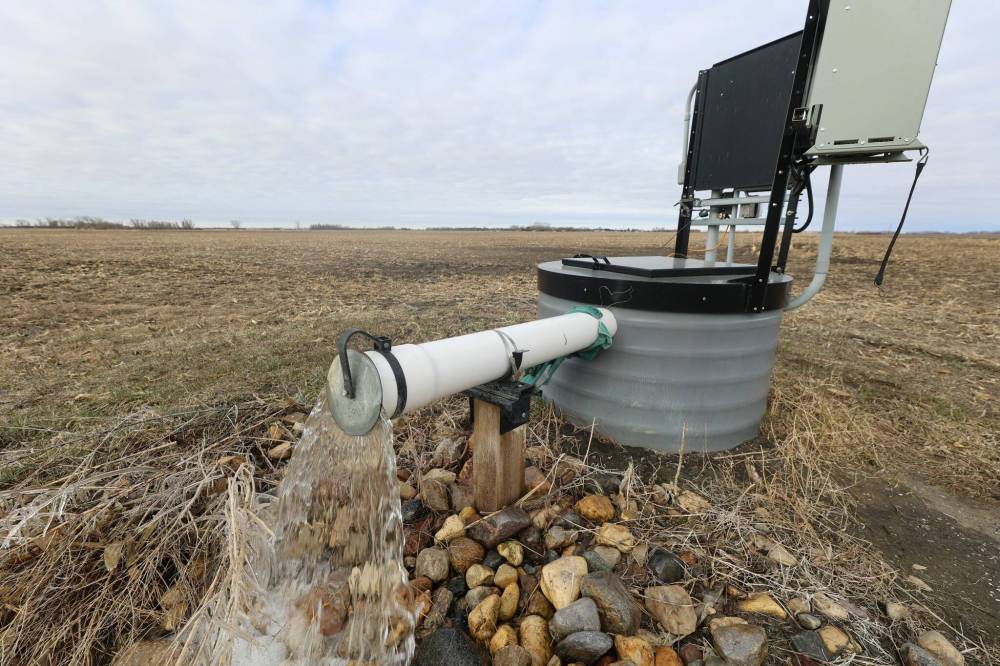
An automatic pump removes water from farmland in Glenboro. The equipment cost Fisher $240,000, he said, and has brought the farmland behind it back into farming condition after having been flooded with water due to a high water table in Glenboro. (Connor McDowell/The Brandon Sun)
“I think the numbers are down pretty low. I wasn’t seeing as many signs,” he told the Sun. “I’ve been trapping beavers for lots of years; you can see on the banks where they’ve been going up and down.”
But beavers will likely continue to populate the area as they come up from the Souris River and look for places to dam, he said.
“One to two years, and the population could be right back to where it was,” Rolfe said. “Last year, myself alone, I caught 32 beavers out of there.”
In recent years, water flooding has improved, Norm Stilkowski, a resident of Glenboro, told the Sun in a recent interview. He said flooding has long been a problem in the community, but that it’s been easing up.
When the Sun visited in late April, Stilkowski had a 40-foot-long, homemade pipe running from his home to the end of his yard. The tube was supported by various household objects, such as a rock holding it down in one place, and other objects propping it up elsewhere. At the opening, water pulsed out onto concrete and grass.
Stilkowski said if he didn’t run a pump from his basement, the floor would be covered in water all the time. Even after a rain, he can see the effect in increased flooding in his basement, he said.
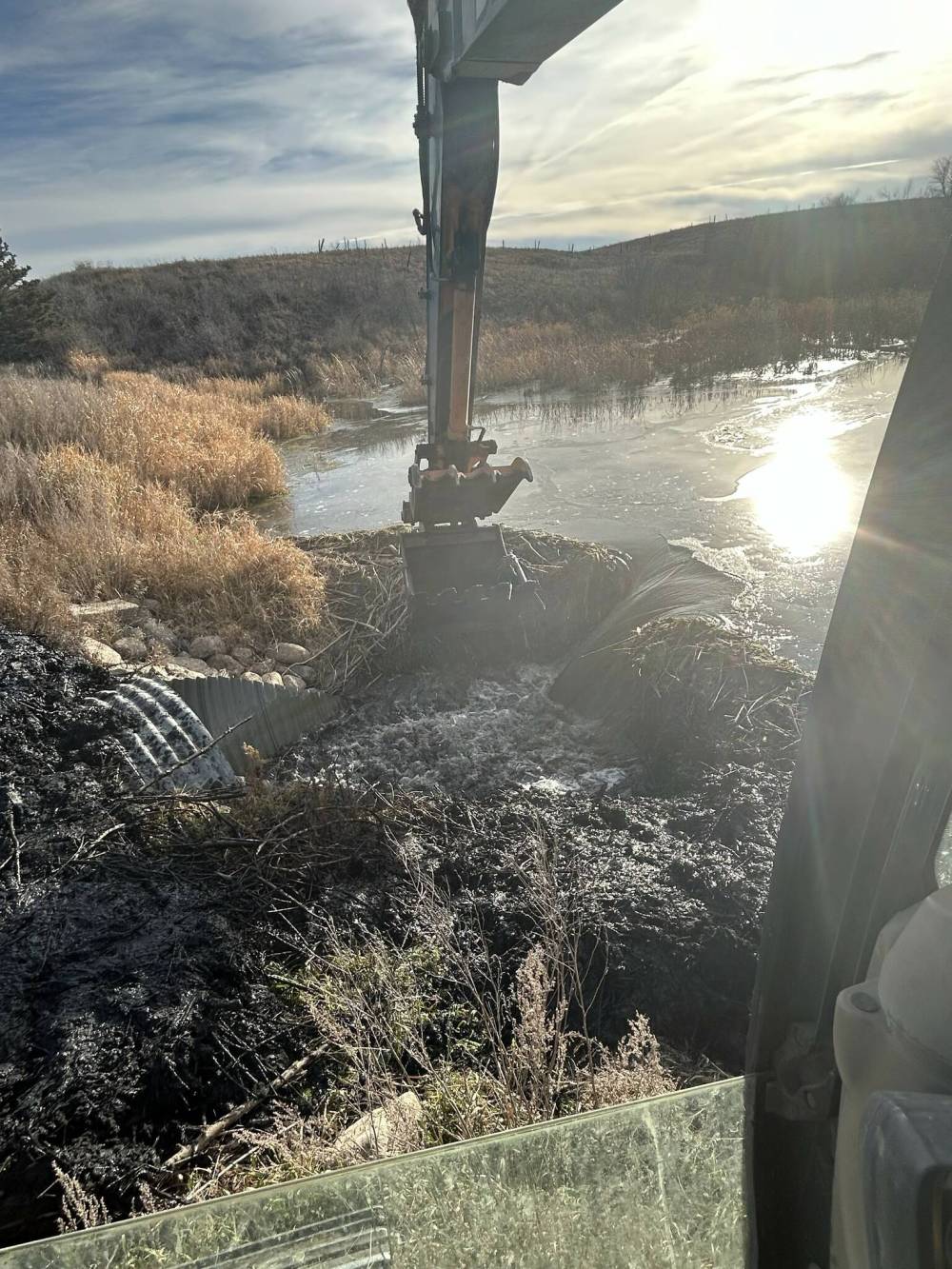
An excavator arm is seen at a beaver dam in Glenboro last year. A body of water is backed up rather than flowing into a culvert and exiting the area. Fisher said the municipality arranged to have beaver dams removed and beavers trapped in this key waterway because the animal is causing water to pile up in the area, raising the water table and leading to overland flooding, basement flooding and agricultural land flooding. The municipality is also working on unclogging its culverts, replacing culverts and freeing up waterways. (Supplied)
Three other property owners declined interviews, but confirmed they were also pumping their basements.
Fisher said the problem of water flooding in Glenboro grew significantly roughly 15 years ago when the province added a 10-foot-in-diametre culvert upstream of the community so that water could enter faster. Following that increased water flow into the area, the municipality has seen higher rates of basement flooding, farmland flooding and road flooding, Fisher said.
The municipality is trying to install more culverts that help pass that water downstream — but Fisher said that has been hard to do under current provincial governance. He complained that the province created the problem by increasing water flow into the community, but now is preventing a solution by not allowing Glenboro to pass the water downstream faster.
“Government mismanagement,” Fisher said. “I want stuff brought out in the public that we are trying our best and the government is not helping us.”
Fisher said The Water Rights Act has been cited as a reason that the municipality cannot install more culverts and clear away channels to increase the flow of water.
“Nobody wants to see the marsh gone. We just want to get it back to the level it was at.”
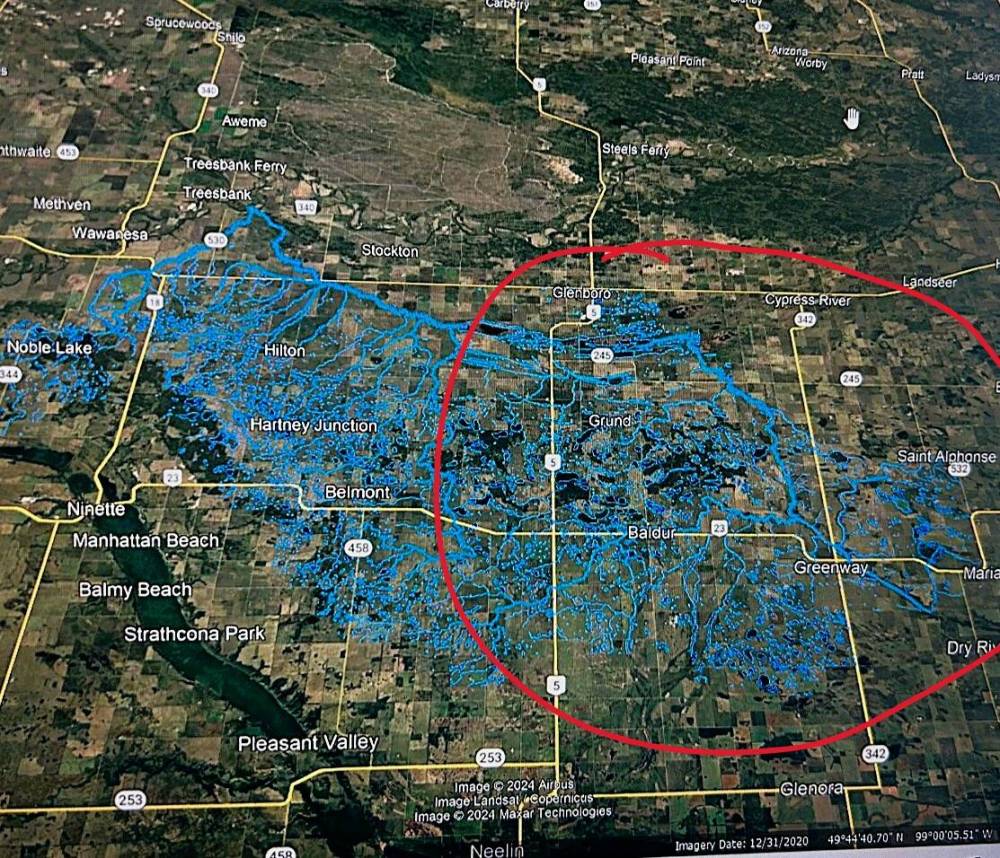
A map shows waterways that feed north into the Glenboro area. Councillor Dale Fisher said he is working hard to improve flow through Glenboro to reduce issues such as flooding when these waterways flow to Glenboro and then get backed up. (Dale Fisher photo, edited by The Brandon Sun)
Fisher invested $240,000 on his own farmland to install a pump that automatically removes water. The technology keeps the water table lower so that the land is productive, he said — otherwise it would be underwater.
He complains that if he wants to free up another piece of farmland to make it usable, it will cost him $80,000.
» cmcdowell@brandonsun.com