
Death toll rises to 14 in Pakistan suicide attack. Pakistani Taliban splinter group claims blast
Advertisement
Read this article for free:
or
Already have an account? Log in here »
We need your support!
Local journalism needs your support!
As we navigate through unprecedented times, our journalists are working harder than ever to bring you the latest local updates to keep you safe and informed.
Now, more than ever, we need your support.
Starting at $15.99 plus taxes every four weeks you can access your Brandon Sun online and full access to all content as it appears on our website.
Subscribe Nowor call circulation directly at (204) 727-0527.
Your pledge helps to ensure we provide the news that matters most to your community!
To continue reading, please subscribe:
Add Brandon Sun access to your Free Press subscription for only an additional
$1 for the first 4 weeks*
- Enjoy unlimited reading on brandonsun.com
- Read the Brandon Sun E-Edition, our digital replica newspaper
*Your next Free Press subscription payment will increase by $1.00 and you will be charged $20.95 plus GST for four weeks. After four weeks, your payment will increase to $24.95 plus GST every four weeks.
Read unlimited articles for free today:
or
Already have an account? Log in here »
PESHAWAR, Pakistan (AP) — The death toll from a suicide attack on a security post in northwest Pakistan rose to 14 police officers, authorities said early Sunday, as a self-proclaimed breakaway group of the Pakistani Taliban claimed responsibility for the attack.
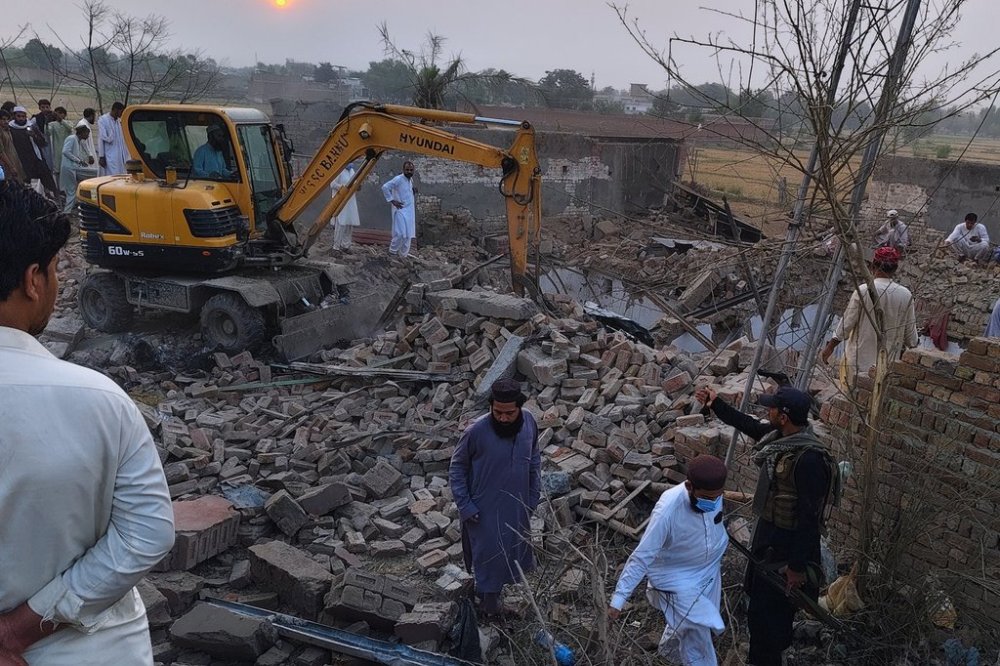
A suicide bomber and several gunmen detonated an explosives-laden vehicle near the post in Bannu, a district in Khyber Pakhtunkhwa province bordering Afghanistan, late Saturday, said senior police official Sajjad Khan. The attack triggered an intense shootout, and some officers were killed in the exchange, while others died later after the building collapsed.
Rescuers conducted an hourslong search operation using heavy machinery to retrieve bodies from under the rubble, Khan said, adding that three police officers were wounded in the attack.
Meanwhile, hundreds gathered Sunday at the police headquarters in Bannu to attend the funerals of the slain officers. Uniformed colleagues stood in silence as coffins draped in the national flag were carried past grieving families. Some relatives broke down upon seeing the coffins, as a Muslim cleric led funeral prayers under tight security
Security forces have launched an operation to track down the perpetrators.
A newly formed militant group, Ittehad-ul-Mujahideen Pakistan, claimed responsibility for the attack in a statement sent to reporters. While the group claims it was formed by splinter factions of the Pakistani Taliban, known as Tehrik-e-Taliban Pakistan, authorities have accused it of being a front for the TTP.
Pakistan has witnessed a surge in militant violence in recent years, much of it blamed on the TTP, a separate group but an ally of the Afghan Taliban, who returned to power in Afghanistan in 2021. Islamabad often accuses Afghanistan’s Taliban government of providing sanctuary to the TTP, a claim that Kabul denies.
President Asif Ali Zardari condemned the attack and offered condolences to the victims’ families in a statement. He also instructed local authorities to assist the wounded and residents whose homes were damaged in the attack.
Zadari also said, “terrorists operating from sanctuaries in Afghanistan under the Taliban administration and supported externally are targeting civilians and law enforcement personnel in Pakistan.” He also vowed to target “their facilitators and sponsors.”
Prime Minister Shehbaz Sharif also condemned the attack.
Tensions between the two neighbors have persisted, and both sides have engaged in fighting that has killed hundreds of people since late February.
In early April, Afghan and Pakistani officials held peace talks mediated by China. However, despite the talks, sporadic cross-border clashes have continued, though at a lower intensity than before.
___
Ahmed reported from Islamabad. Associated Press writers Rasool Dawar in Peshawar and Ishtiaq Mahsud in Dera Ismail Khan contributed to this report.