
Visits to addictions clinics spike
Number more than triples at Manitoba treatment centres from 2020 to 2025
Advertisement
Read this article for free:
or
Already have an account? Log in here »
We need your support!
Local journalism needs your support!
As we navigate through unprecedented times, our journalists are working harder than ever to bring you the latest local updates to keep you safe and informed.
Now, more than ever, we need your support.
Starting at $15.99 plus taxes every four weeks you can access your Brandon Sun online and full access to all content as it appears on our website.
Subscribe Nowor call circulation directly at (204) 727-0527.
Your pledge helps to ensure we provide the news that matters most to your community!
To continue reading, please subscribe:
Add Brandon Sun access to your Free Press subscription for only an additional
$1 for the first 4 weeks*
- Enjoy unlimited reading on brandonsun.com
- Read the Brandon Sun E-Edition, our digital replica newspaper
*Your next Free Press subscription payment will increase by $1.00 and you will be charged $20.95 plus GST for four weeks. After four weeks, your payment will increase to $24.95 plus GST every four weeks.
Read unlimited articles for free today:
or
Already have an account? Log in here »
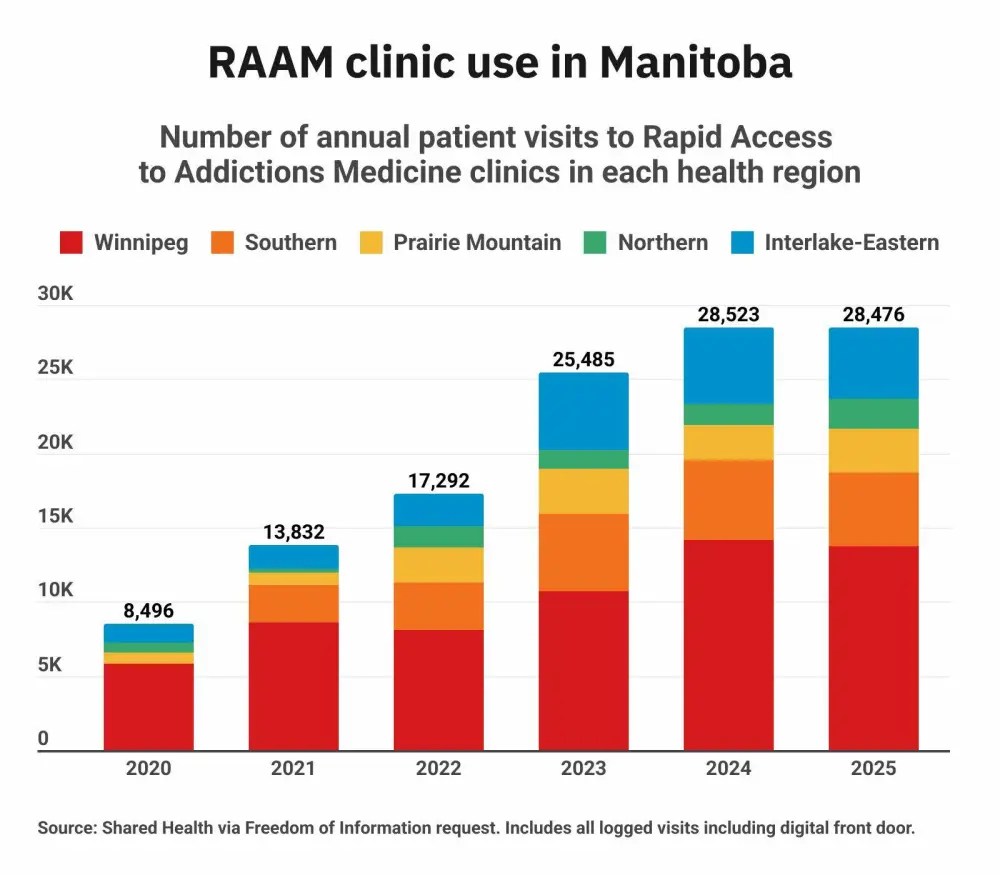
The number of patients entering RAAM clinics in Manitoba has spiked as the drug crisis escalates, even as strained resources have kept the number from ballooning even further.
The number of visits to the clinics more than tripled from 2020 to 2025 — to 28,476 from 8,496. The number of RAAM clinics has also increased by one to seven.
There was a slight decrease in overall visits to the addictions treatment centres from 2024 to 2025. Provincewide, the number dropped to 28,476 from 28,523.
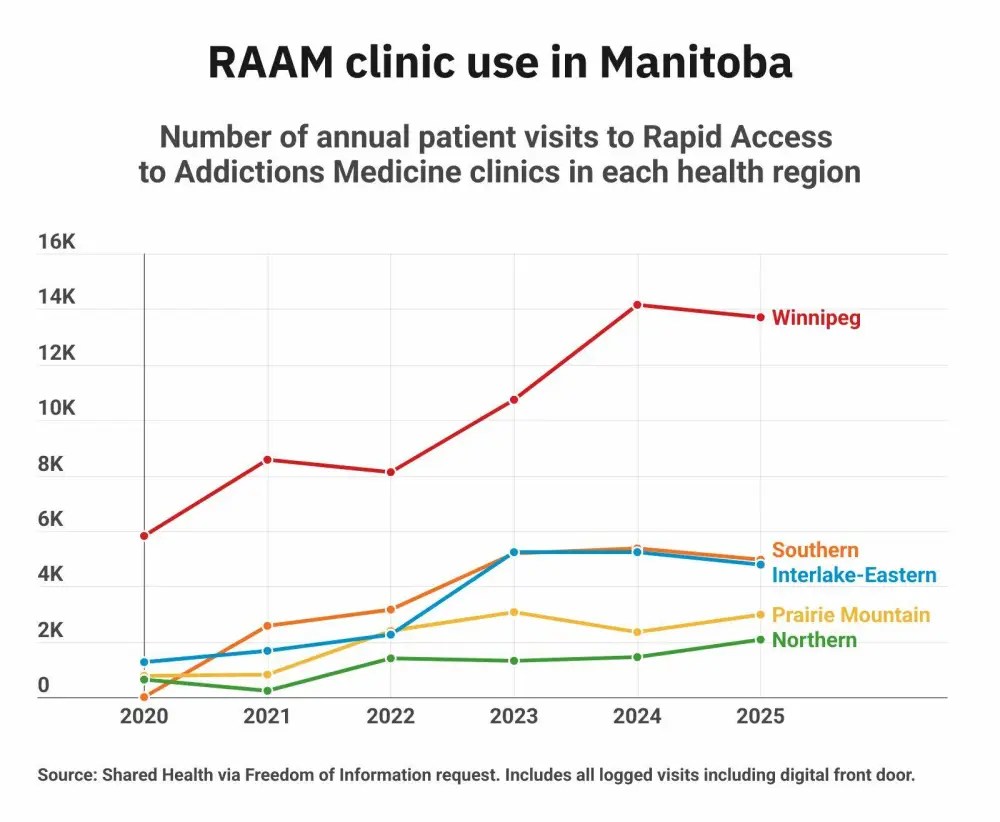
In Winnipeg, visit counts declined to 13,707 from 14,147.
“It’s not that the demand wasn’t there,” said Crystal Cyr, director of Manitoba’s newest Rapid Access to Addictions Medicine Clinic, run by the Aboriginal Health and Wellness Centre on Higgins Avenue.
She speculated the drop was due to Manitoba’s worst wildfire season in 30 years. Staff in various RAAM clinics were pulled away from their work to help evacuees at shelters.
“You likely would’ve seen an increase in the amount of people who were turned away because our clinics were at capacity,” Cyr said.
Upon opening in 2023, Aboriginal Health and Wellness expected its RAAM clinic to take in four to six people per day. The number of visits has almost always exceeded that. Staff register six to 10 people each day it’s open, generally on a first-come, first-served basis.
They try not to turn anyone away, Cyr said. The clinic is open twice weekly and has a physician four hours per day.
“There are not enough services by far,” Cyr stated.
“That said, we are doing the best we can. This is very challenging work, it’s very important work.
“We do our work with a mind towards the future, that hopefully resources will continue to grow as the need grows.”
End Homelessness Winnipeg counted 8,248 homeless people in March, a 104-person uptick from February.
Cyr said she hopes for more resources from the Manitoba government before the wildfire season begins.
The province slated $3.81 million for RAAM clinics in fiscal year 2026-27, the same as one year earlier.
The clinics received $3.32 million during the 2023-24 and 2024-25 fiscal years. In 2021-22, the pot was $1.38 million.
Addictions Minister Bernadette Smith wasn’t available for an interview. In a statement, she noted the province has launched a virtual RAAM program. (In Winnipeg, the program had 389 visits last year.)
Some addictions-focused organizations want RAAM services expanded. A hub with 24-7 access would be ideal, said Marion Willis, founder of St. Boniface Street Links.
RAAM clinics typically operate on weekdays, only two in Winnipeg have Saturday appointments.
St. Boniface Street Links, a non-profit, works with people who have addictions and the homeless east of the Red River. There’s a need for a RAAM clinic in that area, Willis said. The inner-city ha all three Winnipeg sites.
“It’s not that the government doesn’t understand or doesn’t care,” Willis said about the strain on resources. “You can’t give what you don’t got.”
Federal action is needed, she said.
Meantime, she’s been talking to Northway Pharmacy about starting an opioid agonist treatment clinic, similar to a RAAM clinic, to tackle demand. It would be run by a medical team, Willis said, adding her non-profit is too swamped to launch the project in the near-term.
Northway Pharmacy Brothers treats 50 to 70 people daily for medications related to substance-use disorders, manager Brett Roeland said.
He’s operating partner of two Winnipeg addictions treatment centres, including Phoenix Recovery, which shares a building with the Selkirk Avenue pharmacy. RAAM clinics refer patients they’ve stabilized to Phoenix Recovery and other community organizations for further treatment.
“There’s a little bit of a bottleneck in the community about who’s actually taking care of this type of individual, and who actually has the training and knowledge to do so,” Roeland said.
Cyr echoed him, noting there’s a limited number of physicians who practise addictions medicine: “There are so many gaps in the system.”
Resource Assistance for Youth sometimes struggles to get its referrals into RAAM clinics because of criteria barriers, such as the need for people to show they’ll consistently use prescription medication, said executive director Kate Sjoberg.
At least 4,100 RAAM clinic visits last year were tied to counselling. It’s an “encouraging” sign of repeat visitors, said Kayla Joyce, a University of Manitoba assistant professor of clinical health psychology.
RAAM clinic visits can reduce emergency department use, hospitalizations and death. It’s unclear how RAAM services have impacted Manitoba health service use trajectories and populations, Joyce wrote in an email, adding it’s something she hopes to study.
Anecdotally, Roeland said he’s had patients enter RAAM clinics and end up in housing months later.
“The people who are coming into those RAAM clinics are wanting to get away from drugs,” said Tory MLA Jeff Bereza. “I believe the RAAM clinic is the first step.”
They need a better pipeline for patients to access further recovery supports, such as detox beds, he added.
Southern Health, which includes Portage la Prairie, recorded 4,967 RAAM visits last year, up from 2,569 in 2021 (it opened in late October 2020).
Interlake-Eastern’s RAAM clinic tracked 4,773 visits in 2025, from 1,252 in 2020. Prairie Mountain Health’s RAAM clinic visits jumped to 2,963 from 773 during the same time period.
The Northern regional health authority counted 1,448 RAAM clinic visits last year, from 247 in 2021.
» Winnipeg Free Press