
U.S. man charged with luring Manitoba girl, 10, online
Advertisement
Read this article for free:
or
Already have an account? Log in here »
We need your support!
Local journalism needs your support!
As we navigate through unprecedented times, our journalists are working harder than ever to bring you the latest local updates to keep you safe and informed.
Now, more than ever, we need your support.
Starting at $15.99 plus taxes every four weeks you can access your Brandon Sun online and full access to all content as it appears on our website.
Subscribe Nowor call circulation directly at (204) 727-0527.
Your pledge helps to ensure we provide the news that matters most to your community!
To continue reading, please subscribe:
Add Brandon Sun access to your Free Press subscription for only an additional
$1 for the first 4 weeks*
- Enjoy unlimited reading on brandonsun.com
- Read the Brandon Sun E-Edition, our digital replica newspaper
*Your next Free Press subscription payment will increase by $1.00 and you will be charged $20.95 plus GST for four weeks. After four weeks, your payment will increase to $24.95 plus GST every four weeks.
Read unlimited articles for free today:
or
Already have an account? Log in here »
WINNIPEG — A 32-year-old U.S. man has been accused of luring a 10-year-old Manitoba girl online and convincing her to send images of herself while he posed as a teenage boy.
Manitoba’s justice minister described the case as “absolutely horrific” Monday, emphasizing that it underscores the need to safeguard youth through a social media ban and increased accountability for social media platforms.
“Protecting kids is the most important job that we have here,” Matt Wiebe said. “It’s our sacred duty to protect kids in all ways, but especially from these kinds of horrific situations. And as a dad, it really hits close to home.”

Cpl. Emmie Clements of the Manitoba RCMP Internet Child Exploitation Unit announces the arrest of an Ohio man for the online luring of a 10-year-old Manitoba girl at a press conference in Winnipeg on Monday. (Mikaela MacKenzie/Winnipeg Free Press)
On Monday, RCMP announced that U.S. law enforcement officials had charged Cortney Arden Wise III of Wadsworth, Ohio, with sexual exploitation of children, receipt of visual depictions of real minors engaged in sexually explicit conduct and possession of child pornography.
He is being held in custody in the U.S.
“This incident was a terrible reminder of the dangers that lurk on the internet, especially for children and teenagers,” Cpl. Emmie Clements said during a news conference in Winnipeg on Monday. “It only takes a few moments for bad actors to make contact with their next victims.”
Records filed during a February detention hearing for Wise in U.S. federal court in Ohio allege that he pretended to be a 15-year-old boy online.
While Clements declined to identify the social media platform involved, saying responsibility ultimately lies with offenders rather than the platforms themselves, court documents say the girl created a Snapchat account using a false age while using her grandmother’s cellphone to play games. Her grandmother later discovered the messages.
A U.S. Homeland Security agent wrote in a Feb. 12 arrest warrant affidavit that the girl — who said she was 12 years old — allegedly followed Wise’s instructions by posing in certain ways and sending several sexually explicit photos and videos.
During the detention hearing, the agent also testified that investigators believe Wise had engaged in similar behaviour in the past.
Manitoba RCMP officers alerted Homeland Security agents, who arrested a suspect and seized electronic devices during a Feb. 12 raid in Wadsworth.
The devices contained “evidence of communication” with a Manitoba child, Clements said. She declined to say how long investigators believe the girl and Wise had been communicating.
Last month, Premier Wab Kinew revealed that the province is exploring a ban on social media and AI chatbots for youth, similar to measures introduced in Australia earlier this year. The proposed restriction would apply to children aged 16 and under.
Wiebe said Monday that the ban has two main goals: implementing protections and safeguards, and ensuring social media companies are held accountable for what occurs on their platforms.
Lindsay Lobb, director of operations for support services at the Canadian Centre for Child Protection, said reports of online luring have surged in recent years — rising from about 750 reports in 2020 to more than 3,300 in 2025.
“Some of this is tied to the scam of financial sextortion, which we saw skyrocket during (the COVID-19 pandemic),” she said. “But alongside that, different types of luring have become really prevalent, not just luring and extortion for money, but also luring and extortion for more images.”
She said between 2020 and 2024, there was a 265 per cent increase in such cases.
“What we know is that much of this is attributed to adults being allowed to intersect with children in largely unregulated places,” she said, noting that Instagram, Snapchat, and TikTok are responsible for many of the luring attempts reported to the organization, with TikTok’s numbers increasing sharply after the platform introduced direct messaging last summer.
“Parents are doing their best. We know that more needs to be done. There needs to be a co-ordinated approach and a shared responsibility to protect children online.”
Lobb said the centre supports Manitoba’s proposed social media ban, and echoed Wiebe’s comments on holding social media platforms to a higher standard.
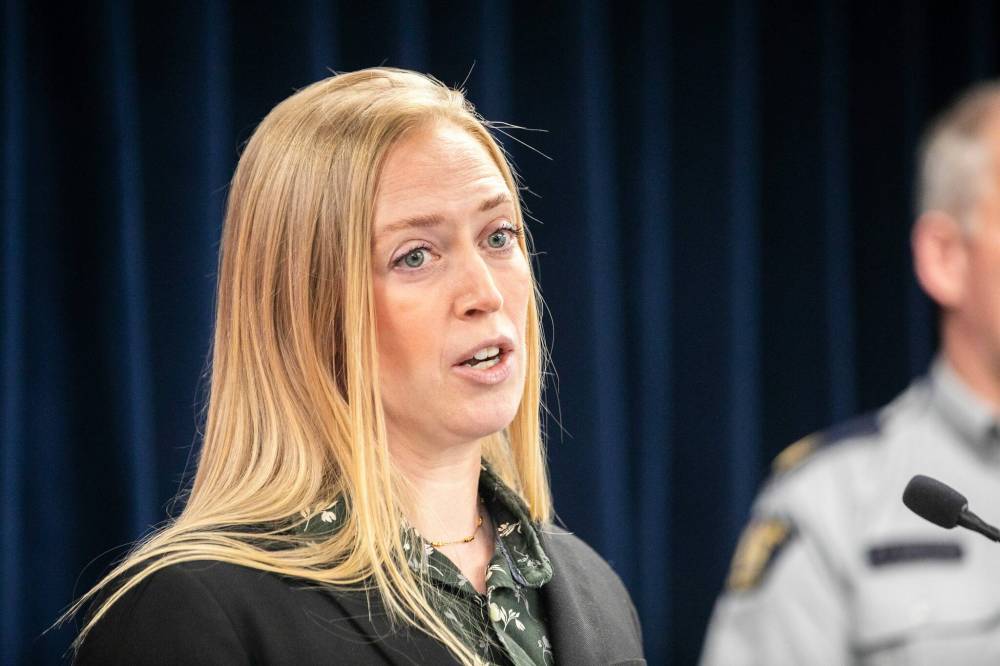
Lindsay Lobb, director of operations for support services at the Canadian Centre for Child Protection, speaks at Monday's press conference in Winnipeg. (Mikaela MacKenzie/Winnipeg Free Press)
“We are beyond (social media platforms) saying they can police themselves because we know they are not,” Lobb said. “They have created spaces where there is unregulated contact between adults and children, and that is where we need to step in and why government is exploring this.”
While acknowledging that such restrictions are still relatively new and research remains limited, she said barriers that make it harder for offenders to access children can still have value.
“It’s not going to be perfect the first time around, there’s going to be the need for tweaks … but there has to be a place that we start,” she said.
Lobb added that many younger children do not fully understand the nature of what is happening to them online.
“These kids are being groomed, they are being directed and told what to do and how to do it, or they’re being directed to go onto certain platforms,” she said. “They’re being told it’s a game.”
For teenagers, she said, vulnerabilities can be compounded by normal stages of adolescent development, including a growing desire for independence, evolving relationships and sexual exploration.
“It’s a perfect storm for offenders to take advantage of,” she said.
Clements said parents can reduce risks by actively supervising children’s online activity — including knowing what devices they use, what apps they access and maintaining access to passwords, where appropriate. She also encouraged limiting internet use and disabling home Wi-Fi during certain hours.
“A lot of children are able to actually hide a little bit more from their parents, from changing the passcode and the password on a social media platform, and then they are hiding the conversation,” she said. “There are also children that just erase communication, and as new communication comes in, they just keep erasing it to hide.”
Lobb said stories like this one can also help parents begin difficult conversations with their children about online risks.
She pointed parents to the Canadian Centre for Child Protection’s “parenting in a digital world” resource, which offers guidance on discussing online safety and understanding the risks children may encounter online.
“It allows parents and kids to talk about it in a way that doesn’t feel very personal,” she said. “It gives them the opportunity to talk about it in a way where it doesn’t feel like it’s about them.”
» Winnipeg Free Press, with files from Chris Kitching